Workshop: Parliamentary Culture in Colonial Contexts, c. 1500-1700
11 September 2023 | Jesus College, Oxford
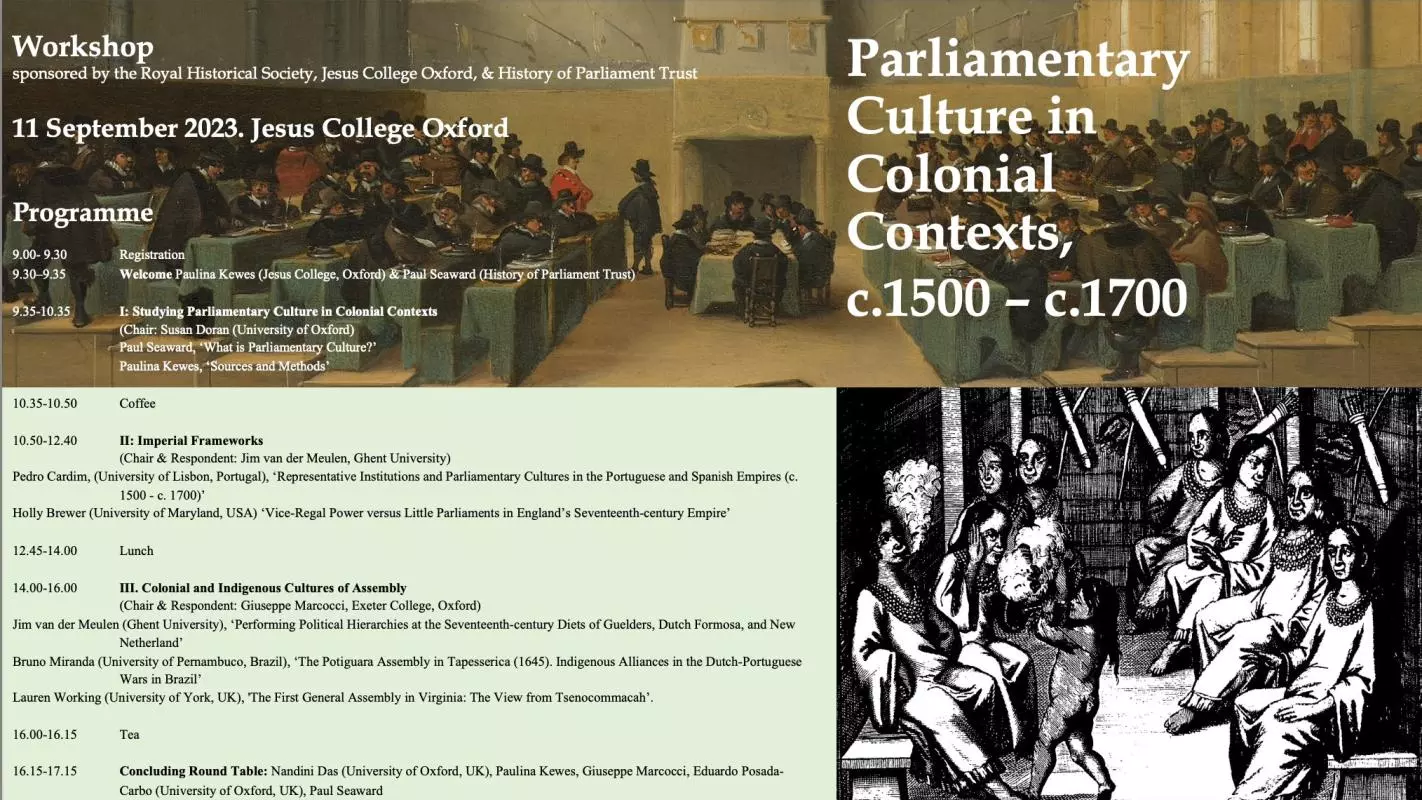
Our workshop brought together scholars from the UK, Europe, Brazil, and the United States. Sponsored by the Royal Historical Society, the History of Parliament Trust, and Jesus College, Oxford, the workshop explored what happens to our understanding of parliamentary culture when viewed beyond the institutions and political histories of Europe.
The day began with Paulina Kewes and Paul Seaward setting out the conceptual and methodological questions at the heart of the workshop. Kewes addressed the sources and methods available for studying parliamentary culture in colonial settings, while Seaward asked the seemingly simple (yet deceptively complex) question: what is parliamentary culture? His discussion drew attention to assemblies as institutions for collective decision-making, legitimizing leadership, and presenting a sense of political community, but also to their complicated relationship with wider publics.
The first main session examined the relationship between metropolitan political traditions and imperial contexts. Pedro Cardim (see also his essay on the Cortes of Portugal) considered representative institutions and parliamentary cultures across the Portuguese and Spanish empires, while Holly Brewer discussed the tensions between vice-regal authority and what contemporaries could describe as ‘little parliaments’ in the seventeenth-century English empire. The second half of the workshop shifted the focus more explicitly towards specific colonial and Indigenous cultures of assembly. Jim van der Meulen compared political assemblies between the Dutch metropole (see also his essay on the States General) with colonial iterations in Dutch Formosa (Taiwan) and New Netherland (North America); Bruno Miranda examined the fascinating yet wholly overlooked Potiguara assembly at Tapesserica during the Dutch-Portuguese wars in Brazil; and Lauren Working reconsidered the first General Assembly in Virginia from the perspective of Tsenocommacah, with much attention for material culture and the problems of reconstructing Indigenous perspectives.
Across the papers, several shared questions emerged. How far can concepts such as ‘parliament’, ‘representation’, or even ‘assembly’ travel across political cultures without imposing European categories on very different institutions? How did Europeans understand Indigenous practices of deliberation and collective decision-making, and how did Indigenous communities in turn engage with, appropriate, or reshape colonial institutions? Miranda’s paper, for example, highlighted both divisions within the Potiguara that predated European arrival and the political importance of an Indigenous remonstrance delivered to the Dutch colonial governor. Discussion repeatedly returned to questions of terminology, sources, and the uneven survival of evidence for non-European political practices.
The concluding round table, with Nandini Das, Edoardo Posada-Carbó, Giuseppe Marcocci, Paul Seaward, and Paulina Kewes, drew these strands together. They paid particular attention to issues such as the nature of deliberation, notions of civility, political belonging, and exclusion. The participants stressed the need to think of parliamentary cultures in the plural, and to avoid teleological histories in which colonial assemblies are treated simply as imperfect predecessors of later parliamentary institutions. Questions of gender and masculinity, the distinction between presence and active participation, and the very different meanings attached to assemblies within colonial societies all pointed towards a broader and more comparative history of political gathering. These discussions also saw lively participation from members in the audience, including from project member Steven Gunn.
The workshop showed the value of approaching parliamentary culture in the early modern world as more than simply a European model exported overseas. The gatherings examined during the workshop reveal how colonial parliamentary culture was a dynamic product of the clashing, commingling, and hybridizing of political traditions—derived both from distinct parts of Europe and from different Indigenous societies.
The discussions at the workshop were so lively that we decided to rework part of the contributions and submit them as a special issue with the Transactions of the Royal Historical Society.
Organizing committee
- Paulina Kewes
- Paul Seaward
Jim van der Meulen