
The Cortes of Portugal
From the late medieval period to the nineteenth century, the Portuguese representative assembly – the Cortes – was regarded as the "meeting" between the king and the kingdom. From time to time, the monarch summoned representatives of the realm to consult with them and arrive at decisions in matters of governance. These meetings usually lasted several months and were marked by myriad debates on the current political situation. Some participants took advantage of these meetings to air their grievances, and at times the deliberations in the Portuguese Cortes escalated into heated verbal confrontations between the estates' representatives and royal officials.
Each one of the main kingdoms of the Iberian Peninsula had its own representative assembly. Alongside Portugal, the kingdoms of Castile, Aragon, Catalonia, Valencia, Mallorca, and Navarre also had their own versions of the Cortes. Most of them were likewise based on a tripartite concept of representation, with each of the Cortes divided into three sections, or “estates”: clergy, nobility, and commons. The sole exception was Castile. In 1538 Charles I decreed that henceforth only representatives of the “third estate” would be summoned to the Cortes – that is, the representatives of the main Castilian urban centres.
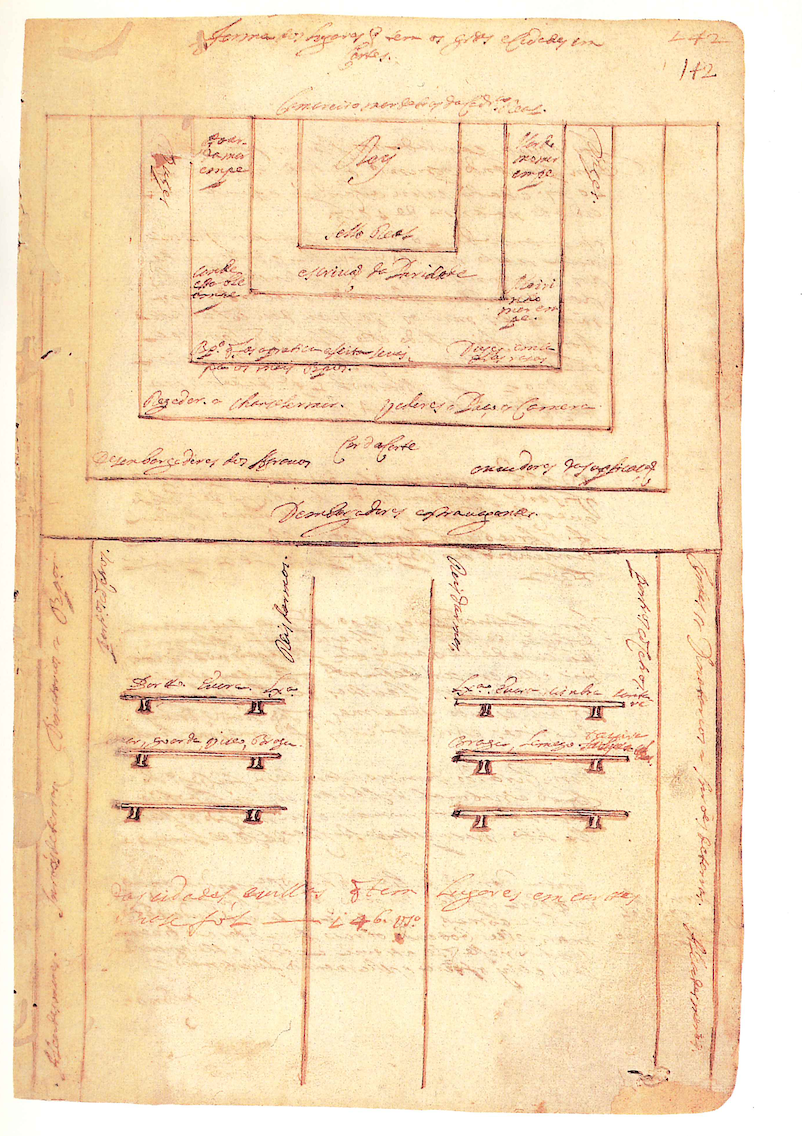
Preparatory drawing and notes for an opening ceremony of the Cortes (mid-sixteenth century). Source: Biblioteca Nacional de Portugal, PBA cód. 527, f. 142.
Preparatory drawing and notes for an opening ceremony of the Cortes (mid-sixteenth century). Source: Biblioteca Nacional de Portugal, PBA cód. 527, f. 142.
As in the above-mentioned Iberian territories, Portugal's representative assembly was not permanent, but met periodically when convened by the king. The meetings had no predetermined duration, and only the monarch was vested with the authority to dissolve them in a manner deemed legitimate. Moreover, gatherings that took place in the absence of a royal summons were considered illegal. The same could be said of assemblies that refused to obey royal orders to conclude their deliberations.
In late medieval times the Portuguese assembly met often, but throughout the fifteenth century this frequency declined. Two contrasting dynamics emerged. On the one hand, the Crown convened the Cortes with greater rarity and replaced them with more rapid forms of consultation. On the other hand, the political weight of the Cortes grew, above all because their meetings became a crucial space for negotiating the Crown's fiscal measures.
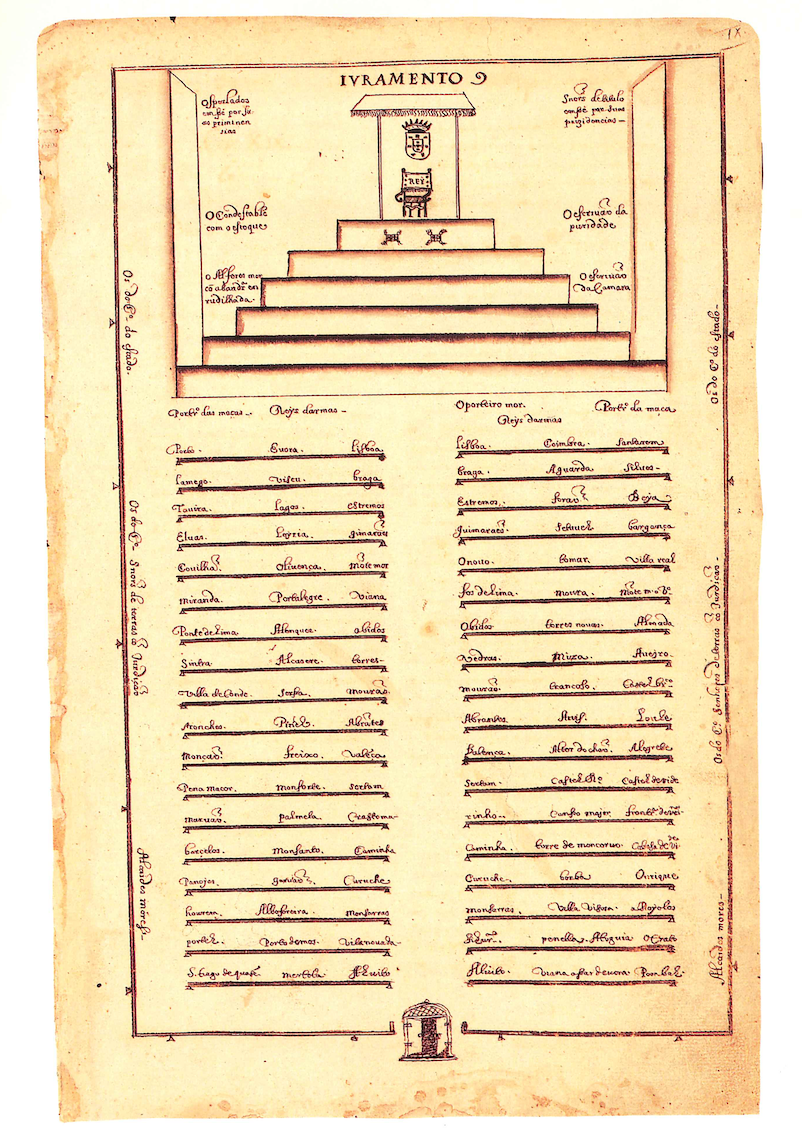
Drawing depicting the place where the dignitaries of the three estates who participated in the king's oath were to be positioned. António Soares de Albergaria, «Triunfos de la Nobleza Lusitana, Y origen de svs Blazones…» (1631). Source: Biblioteca Nacional de Portugal, cód. 1119.
Drawing depicting the place where the dignitaries of the three estates who participated in the king's oath were to be positioned. António Soares de Albergaria, «Triunfos de la Nobleza Lusitana, Y origen de svs Blazones…» (1631). Source: Biblioteca Nacional de Portugal, cód. 1119.
Throughout the sixteenth century several Iberian territories came under the authority of the king of Spain, and in 1580 it was Portugal's turn to be incorporated into the Spanish Monarchy. From that moment on, the Cortes were increasingly deemed a fundamental part of the Portuguese “constitutional order” and political identity. The Cortes came to be seen as one of the main symbols of the regal status of the Portuguese territory. Moreover, the Cortes was always presented as a fundamental institution since Portugal had become an independent kingdom. It would therefore have to continue to exist regardless of whether the king was in Portugal or in another part of the Spanish Monarchy. In this context, the Cortes came to be seen as a kind of guardian of the royal status of the Portuguese territory, its laws and privileges. It can therefore be said that, although the Cortes met less often, their political significance rose.
The Cortes were summoned on nine occasions during the sixteenth century, and another nine times during the century that followed. The assembly was always held in peninsular Portugal and increasingly often in Lisbon, a city which became the permanent seat of the Crown's government and administrative bodies. The Portuguese Cortes met less frequently than the Catalonian Cortes during the sixteenth century, but more often in the seventeenth century. The Cortes of Aragon, Valencia, and Mallorca met more rarely than those of Portugal during the entirety of the sixteenth and seventeenth centuries. Throughout the same period, the Castilian Cortes convened with greater regularity than any of their Iberian counterparts.
Royal officers eventually realized that counting on the Cortes' approval of certain unpopular decisions – like the introduction of new taxes – could help make such measures more binding. For their part, the three estates viewed the representative assembly as a convenient arena in which to negotiate government policies and protect their own rights. Despite the diversity of the stakeholders making up the three estates, the Cortes gave each of them a voice.
It is worth noting that the incorporation of Portugal into the Spanish Monarchy enhanced the importance of the Portuguese representative assembly. During this era, Spanish authorities implemented several centralizing reforms, many of which disregarded Portugal's longstanding political and legal status. In response, many Portuguese considered the Cortes to be a bastion of Portugal's “ancient constitution” (‘foros' and ‘privilégios'). The Cortes were then associated with a sense of territorial pride, a signal that Portugal, even after being subsumed under the Spanish Monarchy, remained a distinct and ancient kingdom with a long history of its own. This fact gave the assembly even greater political prominence. After the assertion of independence from Spain in 1640 the kings of the newly-enthroned Braganza dynasty, and in particular John IV, convened the Cortes with remarkable regularity between 1640 and 1656. The message was clear: unlike the monarchs of the House of Habsburg, the Braganza kings were worthy of Portugal's royal status, for they consulted with the kingdom's representatives and let them participate in governmental decisions.
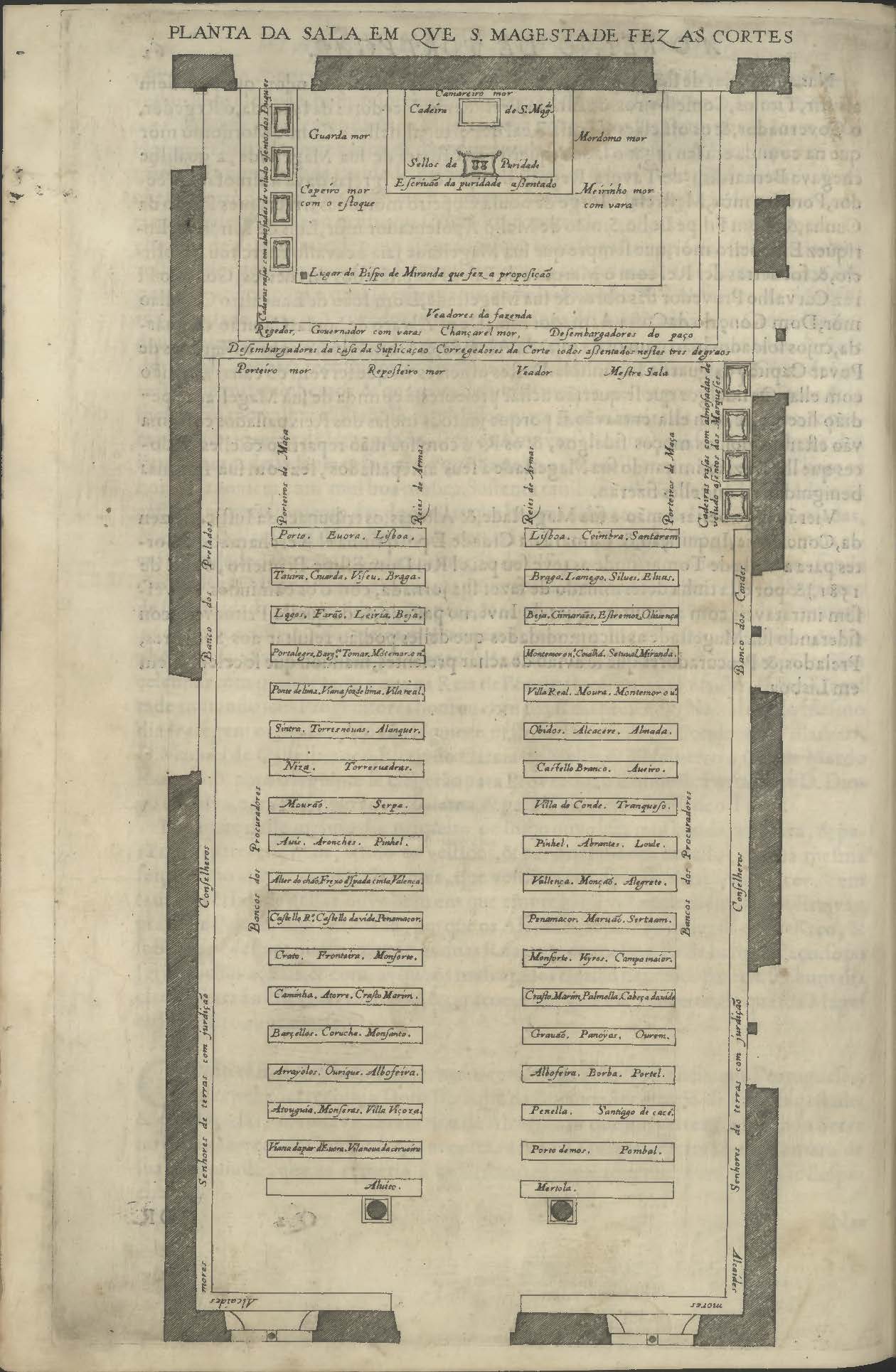
Printed plan of the room where the solemn opening of the Cortes of 1619, held in Lisbon, took place. Source: João Baptista Lavanha, Viagem da Catholica Real Magestade del Rey D. Filipe II. N. S. ao Reyno de Portvgal e rellação do solene recebimento que nelle se lhe fez… (Madrid, Thomas Iunti, 1621).
Printed plan of the room where the solemn opening of the Cortes of 1619, held in Lisbon, took place. Source: João Baptista Lavanha, Viagem da Catholica Real Magestade del Rey D. Filipe II. N. S. ao Reyno de Portvgal e rellação do solene recebimento que nelle se lhe fez… (Madrid, Thomas Iunti, 1621).
The main motivation driving the estates' representatives to engage in the Cortes was the tradition of participatory government that existed throughout the Iberian Peninsula. Conciliar forms of decision-making had been developing since the late medieval period, both locally and on a larger scale. The opinion that certain governmental matters, such as royal succession or the levying of new taxes, required the consent of the "assembly of the three estates" had become widespread. The Cortes were thus seen as yet another institution that supported the king in his decision-making.
As has already been stated above, the Cortes were attended by representatives of the so-called "three estates of the kingdom", i.e., members of the clergy, the nobility, and the commons. Each of these groups had historically been called an "arm" (‘braço do clero', ‘braço da nobreza', and ‘braço do povo'), a designation evoking an ancestral corporate understanding of society. The expression "the political body of the realm" (‘corpo político do reino') was commonplace in documents related to the Cortes and referred to the members of all three estates.
An invitation to attend the Cortes was both a privilege and an obligation. It was a privilege because this distinction was granted by the king to only a select set of dignitaries and municipalities, and was thus a sign of the monarch's confidence and special esteem. On the other hand, attendance, at the king's behest, was compulsory.
Let us now take a closer look at what sort of people represented each of these three estates that met at the Cortes. The "arm” of the clergy was comprised of the prelates, the masters of the military orders, the general inquisitor, and members of the high clergy, such as the heads of the principal convents, as well as the rector of the University of Coimbra. Sometimes the bishops of overseas dioceses also took part, although this necessitated the express authorization of the Crown. Turning to the "arm” of the nobility, we find the heads of the upper nobility, the donataries of the Crown lands, and the military commanders of villages located near the border with Castile.
As far as the "arm” of the people, or commons, was concerned, in Portugal the royal summons were addressed to around a hundred municipalities, which belonged to a group called the "cities and towns with seats in the Cortes". Until the mid-seventeenth century all these municipalities were located in the so-called "kingdom” (i.e., the Portuguese territory on the Iberian Peninsula). However, after 1640 the Crown authorized three overseas municipalities to send their representatives to the Cortes: Goa (in India), and Salvador da Bahia and São Luís do Maranhão (in Brazil). The "third estate" was thus the manifestation of the “kingdom” as an ensemble of urban centres. This kind of representation also made explicit the hierarchy among the hundred or so Portuguese cities and towns that took part.
Overall, the Cortes brought together nearly four hundred people. For the representatives from the “arm of the nobles” and “arm of the clergy”, a seat in the Cortes was an honour linked to social and jurisdictional status. While these clerics and noblemen were summoned to the Cortes in a personal capacity, the representatives of the cities and towns (that is, the “arm of the people”, the commons, or the “third estate”) were chosen locally. Each municipality would elect two individuals to represent it in the Cortes and gave the elected persons the rights and responsibilities of "procurator". Additionally, the local council conferred upon the two chosen parties an "imperative mandate". Besides circumscribing the matters on which a procurator could offer opinions, this mandate bound him to the "particular" interests of the municipality that had chosen him. It was in this capacity that he was to make arguments and adopt resolutions during the Cortes.
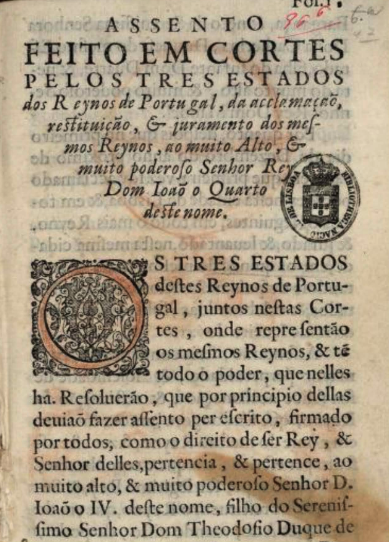
Cover page of the official document (“Assento”) certifying the decision of the Cortes of Portugal to elect John IV of Braganza as the new king of Portugal, thus consummating the political separation between Portugal and the Spanish Monarchy (January 1641). Source: Assento feito em Cortes pelos tres estados dos Reynos de Portugal, da acclamaçaõ, restituição, & juramento dos mesmos Reynos ao muito alto, & muito poderoso Senhor Rey Dom Ioaõ o Quarto deste nome (Lisbon, Paulo Craesbeeck, 1641).
Cover page of the official document (“Assento”) certifying the decision of the Cortes of Portugal to elect John IV of Braganza as the new king of Portugal, thus consummating the political separation between Portugal and the Spanish Monarchy (January 1641). Source: Assento feito em Cortes pelos tres estados dos Reynos de Portugal, da acclamaçaõ, restituição, & juramento dos mesmos Reynos ao muito alto, & muito poderoso Senhor Rey Dom Ioaõ o Quarto deste nome (Lisbon, Paulo Craesbeeck, 1641).
In reality, most of the procurators who formed the third estate (the “arm of the people”) came from the local nobility (‘nobreza da terra' or ‘gente da governança') of the municipalities represented at the Cortes, and therefore spoke largely on behalf of the elites of each city or town. There existed, moreover, a tremendous degree of diversity across the urban centres represented at the Portuguese Cortes. The procurators of populous and celebrated cities sat shoulder-to-shoulder with representatives from smaller and less politically and economically vibrant towns. Indeed, some of the kingdom's major urban centres were represented by members of the upper nobility or by magistrates from the high courts. The social gulf dividing the representatives of large and small municipalities could trigger considerable tensions at the Cortes.
A significant number of these representatives came from town councils situated on the seigneurial lands of both the church and the nobility. The duchy of Braganza, for example, had several municipalities that sat in the Cortes, and their representatives made up a total of 12-13 per cent of the "third estate". These representatives of municipalities in seigneurial lands allowed the upper nobility to have a degree of influence in the debates taking place in the third estate.
The opening of each meeting of Cortes was always a solemn event. If the convocation of the three estates was occasioned by the swearing-in of a new king or crown prince, the formalities accompanying a new session of the Cortes were prefaced by yet another display: the swearing-in ceremony. Even if the Cortes did not involve any initial oath-taking, the representative assembly was still inaugurated by a stately set of formalized rituals, which were always presided over by the monarch. The presence of the king at the Cortes at this phase was obligatory. It was, furthermore, a means of demonstrating to everyone present that the assembly was happening at the royal initiative.
The opening ceremony included two speeches. The first was an address on behalf of the Crown delivered by a royal dignitary, usually a prelate chosen by the king's circle. The function of this first speech was to convey to the participants the royal expectations for the assembly. In addition to explaining the matter that had prompted the convocation, the prelate would give information on the decisions that the Crown hoped to reach. It was therefore a piece of oratory very much controlled by the royal ministers. Some drafts of speeches were even rejected due to nonconformity with Crown interests. This first speech was followed by an address on behalf of the kingdom, always given by the procurator of Lisbon in his capacity as the representative of the “city head of the kingdom". This second speech was, in a sense, a response to the oration that had preceded it: taking advantage of the king's presence, the procurator sought to express the expectations of the representatives of the kingdom for the meeting. The tone of this speech could range from deferential to demanding, depending on the dignitary chosen and the circumstances in which the Cortes were being held. With the conclusion of this second speech, the king returned to his chambers and the opening ceremony of the Cortes came to an end.
After the opening session, the three estates met in three different (and sometimes distant) buildings in whichever urban centre the Cortes were being held. In general, the representatives would not see the king again throughout the course of their deliberations. The three estates held their meetings over a period extending from three to six months. In terms of duration, the Cortes of Portugal were comparable to their Aragonese, Catalan, and Valencian counterparts, but tended to be much shorter than the Cortes of Castile and some sessions of the English Parliament.
The Cortes mainly intervened in two facets of government: firstly, in matters related to the royal succession; and secondly, in fiscal affairs. If, however, royal ministers attending the meeting (or representatives of the three estates) raised issues in other areas, the assembly retained the possibility of dealing with these too. Petitions brought by the procurators, for instance, sparked many a debate at the Cortes. This jurisdictional latitude ultimately led to the assembly's involvement in a wide variety of governmental issues.
Thus, although the official letter convening the Cortes always contained an explicit indication of the subject for the meeting (generally royal succession, or fiscal matters) the power delegated to the Cortes was not always clear. For many, the assembly's role in issues of royal succession was purely symbolic, and even dispensable. These critics pointed out that the Portuguese monarchy was hereditary, and that the inaugural swearing-in of each new king at the Cortes was no more than “empty ceremony”. Diego de Silva y Mendoza, count of Salinas and a member of Philip III's royal circle, held this view. When asked about the prerogatives of the Cortes of Portugal in 1613, Salinas replied that "in Portugal it is assumed that the heir is king even before the oath. Therefore, the oath is more useful for the Kingdom than for the King, because for the heir the oath is a ceremony, while for the Kingdom it is a substance”. He further added that leaving the king subject to the judgment of the Cortes reflected poorly on the image of power a monarch ought to cultivate, and de facto weakened his authority greatly. For others, though, the active involvement of the assembly was unavoidable, particularly when problems of the succession arose. Those who held this latter opinion placed immense value in the oaths taken in the Cortes and celebrated at the inauguration of a new reign, and maintained that the decisions adopted by the representatives were binding on both the king and the kingdom.
Similarly, there were various strands of thought on the fiscal responsibilities assigned to the Cortes. According to customary practices, whenever a new tax was introduced, the kings had to convene the three estates and secure their "consent". The amount to be paid and the duration of the contribution would also be a matter of the assembly's discretion. Traditionally, the Cortes' ruling on fiscal matters would stand for three years, after which the monarch would, if necessary, convene a new assembly to re-evaluate, together with the representatives, whether the taxation ought to stay in place. But from the sixteenth century onwards, the Crown levied several new taxes without consulting the Cortes. Those who defended bypassing the Cortes pointed to the king's sovereign rights. Especially at moments requiring swift decisions, they contended, he had the absolute authority to make unilateral decisions, even with regard to taxation.
Underlying these disagreements was undoubtedly the gap between two different conceptions of royal power. Some subscribed to a more precedent-based view of kingship and insisted that a good king was one who frequently convened the Cortes, thereby giving his vassals the possibility of participating in governance. Others, however, affirmed the sovereignty and special status of a monarch, and rejected the notion that such a king was obliged to consult his vassals whenever he needed to levy new taxes or settle succession issues. Advocates for both positions vociferously argued for their respective political visions throughout the sixteenth and seventeenth centuries, and debates on these matters continued until the end of the eighteenth century.
Throughout the period under consideration, it was understood that the decision to summon the Cortes involved some risks. Many perceived that, once convened, the assembly facilitated the coordination of more concerted forms of opposition to royal measures. In the mid-seventeenth century, Francisco Manuel de Melo, a Portuguese man of letters, wrote in his book A Visita das Fontes that “for the community, the Cortes are like purges for the body: they revive old humours, and sometimes make the body sicker than it was before such a remedy”. Indeed, protest against royal decrees was sometimes exacerbated by the Cortes. It was usually within the "third estate", the commons, that the most intense disputes took place; trenchant criticisms of the government, and complaints about privileged groups and their tax exemptions, were popular themes in this context.
Despite the consensus-based model remaining the Cortes' ideal, voting was often used to reach decisions in the assembly. Importantly, both the content of the debates and the practice of voting reveal that parliamentary political structures were present in Early Modern Portugal. The minutes of such meetings show that some of the most politically-potent statements were voiced by representatives of modest town councils. As for the Lisbon representatives, their role was rather consistent and unambiguous: to advance the interests of the Crown.
An illustrative of this phenomenon took place in the mid-seventeenth century. In the Cortes of 1643 the procurator of Alvito (a small town in southern Portugal) rejected the king's fiscal plans. As he watched his fellow representatives fold under pressure to comply with the monarch's wishes, he rose from his seat and declared that he was "surprised that the procurators lacked the constancy and courage to maintain their initial opposition to taxation, and that they must have been corrupted". The royal officers responded aggressively, told him that "he was being very impudent", and threatened to have him arrested. The next day the Alvito procurator was barred from participating in the Cortes.
We would probably know nothing of such episodes were it not for the fact that a royal officer was required to draw up a detailed description of the sessions, which were subsequently certified by a notary. The account of the opening ceremony was particularly crucial. Usually called the "Assento de Cortes", it contained the text of both speeches and a complete list of participants. At politically-sensitive junctures, the "assento" was sometimes printed and circulated – even when the Cortes were still in session. Making these proceedings more public was a way of committing the dignitaries appointed therein to the decisions adopted by the assembly.
One of the tensest scenes in the history of the Portuguese Cortes took place in May 1674. Openly opposing the Crown's officials, the “three estates” boldly insisted that the Prince Regent Peter should assume the royal title and replace his brother Alphonse VI on the throne. The royal officers present not only rejected this proposal, but also denied Cortes the prerogative itself. Letting the Cortes have their way at this pivotal moment would have set a dangerous precedent, a fact of which the royal officers were fully aware. Yet some of the representatives doggedly maintained their position, expressing their dissatisfaction fiercely. Their insistence led the Marquis of Marialva – a member of the upper nobility representing Lisbon – to command them to be silent. Marialva reminded the commons that they were not in the Parliament of England, and that the Prince Regent was a sovereign and absolute lord who could do with the kingdom as he pleased. This statement was delivered at a session of the "third estate" in which many representatives criticised the Crown for offering a pardon to New-Christians (and the Jewish population) in exchange for a financial contribution. This episode suggests that by the second half of the seventeenth century, many Portuguese considered the Parliament of England to be an assembly where royal authority could be challenged much more forcefully than in their own country.
The last Cortes to be convened in Portugal were in 1697. On that occasion, the assembly's prerogatives in matters of the succession to the throne were drastically curtailed. With respect to their voice in taxation, the demotion of the Cortes came about more tacitly. During the first two decades of the eighteenth century, royal authorities imposed a series of new taxes without consulting the Cortes. Although they never formally declared that the assembly had been disbanded, no eighteenth-century king ever convened the Cortes. Parallel to the fading away of the Cortes, an "absolute" conception of kingship gradually gained strength.
The Cortes of Portugal would only be convened again in late 1820, in the context of the uprising that aimed to establish a liberal regime based on a written constitution. However, the insurgents' idea of the Cortes was completely different from the assembly that had existed in the Early Modern period. The assembly would be summoned by the “people”, not by the king. It would have a unicameral, rather than a tripartite, structure. Its members would represent the “Nation”, not the kingdom and its three estates, and would all be called “deputies of the Nation” (and not procurators). Last but not least, the assembly's main purpose would be to produce a written constitution meant to bring about structural changes in society. This was a far cry, therefore, from the Early Modern Cortes, whose purpose was, above all, to contribute to a peaceful coexistence between the three estates and the king.
Professor Pedro Cardim,
Universidade Nova de Lisboa

Further Reading:
The most comprehensive collection of documents about the Cortes of Portugal is the section «Cortes 1325/1832», from the Torre do Tombo archives, in Lisbon:
https://digitarq.arquivos.pt/details?id=4411506
Other Portuguese archives with relevant documents (minutes of the sessions; petitions):
- Library of the Palace of Ajuda, Lisbon.
- National Library of Portugal, section «Reservados».
- Library of the Academy of Sciences of Lisbon.
- Library of the Public Library of Évora.
Documents regarding the election of the representatives to the Cortes can be found in many of the municipal archives across Portugal.
Bouza Álvarez, Fernando, 1987. Portugal en la Monarquía Hispánica (1580-1640). Felipe II, las Cortes de Tomar y la genesis del Portugal Católico. Madrid: Universidad Complutense de Madrid.
Buceta, Erasmo, 1933. «Dictamen del Conde de Salinas en que se examinan las prerrogativas de la Corona y de las Cortes de Portugal», Anuario de Historia del Derecho Español, pp. 3-14.
Cardim, Pedro, 1998. Cortes e Cultura Política no Portugal do Antigo Regime. Lisbon: Cosmos.
Cardim, Pedro, 2016. «Political Status and Identity: Debating the Status of American Territories across the Sixteenth and Seventeenth Century Iberian World», Rechtsgeschichte. Journal of the Max Planck Institute for European Legal History, 24, pp. 101-116.
Coelho, Maria Helena da Cruz & Maria Manuela Tavares Ribeiro (eds.), 2010. Parlamentos: a lei, a prática e as representações. Da Idade Média à Actualidade. Lisbon-Coimbra: Assembleia da República e Universidade de Coimbra.
Thompson, I. A. A. & Pauline Croft, 1992. «Aristocracy and representative government in unicameral and bicameral institutions. The role of the peers in the Castilian Cortes and the English Parliament, 1529-1664» in H. W. Blom, W. P. Blockmans, H. de Schepper (eds.), Bicameralisme. Tweekamerstelsel vroeger en nu. Handelingen van de internationale conferentie ter gelegenheid van het 175-jarig bestaan van de Eerste Kamer der Staten-Generaal in de Nederlanden. The Hague: SDU, pp. 63-86.