
The Potiguara Assembly in Tapesserica
Indigenous Alliances in the Dutch-Portuguese Wars in Brazil
At the end of March 1645, after travelling several miles, 134 Potiguara from different areas of northeast Brazil assembled in an aldeia (Indigenous settlement) called Tapesserica. The object of the assembly was to elect representatives to deal with the Dutch West India Company. As an alliance between both sides had been struck, issues emerged that needed to be resolved. This gathering allowed for discussion that encouraged Potiguara leaders to write a document presenting their claims. Sometime after the gathering, the Potiguara delivered a remonstrantie (remonstrance) to the members of the Company government in Recife, the capital of Dutch Brazil (1630-1654), and the latter examined and scrutinized their demands.
This essay analyzes the Tapesserica assembly, the reasons why it was convened, and its connections with Indigenous political culture predating European arrival in Brazil. Who were the Potiguara? What more can be said about this gathering at Tapesserica? Before we go any further, it is also necessary to state that the Potiguara assembly cannot be understood without tracing their trajectory back to periods before the establishment of Indigenous-Portuguese-Dutch relations in the sixteenth and seventeenth centuries.
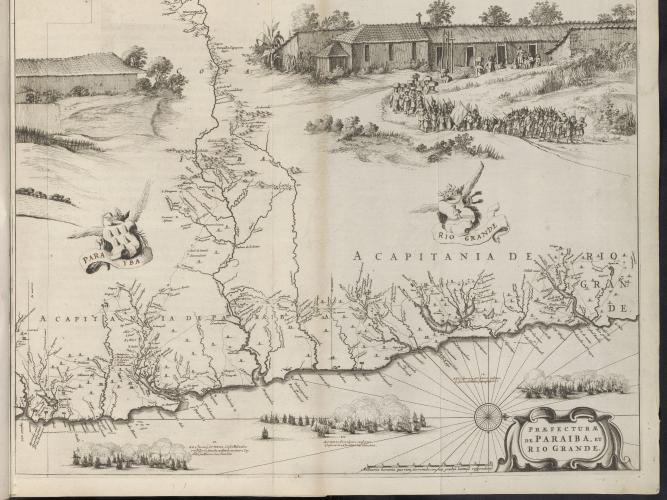
'Caerte van Brasilia'. Watercolour on paper by Johan Vingboons, ca. 1660. (Pernambuco Archeological, Historical and Geographical Institute Coll.)
'Caerte van Brasilia'. Watercolour on paper by Johan Vingboons, ca. 1660. (Pernambuco Archeological, Historical and Geographical Institute Coll.)
The Potiguara people were part of the Tupi linguistic family and lived along areas of the coast of Maranhão to Itamaracá, on the northern border of Pernambuco. When the Portuguese landed in Potiguara territory around the turn of the sixteenth century, the latter's population had numbered 100,000. The Potiguara organized themselves in different aldeias that comprised from 500 to 2,000 people. Distinct aldeias could maintain peaceful or hostile relations with each other. The residents of distinct aldeias would commonly forge alliances against shared enemies to defend their territory. There was no aldeia that represented a political center, despite some aldeias having a higher concentration of military forces and greater influence—through their leaders—than others. No leader ruled the conglomeration of aldeias. Power was fragmented among these natives, and a single aldeia could have more than one leader. This pattern was observable among other aldeias holding the ethnonym Potiguara—as was common among other Tupi-speaking peoples. Furthermore, they had the capacity to organize themselves politically and set aside their differences for the sake of the group.
A leader, or leaders, of one aldeia might be more respected than those of others, but ultimately, no leader was supremely powerful. Rather, the polities' decision-making power was vested in the collective. Commonly, leaders were experienced elders, distinguished warriors, and skillful orators. In times of war, the leaders of one aldeia and those of neighboring aldeias might meet to convene war councils and coordinate strategies. Some leaders would emerge in times of war, assuming more powerful positions than usual in that context, but this was usually transitory. If a leader gained more power than normal, the group might withdraw from him, or he might become a leader of a smaller aldeia. Tupi-speaking peoples often fractured when leaders disagreed, and the dissenting group would form a new aldeia.
'Praefecturae de Paraiba, et Rio Grande'. George Marcgraf, Frans Post and Johannes Willemszoon Blaeu. Engraving with hand coloring on paper. Amsterdam, 1662 (The Barry Lawrence Ruderman Map Collection, Stanford University Libraries, USA)
'Praefecturae de Paraiba, et Rio Grande'. George Marcgraf, Frans Post and Johannes Willemszoon Blaeu. Engraving with hand coloring on paper. Amsterdam, 1662 (The Barry Lawrence Ruderman Map Collection, Stanford University Libraries, USA)
Distinct peoples, such as the Caeté and Tabajara who lived from the coast of Pernambuco to Sergipe, would forge broader alliances and meet up to decide the fate of their groups. These gatherings and war councils might be the most similar types of assembly in Tupi-language groups predating the European arrival. However, not much is known about them. The main reason for this is a lack of historical sources. European accounts are biased and usually emphasize aspects related to war in these societies.
The Potiguara indigenous community had a troubled history with the Portuguese. They received the Portuguese well at first and forged alliances, but the latter's exploitation of the Potiguara would inevitably result in enmity. They waged war against their European colonizers and would become a serious threat to Portuguese settlers in Pernambuco. During the sixteenth century, some of these Potiguara were actively allied with the French in territorial disputes with the Portuguese. When the French were expelled from Brazil, in the early seventeenth century, conflicts and agreements brought these Potiguara back to the Portuguese side.
Still, some of the Potiguara would not submit to Portuguese hegemony and found refuge in the hinterlands of Paraíba, Ceará and Maranhão. Thus, at the beginning of the seventeenth century, the Potiguara were divided between those who followed the Portuguese and those who took a different path. Their internal conflicts and their struggles with the Portuguese continued throughout the seventeenth century.
The Dutch in Brazil
From 1624 to 1654, the Dutch seized part of the northeast of Brazil via the West India Company. This private company was created in opposition to the Habsburg Monarchy as the Dutch Republic sought to sustain competition with and resistance to Iberian colonial projects. Dubbed the Eighty Years' War (1568–1648) or Dutch Revolt, this period of competition sought to weaken the Iberian transatlantic trade economy that was essential to the Spanish and Portuguese. The Dutch Republic also tried to open Spanish and Portuguese colonial seaports to its trade vessels. Interest in Brazil was associated with the opportunity of acquiring revenues principally from trading sugar, but also from tobacco and brazilwood. The Dutch previously distributed sugar and brazilwood in the Republic through trade routes that linked Dutch cities and Portuguese harbors.
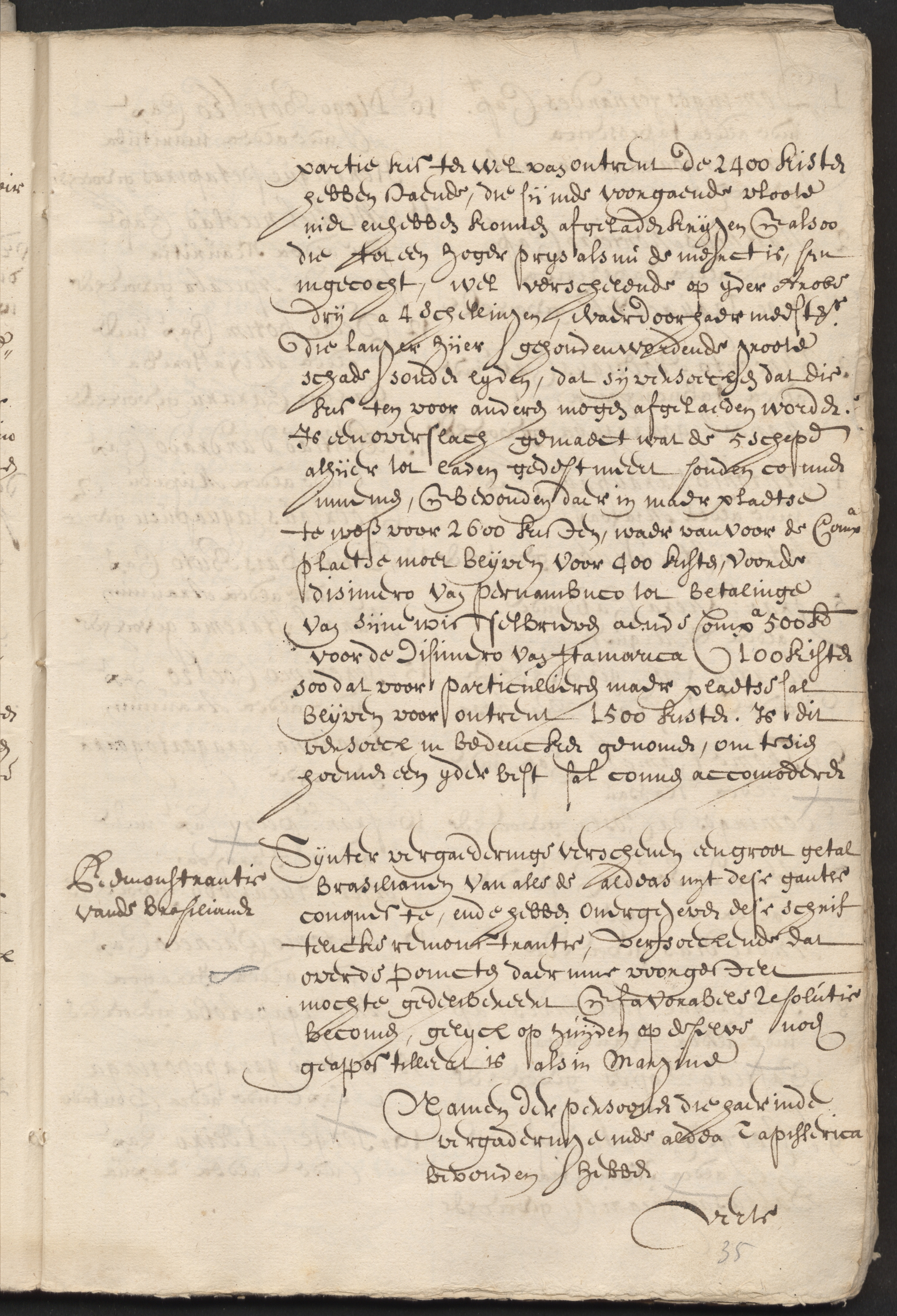
'The remonstrance of the Brazilians'. Daily Minute of the Political Council in Brazil, 11.04.1645 (National Archives, The Netherlands. Archive of the Old West India Company)
'The remonstrance of the Brazilians'. Daily Minute of the Political Council in Brazil, 11.04.1645 (National Archives, The Netherlands. Archive of the Old West India Company)
Integrated into the Spanish crown because of the 1580 Portuguese succession crisis, Brazil became the major target of a Dutch military offensive when commerce between Brazil and the Dutch Republic was impacted by restrictions imposed by the Habsburg Crown. The first Dutch attack on Brazil resulted in the invasion and occupation of Salvador, the capital of the colony, in 1624. But the Dutch could not hold the position and, after a siege in 1625, they were expelled. A fleet under the command of Boudewijn Hendrikszoon that departed from the Dutch Republic tried to support the surrounded Dutch forces by providing reinforcements, but they arrived in Brazil too late.
The fleet split up to accomplish distinct Atlantic objectives. One group set sail to the Caribbean, seeking to seize Puerto Rico and create a position to attack the silver fleet that regularly left Spanish colonial territories. Before reaching the Caribbean, however, retreating from Salvador in search of some safe harbor to care for their ill, after a long journey to the South Seas, they anchored further north, specifically in Paraíba. It was in Paraíba that the trajectory of some Potiguara changed radically after their encounter with the Dutch.
The Potiguara-Dutch Alliance
The Potiguara saw the vessels of the Dutch West India Company in Paraíba as an opportunity to challenge the hegemony of the Portuguese colonists. They helped the Dutch and, together with them, attacked Portuguese settlers. Soon, however, they would find that the troops of the West India Company had other plans. The Dutch set sail for the Caribbean. Some of the Potiguara joined the Dutch expedition and ended up travelling to the Netherlands. A few of them—around fifteen—are named in Dutch sources: André Francisco, Antônio Francisco, Antônio Paraupaba, Gaspar Paraupaba, Luís Gaspar, and Pieter Poty, among others.
After the defeat at Salvador, the Dutch devised a new plan to conquer Brazil. Now Pernambuco was the target. The fall of Pernambuco in 1630 did not result in a Dutch advance into the interior of the colony. To strengthen their still vulnerable position and acquire access to the hinterlands, the Dutch tried to dominate territories further north, in Paraíba and Rio Grande. To do so, they counted on Antônio Paraupaba, Gaspar Paraupaba, and Pieter Poty, who returned to Brazil in 1631 and acted as guides, interpreters, and mediators with other nations, such as the Tarairiú in the backlands of the Rio Grande and Ceará, a Tapuia-language people.
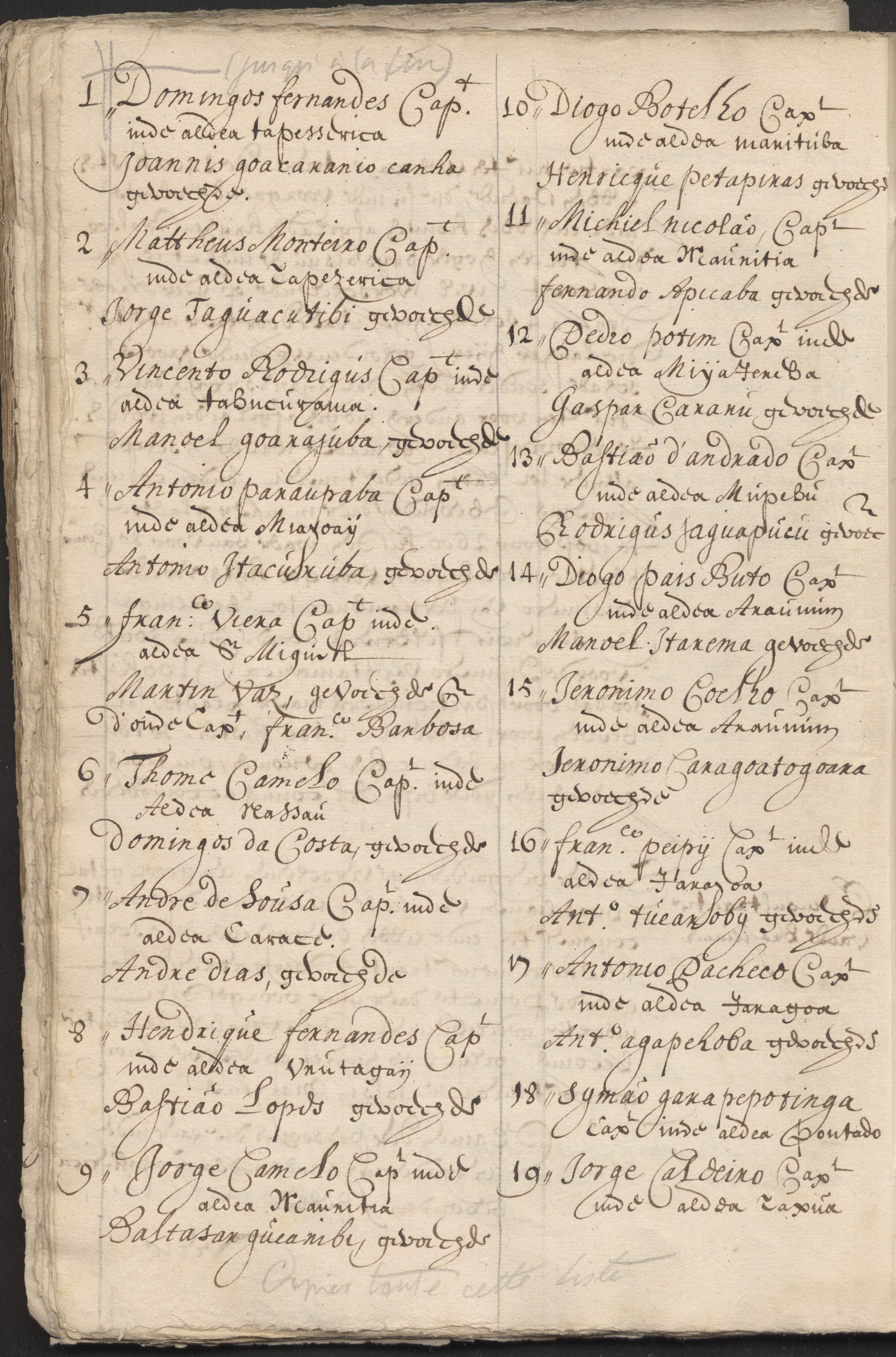
'Potiguara representatives'. Daily Minute of the Political Council in Brazil, 11.04.1645. (National Archives, The Netherlands. Archive of the Old West India Company)
'Potiguara representatives'. Daily Minute of the Political Council in Brazil, 11.04.1645. (National Archives, The Netherlands. Archive of the Old West India Company)
Initially, there was reluctance from native groups in Pernambuco and Paraíba to form alliances with the Dutch, whether out of loyalty to the Luso-Spanish colonists or apprehension in light of the wars that had occurred before and their brutal consequences. This initial hesitation, also a result of the actions of pro-Iberian indigenous leaders and missionary activity, delayed the Dutch advance in the territory. The qualms these natives had with the Dutch project could also be related, first, to their political reading of the status of the conflict among the Europeans and, second, to the Dutch inability to expand their presence in the territory.
Despite all the initial native insecurity in teaming up with the Dutch, it was with the help of their Potiguara and Tarairiú allies that the Dutch were finally able to move more safely through the territory, especially in the northernmost part. Later, some of the Indigenous groups from Paraíba, Itamaracá, and Pernambuco made agreements with the Dutch and joined their troops, playing an important military role against the Luso-Spanish forces in Brazil. The people of the Tabajara nation, among other groups, joined the Potiguara and Tarairiú. Antônio Paraupaba's importance grew along with the Dutch advance in the colony. From an interpreter and mediator, he would ascend to a prominent position and become one of the main indigenous agents of the West India Company in Brazil, alongside another fellow Potiguara, the aforementioned Pieter Poty.
Indigenous involvement in the Iberian and Dutch projects was essential to the success of the war and the colonial enterprise. These indigenous peoples sought to make deals that seemed most convenient for their groups. They chose and negotiated according to their agendas when possible. This led to many confrontations between the Company's authorities and their native allies. Paraupaba, Poty, and other leaders indicated they were following different plans that did not align with the demands of the Dutch. Conflicts arose, rebellions threatened parts of Dutch Brazil and agreements had to be renegotiated.
The Tapesserica Assembly
The Potiguara assembly held in Tapesserica in 1645 originated from the Potiguara demands for self-governance, improvement of their colonial conditions, and the desire of the Dutch to pacify their native allies. The alliances between the Potiguara and the Dutch did not come without burdens to the natives, and this resulted in tensions in their relationship. As soon as they had the chance, the Dutch tried to catechize the Potiguara to tame them and shepherd a more controllable flock. This process involved congregating natives in aldeamentos, Indigenous settlements controlled by Calvinist ministers and European commanders (commandeurs).
Many cases of abuse arose from the relationship between European commandeurs and natives. Living in an aldeamento implied the Potiguara being turned into an available labor force for the Europeans. Mistreatment, exploitation, and even enslavement of natives were their main grievances against the commandeurs and colonists—especially in areas distant from the Dutch government offices, in the far frontiers. Continuous war campaigns in Brazil, but also in West Africa, further burdened the natives, and some groups allied to the Dutch fled to the hinterlands. Death due to illnesses was a major problem, depopulating aldeamentos. Some natives took a more radical approach and revolted, killing the men of the Dutch West India Company garrisons in Ceará and Maranhão.
Conscious of the eroding relation with their allies, Paraupaba, and other Potiguara leaders organized themselves to negotiate directly with the head of the Dutch West India Company in the Netherlands in light of increasing tensions with the local government. Aware of the problems with their allies, the Dutch in Brazil allowed these leaders to travel to the Netherlands. They may have had some involvement in the organization of the Tapesserica gathering in 1645, since they had summoned native leaders of various groups before on at least two occasions. The reinforcement of the ties of their alliances was usually the main purpose of these reunions. This is the context of the Tapesserica assembly in 1645.
As stated earlier, after the gathering, the Potiguara presented Dutch officials with a written remonstrance of their demands. They required, first, that the Dutch should comply with the law of native freedom and set free any peoples held as slaves in the territories governed by the Dutch West India Company. The Potiguara also requested permission to merge certain aldeamentos, namely those of Rio Grande, Paraíba, Itamaracá/Goiana, and Pernambuco. The need to merge aldeamentos was possibly related to severe depopulation that ravaged the Potiguara in the 1640s as a result of the war and illness. Additionally, the Potiguara demanded more ministers for their churches and schoolmasters in the aldeamentos so they could bolster the Protestant cause among the natives. This demand for ministers could be seen as a gesture of goodwill on the part of the Potiguara towards their Dutch allies. The acceptance of Calvinist ministers in their aldeamentos also provided the natives with more intermediaries with the Dutch government and more opportunities to receive the benefits of this relationship.
Lastly, during the gathering, the Potiguara voted for the establishment of three native câmaras (municipal councils) in Itamaracá (with the aldeia Tapesserica as capital), Paraíba (with the aldeia Mauritia as capital), and the Rio Grande (with the aldeia Orange as capital). These would have jurisdiction over some other aldeias and aldeamentos in those areas. Moreover, the Potiguara voted and elected hoofden (‘heads', or principals) for these câmaras, namely Domingos Fernandes Carapeba of the câmara of Itamaracá, Pieter Poty for the câmara of Paraíba, and Antônio Paraupaba for the câmara of Rio Grande. Moreover, the assembly chose schepenen (magistrates) for all those câmaras, specifying every name chosen by them, and demanding that the Dutch approved and endorsed those selected, as can be seen in their remonstrance.
The paucity of sources prevents us from saying much about the Potiguara câmaras. But there are similarities between the câmaras organized by the Potiguara and the Portuguese colonial câmaras in the way their representatives were elected. A head or principal and some magistrates were elected by the main leaders and officials of each aldeia and aldeamento. We can assume that part of the role of the head and the magistrates was to mediate with the colonial powers. Moreover, it was an institution with limited power and autonomy, dependent on the approval of the Dutch government in Brazil. It was, however, a body capable of articulating local interests and framing collective remonstrances.
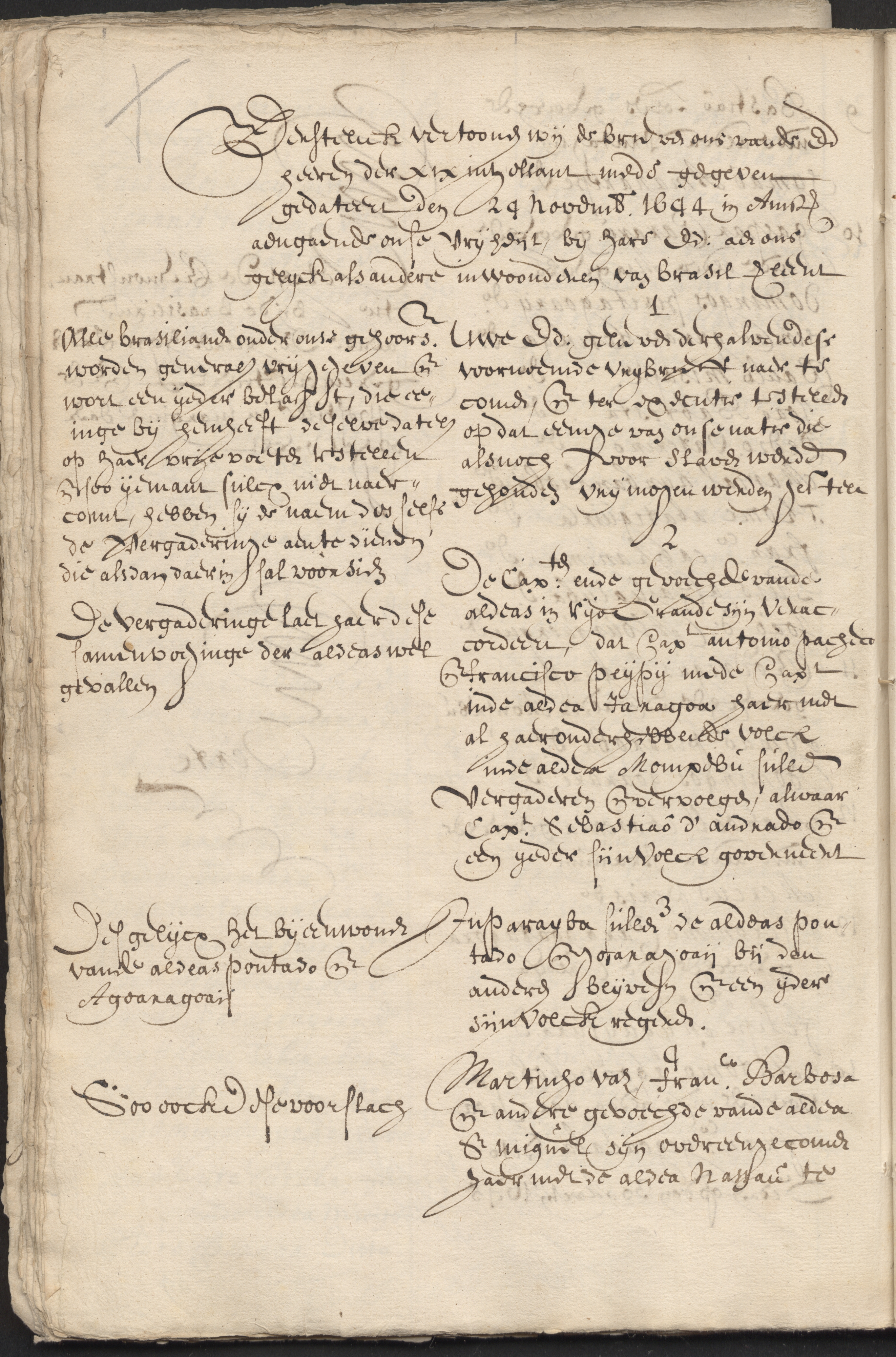
'Remonstrance of the Potiguara representatives and the Dutch response'. Daily Minute of the Political Council in Brazil, 11.04.1645 (National Archives, The Netherlands. Archive of the Old West India Company)
'Remonstrance of the Potiguara representatives and the Dutch response'. Daily Minute of the Political Council in Brazil, 11.04.1645 (National Archives, The Netherlands. Archive of the Old West India Company)
Dealing with serious financial problems and reducing their garrison numbers in Brazil, the Dutch needed even more of their native allies to defend their colony. For that reason, the Dutch government in Brazil agreed to grant all the Potiguara demands. It is hard to know much more about the results of the Potiguara assembly. Just two months after the gathering in Tapesserica, Portuguese settlers revolted against the Dutch. Missions in the aldeamentos came to a halt, and the plan to merge aldeias and aldeamentos was curtailed as many groups of natives were displaced to areas near Dutch settlements. The Dutch not only feared the Portuguese rebels, but their native allies' defection as well.
While often treated as a footnote in the historiography dedicated to the history of the Dutch-Portuguese wars in Brazil, this native gathering sheds much light on the events of this European struggle in the South Atlantic and the involvement of the Indigenous in the conflict. It reveals to us elements of native governance and their role as historical agents, choosing pathways and deciding their destiny in a continuously changing world. Historians may consider the gathering as having been summoned by the Dutch government in Brazil and as a byproduct of the European agenda. This interpretation has a degree of merit, but when reading some of the resolutions drafted in the assembly, as described in the daily notes of the Dutch Government in Brazil, it becomes possible to see an active Potiguara project in the demands that they formulated.
Studying the pre-European context to understand what happened in Tapesserica and tracking the work of these Potiguara câmaras is a definitive path to knowing more about forms of collective governance and decision-making among indigenous peoples in Brazil. It is also necessary to further investigate the transformative effect Europeans had on native lives, to compare this assembly with similar Indigenous experiences in Brazil and abroad, and finally to perceive this native gathering as proof of their capacity to negotiate with their allies, and adapt, transform, and survive in times of devastation and invasion.
Further Reading:
B. R. F. Miranda, ‘The Dutch in Brazil, 1624-1654', in The Oxford Encyclopedia of Brazilian History and Culture, ed. G. Palacios, S. W. Garfield, H. Mattos and R. Raminelli (2020).
C. R. Boxer, The Dutch Seaborne Empire 1600-1800 (London, 1965).
E. van den Boogaart, ‘Infernal Allies. The Dutch West India Company and the Tarairiu 1631-1654', in Johan Maurits van Nassau-Siegen 1604-1679. A Humanist Prince in Europe and Brazil, ed. E. van den Boogaart (The Hague, 1979).
J. M. Monteiro, ‘The crises and transformations of invaded societies: Costal Brazil in the sixteenth century', in The Cambridge History of the Native Peoples of the Americas, ed F. Salomon and S. B. Schwartz (2008).
J. van den Tol, ‘Non-Dutch Petitions in the Seventeenth Century Dutch Atlantic'. Early Modern Low Countries 4 (2020).
L. Hulsman, ‘Brazilian Indians in the Dutch Republic. The Remonstrances of Antonio Paraupaba to the States General in 1654 and 1656'. Itinerario, 29.1 (2005).
M. Meuwese, ‘‘For the peace and well-being of the country': intercultural mediators and Dutch-Indian relations in New Netherland and Dutch Brazil, 1600-1664' (PhD. thesis, Notre Dame University, 2003).
M. Meuwese, ‘The Opportunities and Limits of Ethnic Soldiering. The Tupis and the Dutch-Portuguese Struggle for the Southern Atlantic, 1630-1657', in Empires and Indigenes: Intercultural Alliance, Imperial Expansion, and Warfare in the Early Modern World, ed L. Wayne (2011).
M. Meuwese, Brothers in Arms, Partners in Trade. Dutch-Indigenous Alliances in the Atlantic World, 1595-1674 (Leiden, 2012).
M. R. C. de Almeida and T. Seijas, ‘Amerindians in the Iberian World', in The Iberian World 1450-1820, ed. F. Bouza, P. Cardim and A. Feros (2020).