
Tuscan Assemblies
The Tuscan State of the early modern period did not have a parliamentary structure. During the whole period it possessed none of the representative institutions that we can find almost everywhere in Europe. This does not mean, however, that the Tuscan State did not share some of the common elements of the parliamentary culture and practices throughout Europe: rather, they were expressed in a very peculiar way. First of all, because of the crucial importance of the municipal tradition: the cities, to some extent, played the role that elsewhere was played by the ‘states' or stände. To understand the internal constitution of the Grand Duchy of Tuscany we have to consider that the Medici dynasty inherited the ‘State of Florence': the city itself, a flourishing ‘respublica' since the 12th century, and its large dominion, created during the late Middle ages over a large part of the Tuscany. When the first Medici became formally prince in 1530 (the former Medici had no formal legitimation of their power), his title was ‘Duke of the Republic of Florence', and it was not until 1569 that Cosimo I was granted the (papal, then imperial) title of ‘Grand Duke of Tuscany'. The continuity between the municipal Republic, which had created the territorial State, and the Medici who inherited it was not a mere matter of façade. During the second half of the 16th century, when Cosimo was involved in a sharp diplomatic controversy with the Este Dukes of Ferrara about the ceremonial prerogatives of the two princes, who shared the same title, the Tuscan lawyers rejected the Este claims about their older origins, arguing that the Medici were the heirs of the Republic. Since this already existed in the high Middle Ages, well before the Ferrara dukes, for that reason they could be considered older and nobler.
On the other hand, Cosimo I also ruled over territories that did not belong to the ancient Florentine State. Initially this was the State of Siena, another municipal dominion built around the city during the late Middle Ages, conquered by the ducal army in 1555 and granted to Cosimo with a feudal privilege of Emperor Charles V: later, the Grand Dukes added some territories at the southern and northern borders of Tuscany, and also some minor feudal enclaves. The composite reality of the Medici State was one of the reasons why it did not possess a central institution representing the State as a whole apart from the Medici themselves. Strictly speaking, such a collection of territories had not a common constitution, and the person of the sovereign was the only element which embodied the State.
But there are other reasons. European history includes a number of non-monarchic states, sometimes based on a strong network of free cities, with some elements of parliamentary representation: the United Provinces or the Swiss Confederation. What made the Tuscan state clearly different was the fact that neither the Florentine nor the Sienese State were the result of a process of confederation: the hundreds of cities, towns and villages that composed them had been conquered or acquired by Florence or Siena, and their submission was usually marked by a capitulation, which assured some kind of privileged status under the rule of the “dominante”. Thus, the ‘dialogue of power' between the center and the periphery was played in a direct relation between the single city and the dominant, without a central institutional frame: the representatives of the subject towns were sent to Florence to demand the approvation of local statutes, reforms and new laws.
When the Medicean state was set up during the 16th century, this internal logic of the institutions did not change: it was just ‘completed' by the figure of the Duke over the existing offices and dynamics.In 1537 the florentine Senate of the 48 appointed Cosimo as ‘head and principle of the government of the city of Florence and its Dominion', and even simbolically the Prince was conceived as the heir of the republic: Cosimo was usually represented as the ‘Tuscan Hercules', not only because of the classic rhetoric, but as a reference to the traditional image of Hercules in the coat of arms of the Respublica Florentina.
On the other hand, ‘parliamentary' practice was very intense and crucial for the Tuscan State in the internal life of the cities and towns. This was based on a very complex system of local councils. Even under Florentine dominion, and in a sense exactly because of it, the local oligarchies of the big cities such as Pisa, Arezzo, Pistoia or Siena, whose medieval history was made up of a long tradition of freedom and political participation, through the self-government of the municipal councils. The councils embodied local identity and local hierarchies : during the whole modern period the municipal life of the Tuscan cities was marked by the so-called Riforme, a very complex system of selection (mixed of election and sortition) to choose the members of the councils and the magistracies. The ceremonies of the local councils emphasized the link with communal history, using the old titles and references to the medieval period. Practices, rules, images and words as well were mostly the same as those that were used during the Middle Ages. In Pisa, for example, the small council that expressed the self-government of the city was called ‘the six Priors representing the public': the priors were the old name of communal magistracies, and their function was defined “publicum” as that of a public authority. In other cases, when the cities' representatives went to Florence to demand grants and concessions from the Grand-Duke, they sent ‘ambassadors', and the word itself was used to indicate that their own councils represented the city in front of the prince. Classical references were frequently employed to emphasize the city's status. Roman law or classical-antique models of public virtues were mentioned in the local statutes or in images decorating the public spaces. The publication of the printed copy of the local statutes, usually very similar to the version in use during the communal period, was one of the most clear witnesses of such a will di emphasize the continuity with the comunal era of freedom: in Arezzo the statues were published twice between 1534 and 1580, while in Pistoia the first printed appeared in 1546, the very same year of the granducal privilege for the exemption from any territorial office apart from the Pratica di Pistoia.
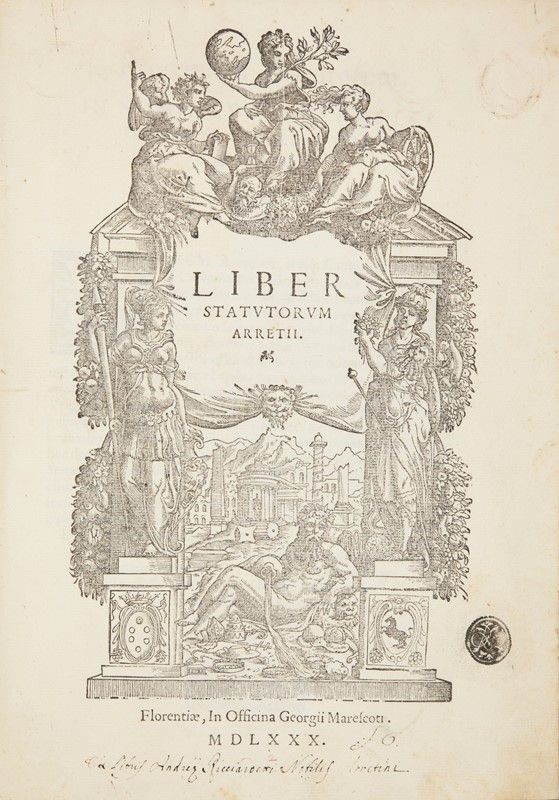
Classical symbolism in the title-page of the Statutes of Arezzo (1580)
Classical symbolism in the title-page of the Statutes of Arezzo (1580)
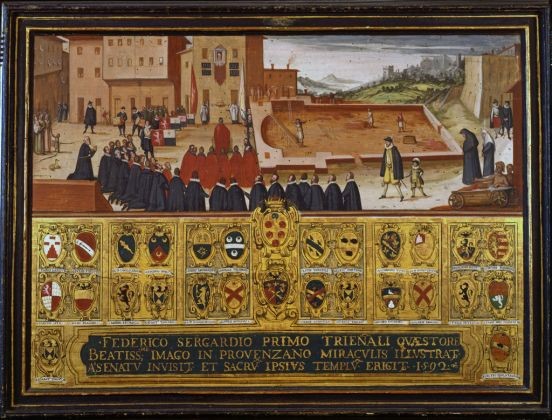
Since some of the Tuscan cities could claim a very ancient origin (Arezzo or Volterra, for example, date back to the Etruscan age) references to such remote images were very realistic and effective. In Siena the medieval images painted on the cover of the ‘biccherne', the solemn registers of the financial administration, were still used in the late 16th century, and the subject of the paintings were commonly the officers or the counsellors (“anziani” “gonfalonieri” or “priori”). This image, for example, designed to recall the foundation of the Provenzano church, shows the Concistoro and Balia around the building, with the coats of arms of the prince (the Medici red balls) and of the most distinguished families of the city.
In case of Arezzo, at the beginning of the 17th century (that is to say a period when the Medice rule was very established) the municipal authorities charged the painter Teofilo Torri to decorate the interior of the public palace with frescoes representing the ancient figures of the roman Arezzo but also the glorious deeds of the medieval Commune and also the privileges granted by Charlemagne to the aretine Church.
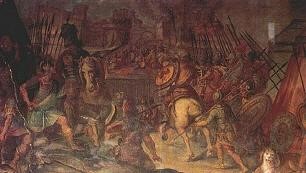
Teofilo Torri (Palazzo del Comune di Arezzo), about 1610: fresco 'The Aretines conquering the city of Cortona' (1258)
Teofilo Torri (Palazzo del Comune di Arezzo), about 1610: fresco 'The Aretines conquering the city of Cortona' (1258)
Considering that the municipal identity was so strong and recognized, it was taken for granted that the prince could not intervene directly in local affairs: the central power could examine and confirm the statutes, which were periodically reformed by the city councils assisted by the florentine officials: but in any case the prince could not ignore the local laws. When the prince visited the cities of his state, the lavish ceremonies that accompanied him were meant to mark the obedience due to the prince, but at the same time to stress the glory and respect of the municipal institutions, because the whole ceremony was usually leaded by the representatives of the medieval offices with their symbols. Such a formal construction was to some extent a fiction. The real functions of the municipal councils were first and foremost to represent the social hierarchies within the city. Nevertheless, their role lasted during the whole Ancient Regime, and it provided a real, albeit narrow, bridge between the glorious history of the communal liberty of the Middle Ages and the new ideas of the romantic age. When the Histoire des republiques italiennes of Sismonde de Sismondi was published in 1807-1818, and the myth of the ‘communal freedom' became part of contemporary political debate, it encouraged a flood of local histories and documentary researches on the medieval antiquities of the municipal fatherlands.
The complex balance between the prince and the cities did not remain unchanged during the centuries. First of all, the Grand Dukes aimed to create a central framework of councils to rule over the state: a framework completely separated from local dynamics, and which was not supposed to be representative in nature. The Pratica Segreta, created by Cosimo I in 1545, was a council composed of the high magistracies and counsellors of the Duke, and had the task to deal with the interior affairs of the state, especially those concerning the local communities. Originally it was meant to revise and confirm the local statutes of the submitted cities; in 1560 the new magistracy of the Nove conservatori del dominio was set up to manage all the relations of the Prince with the local offices and councils. Still, it is highly relevant that neither the Pratica nor the Nove had a uniform authority over the whole state. The composite structure of the state affected even the highest level of government. The Nove, for example, had no authority over Siena, and a twin magistracy of the Nove, the Quattro conservatori was responsible for the Sienese territory (the so called ‘Stato nuovo', new State). The city of Pistoia, which during the whole period claimed a privileged status within the Florentine – then Medici – State, did not come under the authority of the Pratica Segreta, but rather under the Pratica Segreta di Pistoia (later called Pratica Segreta di Pistoia and Pontremoli). This had the same functions of the ‘ordinary' Pratica Segreta, but with a partially different composition and a special territorial competence. Pisa and a part of the Arno valley was not controlled by the prince through the Nove, but through a special institution of medieval origin, the Magistrato de' Fossi. The existence of all these ‘special' magistracies made the Tuscan state a very complicated structure, and gave an impression of confusion and irrationality to the Habsburg rulers who inherited it in the 18th century, after the extinction of the Medici dynasty. But, as seen ‘from below' by the local oligarchies of the old communal cities, it ensured that the central power could not cancel local privileges, and even though there was not a formal ‘representation', i.e a parliamentary institution (the Pratiche and the Nove were a Grand-Ducal creation and their members were chosen by the prince or from among the Florentine citizens) the separation of the territory from the ‘ordinary' government was perceived as a real safeguard of the municipal identities.
There was a last context in which the territories of the Tuscan State can be said to have participated in the public government. In 1562 Cosimo I created the chivalric Order of St. Stephan. It was just one of the many cases of knightly orders founded by European princes of the period, though much later than the most famous English or Burgundian examples. Cosimo's creation actually had some original features. The knights, who received a solemn seat in Pisa, the still existing Palazzo dei Cavalieri, were expected to fight against the Islamic pirates of the Tyrrhenian coast, and therefore their mission was religious as well as military. The importance of the Order, however, was much greater than its practical military effectiveness. To be a member of the Order was a special privilege granted by the prince to the scions of noble and distinguished families of the State. Most knights were Florentines, but a significant number of them, increasing during the Ancient Regime, were members of ancient or recent urban elites families of the most important cities of the state (the so-called “città nobili”). The ranks of the Order, therefore, created a kind of ‘granducal aristocracy', to which all the cities were eager to see some of their citizens listed. As a result, the order can be considered a kind of ritual ‘representation' of the ruling class of the state. Provided with knightly titles, a member of a local family could reach the highest level of the ducal government, and hopefully he would be a good link between his old fatherland and the central power.
Professor Lorenzo Tanzini,
University of Cagliari
Further Reading:
Sources about the ideas of power in government in Tuscany:
L. Mannori, Lo Stato del Granduca 1530-1859. Le istituzioni della Toscana moderna in un percorso di testi commentati, Pisa, Pacini, 2015
G.M. Cecchi, Sommario de' Magistrati di Firenze, a cura di A. D'Addario, Roma, Ministero per i beni culturali e ambientali, 1996
Studies about the Medici State and the role of the cities:
E. Fasano Guarini, Lo Stato mediceo di Cosimo I, Firenze, Sansoni, 1973
F. Diaz, Il Granduca di Toscana. I Medici, in Storia d'Italia, diretta da G. Galasso, vol. XIII/1, Torino, Utet, 1976, pp. 66-109
F. Angiolini, I cavalieri e il principe : l'Ordine di Santo Stefano e la società toscana in età moderna, Firenze, Edifir, 1996
E. Fasano Guarini, Principe ed oligarchie nella Toscana del Cinquecento, in Ead., L'Italia moderna e la Toscana dei prìncipi: discussioni e ricerche storiche, Firenze, Le Monnier, 2008, pp. 221-239
D. Edigati, Cosimo I ‘fontana de iustitia e nemico de' tristi': Pragmatism and Aequitas, in Companion to Cosimo I de' Medici, edited by A. Assonitis and H. van Veen, Leiden, Brill, 2021
Il Comune dopo il Comune: le città toscane nell'antico regime, a cura di D. Edigati e L. Tanzini, Firenze, Olschki, 2022