
Transylvania's Diet
Representative government is probably not the first thing that comes to mind when thinking about Transylvania, yet the region that was once the eastern part of Hungary and is now the northwestern part of Romania had an estate assembly (also known as a “diet”) for about six hundred years. Its longevity, however, did not go hand in hand with much continuity, as the institution went through significant upheavals and transformations through the medieval and early modern periods. In the late Middle Ages, the Transylvanian estates met to discuss local matters and sent delegates to Hungary's general assemblies; between 1711-1867, they had a directly subordinate relationship with the Habsburg monarchy, under whose authority they now fell. But it was especially between 1526 and 1711 that the story of Transylvania's diet stands out, as that was when it became the representative body of an entirely separate (although not exactly independent) state. In that period, not only did it have judicial and legislative powers but, from 1571, elective and constitutive ones as well, as Transylvania became one of the few elective monarchies in early modern Europe. Its assemblies were responsible for electing Transylvania's rulers and forging constitutional instruments to keep them in check, such as enthronement conditions including the right of resistance. This article discusses the main characteristics of Transylvania's diet during the autonomous period. We will start by taking a look at the circumstances of its reinvention in the sixteenth century.
Historical Background
In the medieval period, Transylvania was part of the Holy Crown of Hungary and each of its estates sent representatives to the Hungarian diet. From the late thirteenth century, they also started to meet locally, in their own general assemblies (the first documented Transylvanian estate assembly took place in 1288). These provincial gatherings were convened either by the king or in the king's name, by the Transylvanian voivode, who was a royally appointed governor. Transylvania's medieval assemblies usually dealt with judicial matters and the proclamation and implementation of decrees issued by the Hungarian king and diet; they could not make any laws that went against centrally issued resolutions. Despite a tendency toward local particularism and a measure of increased institutional articulation from the fifteenth century onward, the Transylvanian estates generally did not contest their position within the Holy Crown. But in the first half of the sixteenth century, they were catapulted into an unprecedented position of importance by circumstances that everybody—even those who profited from them—decried as the worst fate that could befall them. The tragedy they referred to was a perfect storm that combined the Ottoman advance into Central Europe (marked by the disastrous battle of Mohács, 1526) with a civil war between Habsburg and anti-Habsburg supporters, which ultimately resulted in the partition of Hungary between Habsburgs, Ottomans, and an Ottoman-backed Transylvania.
As a result of the partition, Hungary was ruled between 1526/1527-1570 by the Ottomans, who had conquered the areas in the center and south, and two rival kings. The two kings had been elected by two separate Hungarian assemblies in 1526 and 1527 and ruled different parts of the country. Ferdinand of Habsburg (succeeded in 1564 by Maximilian II) ruled the western and northern parts, while John Zápolya, former voivode of Transylvania, (succeeded in 1540 by his newborn son, John Sigismund), ruled the eastern parts, which included Transylvania and an adjoined region to the west, called the Partium.
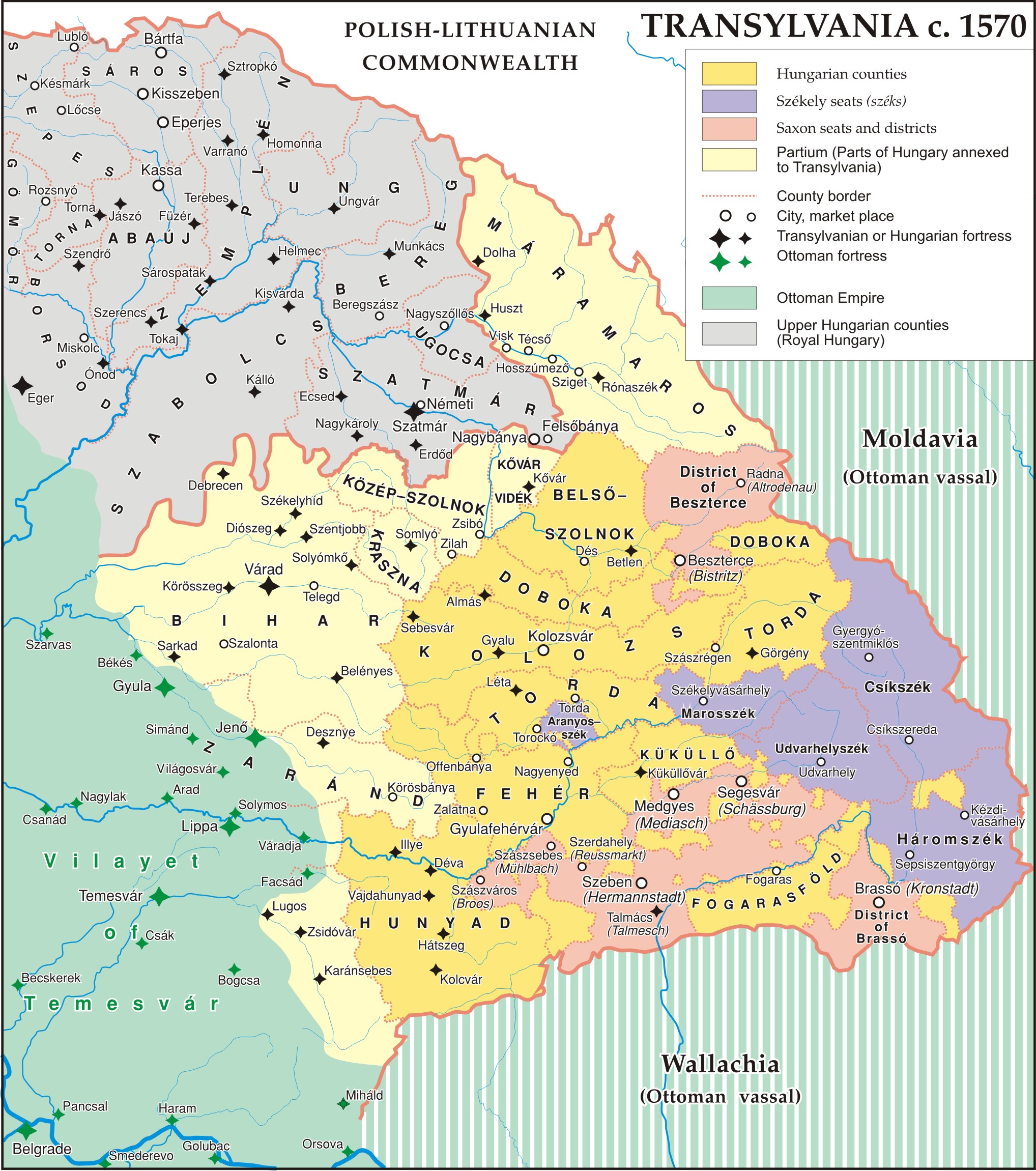
Map of Transylvania c. 1570, courtesy of Béla Nagy
Map of Transylvania c. 1570, courtesy of Béla Nagy
It was only in 1571, when John Sigismund Zápolya expired without issue, that a decisive separation between the eastern parts and the rest of Hungary took place. In the spring of that year, an upgraded version of Transylvania's medieval assembly elected, for the first time, a ruler with no claim to the Hungarian crown (Stephen Báthory, 1571-1586, later also king of Poland-Lithuania, 1576-1586). The new political entity created in this way was not independent but had to answer to its Ottoman suzerain; the subordination was expressed in the form of a tribute (first offered by John Zápolya in 1529) and a subordinate foreign policy. Internally, it enjoyed virtually unlimited autonomy regarding fiscal, administrative, and religious matters, and the estates had freedom in the choice of their rulers, as long as they remained “friends” of the Porte. This arrangement continued until Transylvania's takeover by the Habsburgs in the late seventeenth century.
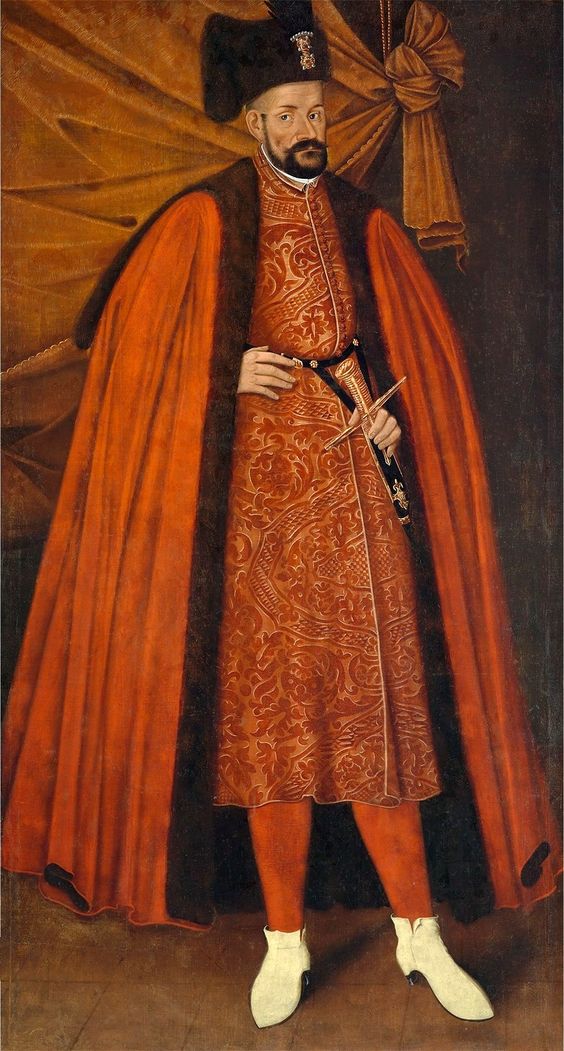
Portrait of Stephen Báthory, 1585, Royal Castle in Warsaw, Wikimedia Commons
Portrait of Stephen Báthory, 1585, Royal Castle in Warsaw, Wikimedia Commons
The 1571 election officially marked Transylvania as a separate state, but the process had already started in the 1540s, soon after the death of John Zápolya (and, according to some historians, even earlier). Its institutions and legal framework inherited some of its most important elements from the Hungarian matrix and their own medieval precedents, but they were molded to respond to the needs of the time. A case in point: when they set about arranging their own central government (especially from 1542 onwards), the Transylvanian estates borrowed the model of succession by election from Hungary. But most Hungarian successions, like those of other late medieval monarchies in northeastern Europe, were limited to selecting a male member from the former king's family; they went beyond the dynasty only when such male relatives were not available. Moreover, the selection was usually done by a small circle of councilors and high lords; the rest of the assembly was usually not involved in confirming, let alone making this choice (the first documented occurrence of a confirmation by the Hungarian nobility was in 1508). Transylvanian successions, by contrast, were primarily based on the elective principle and only occasionally invited relatives of former rulers to the throne; additionally, they were structurally open to the input of elected estate representatives. This expanded version of the elective model came into being, on the one hand, as an extension of the recent Hungarian trend to have uncertain successions confirmed by a wider portion of the nobility than had been previously the case. On the other hand, it was a reaction to the Habsburg claim to the Hungarian crown, which was based on the hereditary principle. All in all, it was mostly the result of a pressing need for legitimacy, sorely needed in the context of rival contenders (before 1571) and a newly emerging state (after 1540 and especially 1571).
And thus, from a mere provincial estate assembly, the Transylvanian diet became the representative body of a new state born on the ruins of medieval Hungary. Within Transylvania, the diet's new prerogatives and the establishment of the elective principle as the preferred method of arranging succession led to wider political participation (and arguably more clout for the diet) than had been the case in the late-medieval Hungarian framework, at least during elections and shortly thereafter. But despite the new powers that they had gained, the Transylvanian estates seemed more terrified than elated. Contemporaries described the situation as catastrophic at worst and temporary at best. In the following decades, plans were constantly concocted to reunite with Hungary and drive the Ottomans out of the region. It took, however, more than 150 years to accomplish one half of that dream, namely the removal of the Ottoman influence from Transylvania and central Hungary (completed in 1711), and an additional 150 years to reunite Transylvania with the rest of Hungary (1867). By the time these events took place, the consensus about the desirability of such restorations had weakened. The resistance was due, at least partly, to the powers that the Transylvanian diet had enjoyed in the meantime. These powers will be discussed below.
Characteristics
As argued in other early modern European contexts, the Transylvanian diet was an event more than an institution, considering that it came into existence only when in session. For that reason, it might be more appropriate to refer to it in the plural, but there are grounds to use the singular as well, not just for the sake of convenience but also because it did acquire an institutional identity over time, arguably even before the autonomous period.
Types
The Transylvanian diet was unicameral. Its assemblies (congregationes, comitia) were labeled as either “general” or “partial”/ “particular” (generalia or partialia/particularia). The word “general” showed that all Transylvanian estates were represented, while “partial” had been primarily used within the wider Hungarian context (i.e., Transylvania's assembly was a provincial, not a central one). The latter lost its meaning in the autonomous period, even though its usage persisted in the first decades after the partition. There were also assemblies that only gathered representatives of one or two estates, often as a prelude to a general assembly (but even those partial assemblies were sometimes called “general”). To simplify matters, our discussion focuses on general assemblies attended by delegates from all Transylvanian estates.
Frequency, time, and place
More than 320 assemblies took place between 1571 and 1690. (After 1690, Transylvania fell under Habsburg authority, which brought fundamental changes in the role of the diet, now stripped of most of its powers. However, it took twenty more years—and a few rebel diets, one of which elected a rebel prince in 1704—to stabilize Habsburg control and Transylvania's new institutions.) In times of stability, assemblies took place once or twice a year, usually in the spring and fall, around the feasts of Saint George and Saint Michael (however, between 1622 and 1658 only one assembly per year was held). In times of crises, the estates could meet as often as five times a year. Meetings could last days or weeks, depending on the agenda of discussion—there was no fixed duration, like in Poland-Lithuania, where Sejm proceedings could not go over six weeks. Before the late eighteenth century, there was no dedicated place for the diets; the meetings often took place in churches, schools, barns, or tents, either in Torda (Turda), Gyulafehérvár (Alba Iulia), Medgyes (Mediaș) or other towns, and even in war camps, depending on circumstances and where the ruler—if there was one—found himself at the time.
Proceedings
As was the case in every other country with an estate assembly, the official meetings of the dignitaries and delegates were only a portion of what went on at Transylvanian diets. Private audiences with the ruler, but also plenty of scheming and negotiations between allies and rival factions, happened before and outside the formal proceedings. An assembly was not just an opportunity to socialize and strengthen patronage ties, but also to influence the outcome of debates behind the curtains.
Proceedings started very early in the morning with the speaker (praeses) of the diet calling out the names of the attendants (those personally invited by the ruler were expected to be present on pain of a fine) and the agenda of discussions containing the items proposed by the ruler and his council. After the ruler's propositions were handled, delegates presented their own memorandum with petitions and grievances that they wanted solved. Attendants were invited to speak concisely and to the point; divagations were kept in check by the president—at least in more settled periods. In more turbulent times, for instance at the assembly that elected Stephen Báthory in 1571, “there was such noise in the room that one could hardly hear his own voice” (Forgách 108).
Attributions
In the autonomous period, Transylvanian assemblies acquired legislative powers next to their earlier attributions. Taxes and laws were regular subjects of discussion, but general levies, administrative matters (such as citizenship conferrals) and foreign policy (especially the relationship with the Porte as well as trade agreements and contacts with other powers) were also discussed. Sometimes the diet would communicate with pretenders to the throne or the ruler's internal rivals. Special sessions were held for high-profile trials, which usually dealt with cases of treason and other capital crimes.
The attributions discussed above were all shared with the ruler, still called a ‘voivode' in the 1570s and 1580s, but gradually donning the title of ‘prince' (first unofficially, from 1576, then formally as well, from 1595). The one prerogative that the Transylvanian diet did not share with the rulers was, logically enough, the task of electing them. Between 1571 and 1711, there were twenty-five successions in Transylvania, of which nineteen were formally performed by assemblies. (The remaining six were irregular power transfers that took place with outside intervention between 1598-1605, during the Long War between the Ottomans and the Habsburgs.)
More importantly perhaps, the diet did not just elect rulers, but it also debated and drew conditions (also known as “articles” or “constitutions”) that the rulers had to promise to observe at their enthronement. These articles grew increasingly more complex with time; from eight items in 1608, the list grew to twenty-four in 1661. They covered various subjects, many of which were directly related to the moment in which they were written, but there were also three important recurring themes that reflected the estates' long-term interests and anxieties. First, they made rulers swear to maintain religious liberty, which had been gradually established in the decades before 1571. Religious liberty was initially meant to protect the various Protestant denominations thriving in Transylvania from the 1540s, but the protection was extended in 1595 to the marginalized Catholic Church and in the seventeenth century to Jews, Anabaptists, and the Orthodox Christians, to various degrees. Second, after the troubles of the Long War, when rulers had been imposed by the Habsburgs without consultation with the estates, enthronement conditions started making explicit mention of the ruler's duty to uphold the right of election (from 1607). Third, they started claiming (sometimes explicitly, other times implicitly) that rulership was conditional and that the estates had the right to withdraw their allegiance in case rulers did not observe their enthronement articles (from 1599). While electoral conditions can be found in other parts of medieval and early modern Europe (for instance the Venetian promissione ducale or the imperial wahlkapitulationen), the Transylvanian articles were most similar in content to those issued at Polish-Lithuanian elections between 1573-1795, which included different but comparable versions of the three clauses mentioned above.
Composition
The attendants of Transylvanian general assemblies included the ruler (or his or her representative, as rulers seldom attended the sessions in person, even though they did travel to the assembly location); Transylvania's high dignitaries and the ruler's loyalists (the latter were personally invited to attend); the members of the princely council; the members of the High Court; representatives of the three estates (namely the Saxons, the Székelys, and the nobility of Transylvania and the Partium), together with local magistrates; and delegates from several towns. The sessions were usually public, although it could happen that the diet would hold a meeting behind closed doors.
Initially, all noblemen could participate in person, but in the fifteenth century the representative system became established. The number of delegates from counties, districts, seats, and towns was determined in the convocation letter for each assembly. There were usually two to eight delegates per administrative unit, but attendance could be higher in special circumstances. For instance, at the 1571 election, six delegates per Saxon seat and ten delegates per county and Székely seat were invited, bringing the total number of elected delegates to around two hundred and fifty people, which is not counting the other participants (around one hundred or so) who were expected to attend on account of their functions in the local or central government. In more stable periods of the autonomous period, however, there were usually no more than one hundred and fifty attendants in total.
But what or who exactly did the delegates to general assemblies represent? It would be hard to properly grasp the dynamics of Transylvania's diet without a deeper understanding of its estates. Their general traits are discussed below.
Transylvania's estates
Initially, Transylvania's estates—referred to in the early period as ‘orders' and later as ‘orders and estates'—were politically, socially, and territorially defined, as they occupied distinct geographical areas and had different privileges and legal regimes. However, at least one of them had a stronger ethnic character (the Saxons), and in time the other two also became confused with two of Transylvania's main ethnic groups, which was not helped by the fact that, from the fifteenth century, the estates were increasingly referred to as ‘nations' (nationes) instead of the older ‘universities' (universitates). Their full designation, in 1575 for instance, was ‘the orders and estates of the three nations of Transylvania and the Partium'.
The nobility was mostly Hungarian, or at any rate Hungarian-speaking (ennobled non-Hungarians usually adopted the language and dominant religion of the Hungarian nobility), and it was mostly located in the Partium and the seven counties that made up the core of Transylvania. From the 1560s, the nobility became predominantly Calvinist and Antitrinitarian. The members of the Saxon natio spoke a dialect of German and were organized in seats and districts located in the south and the north of the country. After the Reformation, they became predominantly Lutheran. The Székelys were a Hungarian-speaking group with military duties, organized in seats located in the east and southeast, and after the Reformation many of them became Calvinist or Antitrinitarian. The Saxon and the Székely estates had pronounced fiscal privileges and judicial autonomy—initially obtained in the thirteenth century from Hungarian kings—as well as idiosyncratic internal organization. The Saxon territories were more urbanized than the rest of the country and Saxon towns were generally trade-oriented. The Székelys were more rural and had an egalitarian social structure that proved rather resilient despite important erosions on their autonomy from the second half of the sixteenth century.
In short, there were cultural, religious, and linguistic elements that, next to political and legal rights, brought the members of one estate closer together. But the ethnic connotation of natio was diluted by persistent territorial and social divisions. For instance, the Saxons who lived outside the Saxon seats and districts were excluded from the Saxon natio. At the same time, the noble estate, sometimes referred to as natio Hungarica and indeed dominated by Hungarians, was open to all ennobled individuals, regardless of ethnicity, while it obviously did not include Hungarian commoners. In short, the meaning of natio remained predominantly political and legal in the early modern period.
Hungarian and Romanian historians have extensively (and not always amicably) debated the absence of a Romanian estate in Transylvania's diet. Mostly Orthodox Christians (unlike the Catholic and Protestant rest of the population), and mostly peasants (but with landed elite in certain areas), Romanians constituted a significant part of the country's population, although how significant is difficult to say before the census of 1869, which shows numbers amounting to 59 percent. In the late thirteenth- and early fourteenth-century, Romanians had been invited to attend a few Transylvanian assemblies, which suggests that they could have conceivably become a separate estate had the practice continued—but it did not. This was possibly due to a series of rebellious actions that took place between 1342-1366, which attached the stain of treason to the whole group and might have initially contributed to leaving them out of Transylvania's evolving political structure.
This political structure became stabilized in the fifteenth century. Under pressure from mounting Ottoman attacks and increasing fiscal demands, which fomented unrest among the peasantry and lower nobility, the elites of the three estates drew closer together. In 1437, they issued a resolution known as the Unio Trium Nationum, where they declared their “brotherly union” against all internal and external enemies, in what looks like a transition from the assembly-as-event to the assembly-as-institution mind frame. The terms of the union were repeatedly confirmed and updated in subsequent centuries, and they can be seen as a form of early modern Transylvanian constitution. Scholars have noted this moment as one in which access to decision making changed from an earlier territorial conception to one based on estate membership, but estate membership remained determined to a certain extent by locality, especially in the case of the Saxons and Székelys, as shown above.
Decision making and outcomes
The ruler usually had a significant amount of influence on the decisions made at assemblies; for one, he or she established the agenda of each meeting, usually in consultation with the princely council. Rulers could also influence outcomes by personally inviting substantial numbers of loyalists to the assemblies; in the first half of the seventeenth century, they usually numbered twenty-six to thirty influential noblemen, but later on, the ruler's invitees could even outnumber the estate delegates (in 1687, there were eighty-one loyalists present). But the rulers' degree of influence on the estates fluctuated significantly, depending on how long and successful their reigns were and how far their attempts to abuse their power had gone. Blunt and repeated violations of their electoral conditions or the estates' privileges, especially if coupled with losing the approval of the Ottoman Porte (which happened when rulers invited Habsburg intervention in Transylvania), could result in resistance from the estates and even depositions, as happened with Gabriel Báthory in 1613.
The estates' power was greatest during power transfers, when a new ruler was elected or had to be reconfirmed. Such was the case with the expulsion of the Jesuits in 1588. After years of support for the Jesuits and the Catholic Church from the Báthory rulers, the predominantly Protestant estates finally found themselves in a position of power when the current ruler, Sigismund Báthory, who had been pushed on the throne while still a minor and had ruled with the help of a diet-appointed regency, reached majority and needed their confirmation for full reigning powers. A similar situation of power transfer (but also the princely abuses that preceded it) made possible the first explicit mention of the right of resistance in the enthronement conditions of a Transylvanian ruler (1613).
In theory, the votes of the three estates were equal, but the nobility had a dominant position, which was arguably strengthened from 1544, when delegates from the Partium became regular attendants to general assemblies. This addition raised the number of represented counties within the noble estate to thirteen, as opposed to nine for the Saxons and seven (later five) for the Székelys. However, the Székelys could become an important player at critical moments. In 1571, Székely troops gathered in arms close to the site of the assembly in order to ensure that the ruler would be elected by the estates, rather than appointed by high dignitaries acting in the interest of outside powers. The Saxons also retained substantial clout, at least when it came to their own liberties and privileges, which they were able to maintain throughout the autonomous period. In this, they were more successful than the Székelys, whose propensity for armed rebellions and supporting usurpers dented their autonomy from the second half of the sixteenth century.
Voting (meaning: the expression of opinions) was not always clearly regulated, but it was usually done by estate. Like in many other early modern assemblies, resolutions were presented as having been taken unanimously (“paribus votis conclusos”) but, in reality, the majority rule was at play. The terms of the union between the three estates specified that the decisions of two estates were binding on the third one (a situation similar to imperial elections, where the choice of four electors was binding on the remaining three, while the final decision was presented as unanimous). The same qualified understanding of unanimity functioned in more chaotic circumstances, when deliberations did not seem to follow a clear pattern. When the greater part of the attendants showed to be in favor of a decision, the remaining delegates usually accepted—or were pressured to accept—the preference of the majority. Acclamation followed, and in the end the final decision could claim unanimity.
In practice, the country's highest dignitaries and wealthiest noblemen—to say nothing of well-established rulers and their loyalists—had more influence on decisions than less prominent estate delegates. But the concept of consensus had a strong hold on the political imagination of the time, and even the powerful strove to obtain it. Besides, just like in Poland-Lithuania in the same period, things did not always turn out in the favor of the powerful few. Transylvania's first independent election (1571) was a struggle between the “establishment” (namely the councilors of the late John Sigismund Zápolya, who shortly before his death had concluded a secret agreement with the Habsburgs, bequeathing Transylvania to Maximilian II in case the former died without issue), and the noble and Székely estates, which pushed for exercising the right of election initially proclaimed in 1542. At a boisterous assembly at whose site more noblemen and Székelys showed up than had been invited, the two groups intimidated the high officials into agreeing with an elected ruler instead of a governor appointed by Maximilian. In later exchanges with Maximilian and his agents, Transylvanian dignitaries defended their actions by claiming that they had to comply with the “consensus of the entire people”—words repeated in Stephen Báthory's enthronement articles (Dudith 3:65; Szilágyi 2:454-5, 472). In short, the notion of consensus did not just define how the members of the diet saw their “union,” but it was also used as a defense mechanism in uncertain times.
The resolutions passed by the diet were initially written in Latin, but from the second half of the 1560s Hungarian was used in the text of the articles themselves, while the headings of the resolutions and the confirmations by the prince continued to be phrased in Latin. (After the Habsburg annexation at the end of the eighteenth century, Latin was again used.) Unfortunately, sources about Transylvanian assemblies and the debates that took place at the meetings are much scanter than in other countries with similar institutions, partly because of the newness of the institution as a general assembly and the troubled times in which it developed, and partly because of later archive destructions in the region. Most diet resolutions and related documents have only been preserved in later copied versions.
Conclusion
As in every other country that managed to maintain a representative system in the early modern period, Transylvania had a political culture that prevented its deliberative customs from falling into disuse. This culture had deep medieval roots but evolved to respond to immediate concerns, as was also the case in sixteenth-century Poland-Lithuania and seventeenth-century England. Unlike Poland-Lithuania and England, but somewhat similarly to the early Dutch Republic, Transylvania had an extremely precarious position, wedged as it was between two powerful neighbors—the Habsburgs and the Ottomans—that competed over it. This situation was tremendously strenuous, but also auspicious for its three estates, which seized the chance to expand their political powers centrally and their self-government locally. Paradoxically, Transylvania's uncertain identity during the autonomous period (was it a breakaway province? a principality? a new monarchy?) also emboldened its rulers to refashion the old office of voivode into a much more powerful position than it had ever been before. The combined experimentations of rulers and estates resulted in a unique combination of features for this period: a distinctive estate structure that made room for non-nobles (i.e. Saxons and Székelys) in general assemblies; a diet with electoral powers; and rulers who, although elected, were nevertheless powerful enough to necessitate restraining with enthronement conditions and the right of resistance—all with the blessing of the Ottoman Porte.
Not all specialists agree that Transylvania's representative system was particularly significant. Some have argued that the diet weighed so little in comparison to the power of rulers, who could often push their agenda on the delegates, that the country's political system had less in common with England and more with Ancien-Régime France. But, despite struggles and abuses, the diet continued to meet regularly throughout the autonomous period. Rulers did not do away with the institution; instead, they sought its support, whether through intimidation or negotiation, and seemed to value the legitimacy it brought. Moreover, there were significant fluctuations in the balance of power between rulers and estates. During and immediately after elections, the estates had ascendancy over new rulers. When the power of a ruler was not yet well established, estate delegates used their leverage to obtain legislative changes or guarantees that were not possible at other times. Although they seldom resisted princely initiatives regarding taxation, state monopolies, and the general levy, they put up much more of a fight when it came to the principles on which their political system was based, among which local autonomy (including on religious matters) and the right of election seem to have mattered the most.
Dr Felicia Rosu,
Leiden University
Cited primary sources:
Dudith, András. Epistulae. 4 vols. Budapest: Akadémiai Kiadó, 1992.
Forgách Ferencz. Magyar historiája, 1540-1572. Edited by Majer Fidél. Pest: F. Eggenberger, 1866.
Szilágyi, Sándor, ed. Erdélyi Országgülési Emlékek. 21 vols. Budapest: Magyar Tudományos Akademia, 1876-1898.
Further reading:
Köpeczi, Béla, ed. History of Transylvania: From 1606 to 1830. 2 vols. Boulder: Social Science Monographs, 2002.
Oborni, Teréz. “State and Governance in the Principality of Transylvania.” Hungarian Studies 27, no. 2 (2013): 313–24.
Oborni, Teréz. “From Province to Principality: Continuity and Change in Transylvania in the First Half of the Sixteenth Century.” In Fight Against the Turk in Central-Europe in the First Half of the 16th Century, edited by István Zombori, 165–79. Budapest: METEM, 2004.
Pop, Ioan-Aurel, Thomas Nägler, and András Magyari, eds. The History of Transylvania. 3 vols. 2nd ed. Cluj-Napoca, Bucharest: Romanian Academy, Romanian Cultural Institute, 2018.
Rady, Martyn. Customary Law in Hungary: Courts, Texts, and the Tripartitum. Oxford: Oxford University Press, 2015.
Roșu, Felicia. “Free from Obedience: Constitutional Expressions of the Right of Resistance in Early Modern Transylvania and Poland-Lithuania.” European History Quarterly 47, no. 1 (2017): 6–31.
Trócsányi, Zsolt. Törvényalkotás az Erdélyi Fejedelemségben. Budapest: Gondolat Kiadó, 2005.
Trócsányi Zsolt. Az Erdélyi fejedelemség korának országgyűlései: adalék az erdélyi rendiség történetéhez. Budapest: Akadémiai Kiadó, 1976.