
The Swiss Diet
The Diet (Tagsatzung) of the Swiss Confederates has been called the longest-lived, continuously operating representative institution in world history. As the political assembly of the independent ‘cantons' (Orte in German, cantoni in Italian, cantons in French) forming the loose Confederacy (Eidgenossenschaft in German), the Diet was active from the 14th century until 1798 and – after modifications in 1803/1815 – from 1848 until today as the Council of States, i.e. as the smaller, federal chamber in the Swiss Confederation's bicameral parliament.
The Swiss Diet developed from the sporadic meetings of the eight (from 1353) to thirteen (since 1513) cantons linked with each other by more than a dozen alliances. With the acquisition of common territories from 1415 onwards, the meetings became annual and were documented in more and more detail from 1450/1470 onwards – due to internal conflicts as well as to the Burgundian Wars (1474-1477).
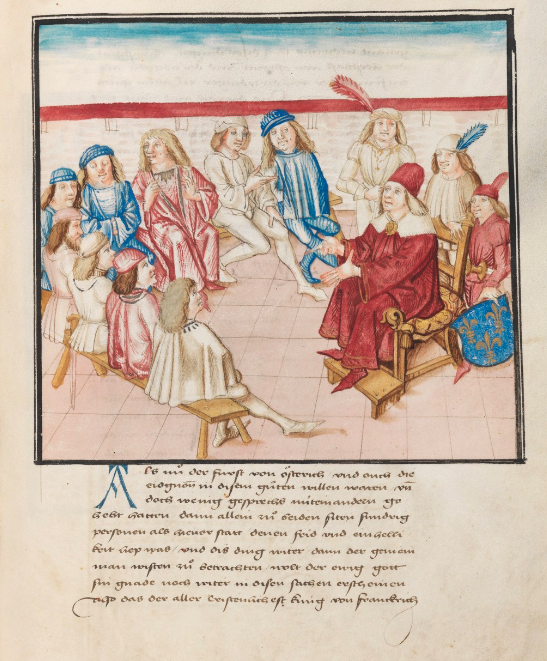
Swiss Diet with French Ambassador, Lucerne, January 1474. Source: https://www.e-codices.unifr.ch/de/bbb/Mss-hh-I0003/213.
Swiss Diet with French Ambassador, Lucerne, January 1474. Source: https://www.e-codices.unifr.ch/de/bbb/Mss-hh-I0003/213.
The Swiss Diet was not an assembly of estates like the Imperial Diet in the Holy Roman Empire or the Estates General in France, as it lacked both the monarch and the social stratification of estates. Sociologically, the deputies were petty nobles, patricians, or aristocrats, but they did not participate in the meetings by virtue of their social or legal status, but as elected deputies of their Orte or cantons, also called republics since the 16th century in Latin or French (Josias Simler, De Republica Helvetiorum, 1576 / La République des Suisses, 1577), but not yet in German. The delegates of the urban cantons were appointed by the patrician or aristocratic oligarchies forming their councils. In the rural cantons, the “true democracies” (vrayes Democraties according to the French lawyer Jean Bodin (Six Livres de la République, p. 280), the general assembly (Landsgemeinde) of all rural citizens older than 16 who were capable of military service, elected either the delegates directly, or a council body, which in turn appointed the deputies. In the confederal system, all deputies had the same rights; each republic was entitled to one vote, regardless of its size and the number of deputies present – usually one or two per canton. Although the Diet was described as a confederal assembly of ‘sovereign' republics, there was no common founding document such as the Union of Utrecht (1579) for the Dutch States General. The historiography of the 19th century therefore spoke of a ‘Congress of Envoys'.
At the very numerous meetings (over 2000 from 1470 to 1798), foreign policy alliances and military treaties were negotiated, internal conflicts among individuals, corporations or cantons were mediated amicably or by arbitration, and pragmatic cooperation was agreed upon, for example in defence, economic and social or health policy. The Diet also reacted to numerous individual or corporate supplications and complaints. Since all cantons considered themselves as ‘free and independent', all decisions required unanimity. The deputies had imperative mandates, i.e. they had to represent their superiors' instructions, not their personal opinions. Negotiations usually took a long time, because most agenda items were batted back and forth several times between the Diet and the governments of each republic in order to find a compromise acceptable to all. Often the solution to a conflict was rather 'not to find a solution'. The Diet itself levied no taxes, had no treasury and no staff of its own. The results of the deliberations were recorded in the Abschiede (recesses) regardless of whether a solution had been found or not. The Swiss Abschiede – unlike the Reichstagsabschiede, the recesses of the Imperial Diet – were neither signed nor sealed. They were rather the secretary's notes on the individual items, resolutions and requests to the deputies and their cantons. For the general sessions held between 1470 and 1798, more than 35,000 agenda items can be traced. This did not, however, reflect the Diet's law-making; only its importance as a forum for discussion. The Diet did not usually make laws but agreed on joint action by its members.
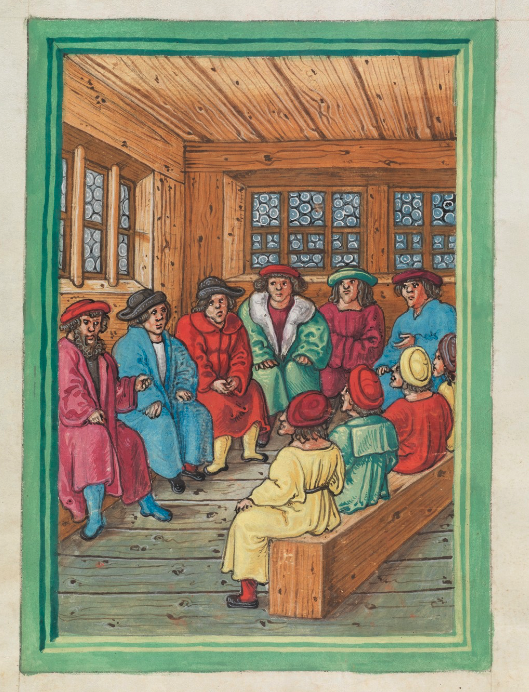
Deputies of the Swiss Diet, Zurich, 1499. Source: https://www.e-codices.unifr.ch/de/kol/S0023-2/392.
Deputies of the Swiss Diet, Zurich, 1499. Source: https://www.e-codices.unifr.ch/de/kol/S0023-2/392.
A small number of the Diet's decisions were recognised and enforced by all republics as fundamental or constitutional laws. Such concordats as the Stans Agreement (Stanser Verkommnis, a war and sedition act in 1481), the Defensionale (military defence in 1647/1668) or the Landfrieden or religious peace treaties (1529, 1531, 1656, 1712) were ratified and had constitutional status, deepening some aspects of the cantons' leagues established between 1291/1315 and 1513.
Another group of signed and sealed treaties concerned the foreign relations of the Confederacy. Although it was formally a member of the Holy Roman Empire until 1648, all confederate cantons together agreed on alliances with Austria 1474/1477/1511, and France 1516/1521, renewed several times, for the last time in 1777. Other treaties were signed by groups of cantons, mostly denominationally defined, such as the Catholic alliances with Savoy (1560), the Holy See (1565) and Spain (1587) or the Reformed alliances of Zurich and Bern with Strasbourg (1588), the Margraviate of Baden (1612), Venice (1615, renewed in 1706) and the Dutch Republic (1712). Such alliances and the details of their implementation were negotiated at the Diet in constant exchange with the residing ambassadors from France (since 1521), from the Holy See (since 1586), from Spain-Milan (since 1594) or extraordinary (temporary) envoys to the Confederacy, e.g. from the Emperor and the Empire, Austria, Savoy, England, the Netherlands, Württemberg, etc. Most illustrations of the Swiss federal Diet also show envoys of foreign powers.
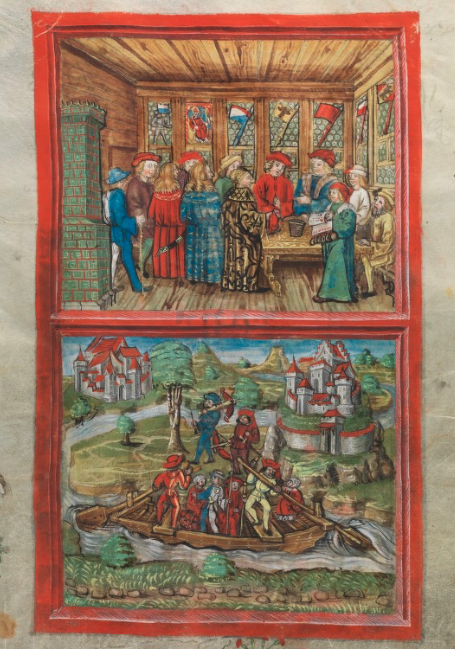
The Swiss Diet negotiating with the ambassadors from Matthias Corvinus, king of Hungary (26 March 1479). Source: https://www.e-codices.unifr.ch/de/kol/S0023-2/245.
The Swiss Diet negotiating with the ambassadors from Matthias Corvinus, king of Hungary (26 March 1479). Source: https://www.e-codices.unifr.ch/de/kol/S0023-2/245.
The Diet was thus not the legislative body of a state, but the central platform of a loose confederation that enabled the member republics to coordinate, communicate and cooperate on their policies. It was here, for example, that the quarrelling confessional camps negotiated their position of non-intervention or 'neutrality' during the Thirty Years' War. Three times this search for a compromise failed and religious war broke out between the republics (1531, 1656, 1712). Peace treaties were negotiated in the same year at the Diet with help from internal and external mediators. Nevertheless, the confessional dispute permanently divided the Confederacy and the Diet. For from 1525 onwards, the Catholic and Protestant cantons met in separate conferences to discuss, from a confessional perspective, the business dealt with in the general Diet, using the same procedures. From 1532 to 1712, there were significantly more confessional conferences (1533 Catholic, 542 Protestant) than general sessions (677). In the 18th century, however, the frequency and importance of confessional conferences decreased.
The ten or so associated towns and principalities of the thirteen republics were involved to varying extents in the Diet's deliberations. While the Abbot of St. Gall and the cities of St. Gall and Biel regularly attended the sessions and, after the Reformation, the corresponding confessional conferences (cf. figures 4, 5 and 6), the republics of Valais, the Three Leagues in the Grisons and Rottweil in Swabia usually stayed away after the Thirty Years' War, while Mulhouse in Alsace was a regular guest during the Reformation and again in the 18th century (cf. figure 4). By contrast, the deputies of other associates such as the city of Geneva, the prince-bishop of Basel or the prince of Neuchâtel, were only received as envoys, and did not have a seat in the assembly. That is why the latter are not displayed in the illustration, whereas the envoys of the associate members are seated in the outer circle on the right-hand side.
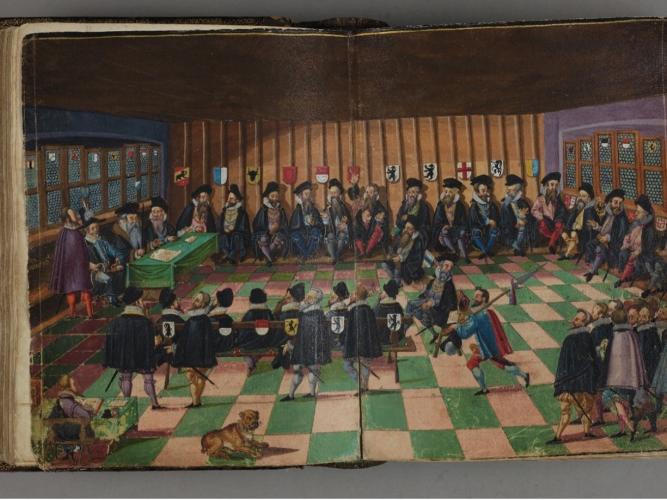
The thirteen cantons of Swiss Diet assembled with the associated members and the French Ambassador at Baden, late 16th century. Source: Andreas Ryff, Circkell der Eidtgnoschaft, manuscript c. 1597, Musée Historique Mulhouse, France, MH MS 1, fol. 173v-174r.
The thirteen cantons of Swiss Diet assembled with the associated members and the French Ambassador at Baden, late 16th century. Source: Andreas Ryff, Circkell der Eidtgnoschaft, manuscript c. 1597, Musée Historique Mulhouse, France, MH MS 1, fol. 173v-174r.
The Diet was also a collective government, if not over the territories of its members, then over jointly conquered mandated territories. The most important of these condominiums (Gemeine Herrschaften) each involved between six and twelve cantons, but never all thirteen. The co-governing republics appointed a bailiff according to a fixed rotation, who had to report annually to the conference of deputies. Here, the deputies of the cantons exercised the rights of sovereignty, passed laws by majority vote, and administered justice (court of appeal). This complex Confederacy – the cantons, associated members and condominiums – comprised less than 1 million inhabitants around 1600.
Despite all the differences in size, composition, function, and lifetime between the representative institutions in Europe, it is possible to identify similarities between the Swiss federal Diet and several other assemblies, especially at the procedural level. The members of the Diet had the right to convene individually and in groups, like the institutions of other confederations such as the Hanseatic League, but in marked contrast to the French Estates General and the English Parliament before 1689. In fact, the Diet met at least annually since 1418/1450 and thus became a regular institution before the Swabian League (1488-1534), the Three Leagues in the Grisons (from 1526) and the Dutch Estates. However, the Diet never took the step of becoming a permanent body, unlike the Dutch States General (1593), the Imperial Diet (promised in 1495, realized in 1663) or the English Parliament (1694).
The members of the Diet were all equal in law. The seating order was based on the ceremonial rank of the cantons (which was based on their importance and date of joining the confederacy), not on the social status of the deputies. Therefore, there was no division into benches or curiae – aristocratic, clerical or bourgeois / third Estate – and no lower or upper house.
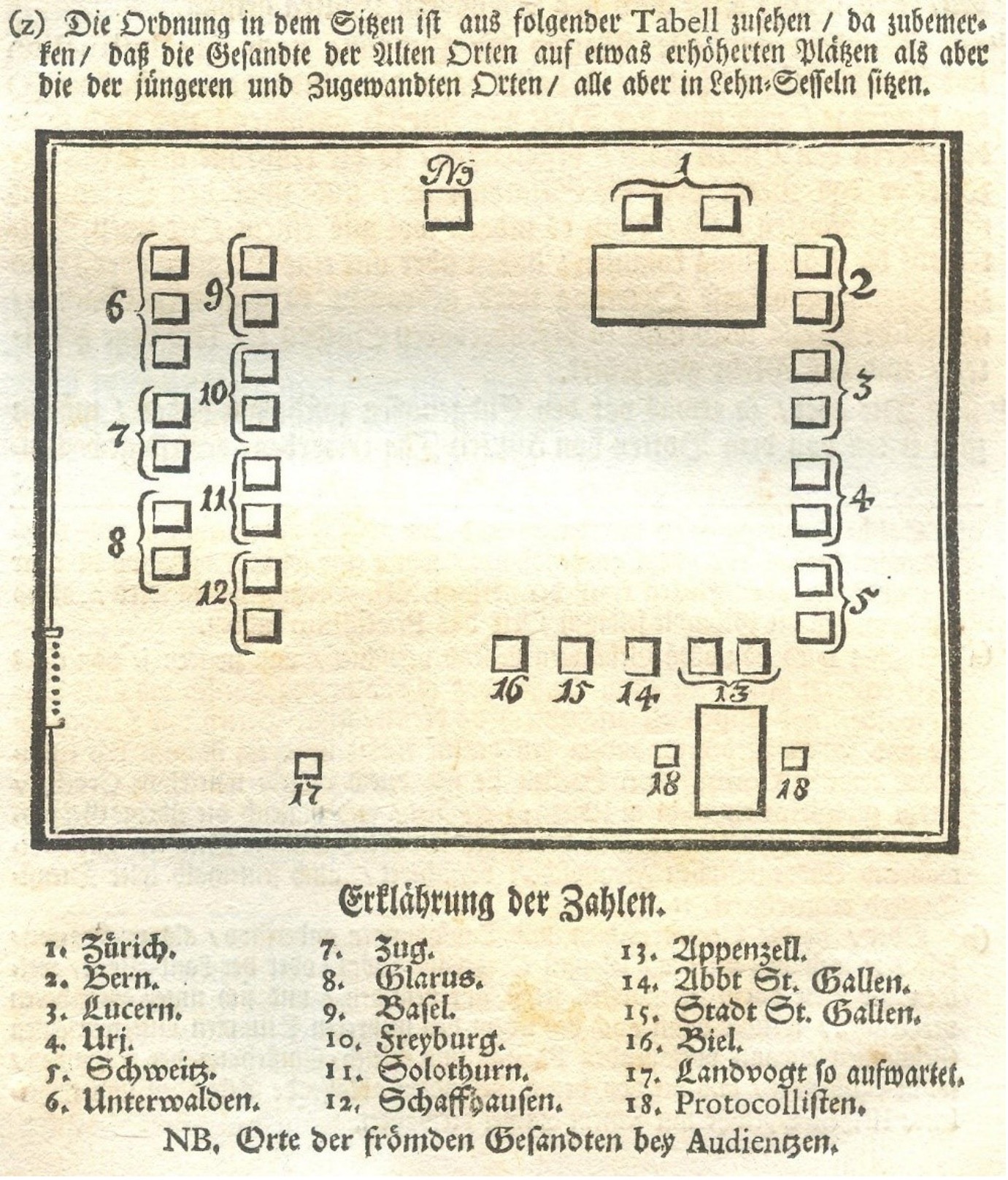
Seating Arrangement at the Swiss Diet at Baden (around 1700). Source: © Andreas Würgler. Josias Simler / Johann Jacob Leu, Von dem Regiment Der loblichen Eydgnoßschaft, Zwey Bücher, new, augmented edition in 2 vols, Zurich: David Gessner Gebrüdern, 1735, vol. 2, p. 435 [detail] [1. ed.. 1722].
Seating Arrangement at the Swiss Diet at Baden (around 1700). Source: © Andreas Würgler. Josias Simler / Johann Jacob Leu, Von dem Regiment Der loblichen Eydgnoßschaft, Zwey Bücher, new, augmented edition in 2 vols, Zurich: David Gessner Gebrüdern, 1735, vol. 2, p. 435 [detail] [1. ed.. 1722].
Like most deputies of many political assemblies of the early modern period, apart from the English Parliament, the deputies to the Diet had an imperative mandate, i.e. they had to strictly follow their superiors' instructions. In practice, however, they had a certain amount of leeway. They acted according to their instructions and brought the decisions of the assembly back to their principals (the cantons) for ratification. Swiss deputies were elected for each session, but this did not prevent a small number of councillors in each generation and canton from being repeatedly elected.
The frequency of the Diet's meetings varied between one and 37 per year from the 15th to the 18th century. The Diet was most active from 1499 to 1531, after which the number of sessions decreased but their average duration increased from 6.5 days in the 15th century to 17 days in the 18th century. This means that the Diet was probably the most active representative institution in Europe in the 16th century.
The rules practised at the assemblies were adapted from the Roman legal procedures common in Europe. They included a religious framework through joint attendance at church services (until the Reformation), an opening ceremony, the inquiry or disclosure of instructions, information and deliberation, the chairman's summing up of a common opinion, and any votes. The latter were often prevented at the session, as it was difficult to achieve unconditional unanimity. In practice, however, the Diet also made compulsory majority decisions (even outside the administration of the condominiums, where the majority decision was the rule). However, decisions of the Diet were only 'valid' once they had been ratified by the council bodies of the individual cantons.
The Diet's chairman organised the sessions. He was the highest elected representative of the canton where the session took place. Up to the Reformation, the Diet assembled mostly in Lucerne, Zurich and Baden. After the confessional division, the general Diet's meetings mostly took place in Baden, the centre of the Gemeine Herrschaft Baden (condominium), under the presidency of the deputy from Zurich, the number one among the cantons. The catholic meetings were chaired by Lucerne's deputy.
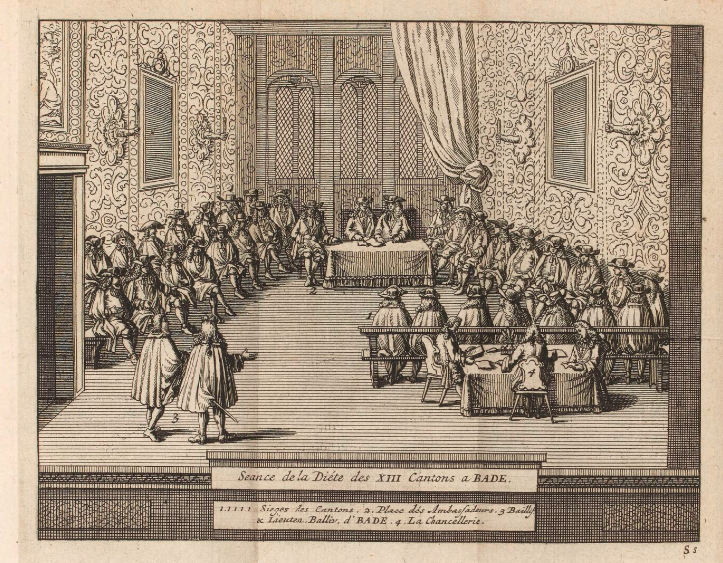
The Swiss Diet and the Ambassador of the King of France Assembled in the Baden Town Hall, late 17th century. Source: https://gallica.bnf.fr/ark:/12148/bpt6k1522140d/f22.item.zoom.
The Swiss Diet and the Ambassador of the King of France Assembled in the Baden Town Hall, late 17th century. Source: https://gallica.bnf.fr/ark:/12148/bpt6k1522140d/f22.item.zoom.
The opening ceremony was the only public part of the Diet's sessions. It started with a confederate welcoming ritual, with the doors open. Until the Reformation, this seems to have been a brief and simple exchange of greetings and good wishes. After the Reformation, the short greetings were more and more extended with lengthy speeches by one of the usually two deputies per canton. The orators customary underlined the goodwill of their superiors and exhorted peace and unity.
The chairman's duty was also to summarize the exchange of instructions and deliberations at the end of each topic. This was not so easy to do, because the answers given by each canton to specific projects or decisions were rarely just ‘yes' or ‘no', but mostly ‘yes, if …', ‘no under certain conditions', ‘perhaps later', ‘we will join the majority' and so on. As the order of speaking usually followed the order of sitting which in turn represented the ceremonial rank of the cantons, the smaller members sometimes preferred to follow the opinion of the greater by saying ‘we join the answer of previous speakers'. From the Reformation, the cantons tended to be split on most issues along confessional lines.
Being elected as an envoy to the Diet was considered a high political honour, limited to the most important members of each canton's council. Although it was hard work – riding one to three days on horseback to the meeting place, staying away from home (and the council's meetings) for up to six weeks, riding back –, the duty of being deputy was highly sought after. And attendance at the Diet was very high: the cantons' deputies attended more than 96% of all general Diets from 1559 to 1798. This means that the cantons considered the confederates' meetings to be most important.
In general, the Diet was the first and most important meeting place of the political elites from the thirteen cantons. Problems that could not be solved by a single canton habitually ended up at the Diet.
If the Swiss Diet – in contrast to many representative institutions like the French Estates General, the English Parliament, or the Dutch States General – did not pass many new laws, its most important function was to organise communication, collaboration, and cooperation between the thirteen members and their allies. It was the central forum to negotiate political solutions for domestic and foreign problems in a very loosely tied confederacy of small republics.
Professor Andreas Würgler,
Université de Genève

Sources:
Amtliche Sammlung der älteren eidgenössischen Abschiede [1245-1798], 8 Bde in 22 Teilen, hg. auf Anordnung der Bundesbehörden von Bundesarchivar Jakob Kaiser u.a., versch. Bearbeiter, versch. Erscheinungsorte 1856-1886. (Summaries of the Diets' recesses on more than 20,000 pages.)
Bodin, Jean, Les six livres de la République, Paris: Iacques du Puys, 1576.
Simler, Josias, Regiment gemeiner loblicher Eydnoschafft, 2 vols., Zurich: Christoph Froschauer, 1576. [Latin Edition: De Republica Helvetiorum libri duo, Zurich: Christophorus Froschauer, 1576 ; French translation: La République des Suisses, 2 vols., Geneva: Antoine Chuppin & François Le Preux, 1577 ; another French translation: Paris: J. du Puys, 1577]; Dutch translation: Republique, dat is, De gemeene regieringhe van Switserland, Leyden, J.C. Dorp, 1600.
Further Reading:
Head, Randolph C., ‘Shared Lordship, Authority, and Administration. The Exercise of Dominion in the ‘Gemeine Herrschaften' of the Swiss Confederation, 1417-1600', in: Central European History 30 (1998) 489-512.
Jucker, Michael, Gesandte, Schreiber, Akten. Politische Kommunikation auf eidgenössischen Tagsatzungen im Spätmittelalter, Zurich: Chronos, 2004.
Würgler, Andreas, ‘The League of the Discordant Members' or How the Old Swiss Confederation Operated and How it Managed to Survive for so Long', in: Holenstein, André / Maissen, Thomas / Prak, Maarten (eds.), The Republican Alternative. The Netherlands and Switzerland Compared, Amsterdam: Amsterdam University Press, 2008, 29-50.
Würgler, Andreas, Die Tagsatzung der Eidgenossen. Politik, Kommunikation und Symbolik einer repräsentativen Institution im europäischen Kontext, 1470-1798, Epfendorf/Neckar: bibliotheca academica Verlag, 2013.
Würgler, Andreas, ‘Tagsatzung', in: Historisches Lexikon der Schweiz (HLS), Version vom 25.09.2014. Online: https://hls-dhs-dss.ch/de/articles/010076/2014-09-25/, konsultiert am 01.08.2022. [available in French and Italian as well].