
The Swedish Riksdag
The Swedish national diet, the Riksdag (literally: day of the realm) grew out of a political necessity. As the young usurper Gustav I (r. 1523–1560) strove to gain legitimacy for his regime, he summoned the privileged groups of the realm in June 1523 to sanction his right to the throne. The assembly included noble magnates and church dignitaries, and possibly some representatives from the towns and the peasant communes. This was in full accordance with Swedish law, which stated that the monarch should be elected by the leading magnates supplemented by representatives of the common men. The meeting in the small cathedral town of Strängnäs marked the establishment of a national monarchy in Sweden, denouncing the claim of Danish monarchs to rule the country as an integral part of the Scandinavian union of crowns. Thus, the Riksdag began as an extraordinary event, staged to express political unity after years of factionalism and civil strife.
There had been precedents, of course. During the fifteenth century, power contenders had frequently called on temporary provincial assemblies consisting of noblemen, burghers and even peasants, to boost their own claim to power. However, there was no national assembly of the estates during medieval times. The Riksdag was an innovation of the early sixteenth century, eventually turning into a political institution that would define the Swedish realm for centuries to come.
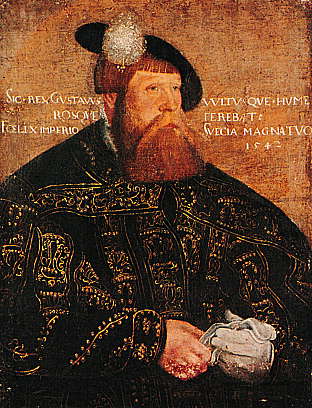
Gustav I Vasa of Sweden, by Jacob Binck 1542 (copy).
Gustav I Vasa of Sweden, by Jacob Binck 1542 (copy).
Little is known of the Strängnäs meeting in 1523, apart from the claim by the participants to represent the realm and its subjects. Nevertheless, the harsh reality of the times would soon lead to more established forms for a national assembly. The defining moment was the meeting in Västerås in 1527, when noblemen, burghers, peasants and some reluctant clerics gathered to confirm King Gustav's right to confiscate the properties of the bishops to avert financial crisis. The Riksdag did not convene again until 1544, when the estates were called upon to recognise the Vasa dynasty's right to rule Sweden as a hereditary kingdom. This constitutional settlement was followed up in 1560, when the Riksdag in Stockholm agreed to Gustav I's plan to make his younger sons hereditary princes with their own duchies to rule.
The Riksdag was thus introduced as a temporary measure for the king to exploit when constitutional matters needed to be settled. The meeting of Västerås in 1544 not only confirmed the status of kingship in Sweden, but also the significance of the estates. Gustav I would henceforth rule as a hereditary king, and then pass on the throne to his eldest son. But in case of dynastic failure, it was the Swedish estates together with the council of the realm who would elect a new king. Henceforth, no changes in the law of succession could be made without the consent of the Riksdag. This marked a decisive break with the medieval tradition where the aristocratic council, not the estates, represented the people of the realm.
Despite long intervals between them, the first meetings of the Riksdag set the tone for what was to follow. The meetings would be attended by noblemen, clerics, burghers and peasants. The first three estates were defined by privilege, while the peasants' participation was motivated by their obligation to pay taxes to the king from the land they farmed. All noble heads of families had the right to represent themselves, but the towns and the peasant communes elected their representatives at local court meetings. The clerics were normally appointed by the bishop in each diocese, and included parish priests as well as chapter members.
The decision to summon the estates was in the hands of the ruling monarch, who decided what matters to discuss. Early attempts by aristocratic opponents to call on the estates were thwarted, and the estates themselves did not assert themselves as an independent political assembly until the eighteenth century. Nevertheless, the Riksdag offered the members of the estates a political voice. The estates would vote as corporate bodies with one vote each, and any disagreement would then be settled by the monarch. In this way, the three commoner estates could never outvote the nobility.
The Riksdag became the institution that nobody wanted, but no one could do without. The Vasa monarchs were threatened by external wars and dynastic infighting, so the rulers depended on the estates to provide the resources needed to sustain the monarchy. Neither the aristocracy nor the towns could muster enough economic strength on their own. The freeholding peasants controlled a major share of the country's landed wealth, so the peasant estate had to be part of the political proceedings. From the late sixteenth century, the estates were summoned more often, and the representatives of the commons gradually learned the rules of the game. Eventually, the nobility, the clerics and the burghers all established their own meeting places in Stockholm. The noblemen met at their own palace (Sw: Riddarhuset), the burghers in the town hall while the clerics held their meetings at the Stockholm cathedral (Sw: Storkyrkan). The peasant estate had to make do with temporary lodgings in the old city centre, but nevertheless managed to maintain their position as a separate estate holding their own discussions.
Compared to other European parliaments of the period, the Riksdag seems remarkable in at least two repects. First, it was an assembly consisting of four estates, with the peasantry as well as the clerics sending their own representatives and negotiating separately. The Riksdag thus had a broader social base than many other parliaments and estate assemblies. Second, in spite of the division into four privileged groups, the separate estates had strong connections to local communities.
Both burghers and peasants were locally organized and could mobilise significant support for their representatives in the Riksdag. The peasants first met at local district courts where they formulated grievances for the whole community and elected their representative, who would then travel to Stockholm and present the community's grievances to the king. At the end of the meeting, the king (or the deputy head of government) would announce the resolution to each grievance in due order.
The proceedings of the Riksdag produced an increasing number of written documents. From the earliest meetings, mainly the king's proposal and the final decision have been preserved. The sources kept in the national archives also contain the official documents of the aristocratic council which responded to the king's proposals on behalf of the nobility. From the latter half of the sixteenth century, we have the collective grievances from each of the estates as well as a considerable number of local grievances from towns and rural districts. However, regular minutes from the individual discussions of the estates (Sw: ståndsprotokoll) are preserved only from the 1620s (the nobility) and the mid-seventeenth century (the burghers and the clerics). The notes of the peasant estate exist from 1720 onwards. It was only during this later period known as the Age of Liberty that the Riksdag meetings became fully regular events. Since the sixteenth century, all decisions had been published in print, but in the 1700s this official series was supplemented by a large variety of pamphlets and individual relations of the proceedings.
The Riksdag thus evolved into an arena for local as well as national politics, and this capacity made the national assembly relevant also for the commoner estates. However, it was not until the 1630s that the commoners managed to form an alliance in the Riksdag to oppose their principal political opponent: the aristocracy. It was no coincidence that this was achieved during the regency of Queen Christina (r. 1644–1654). The Vasa kings had mastered the strategy of rallying the commoner estates in support of royal policies. When there was no ruling monarch at the helm, burghers, peasants and priests had room to manoeuver against the government. The pattern would repeat itself in the 1660s and even more so during the Age of Liberty. With royal authority effectively circumscribed after 1720, the Riksdag became the true centre of power and the stage for fierce political conflict between the nobility and the commoners.
In spite of its central importance to Swedish politics, the constitutional position of the Riksdag remained ill-defined for most of the period. There were no formal rules regulating the proceedings, and the length and timing of the meetings often varied. Each estate was supposed to convene separately to discuss the proposition from the king and to formulate a written reply. However, the estates exchanged information during the process and informal delegations were often used to influence the discussions. Accordingly, the meetings of the Riksdag tended to become increasingly long-term affairs.
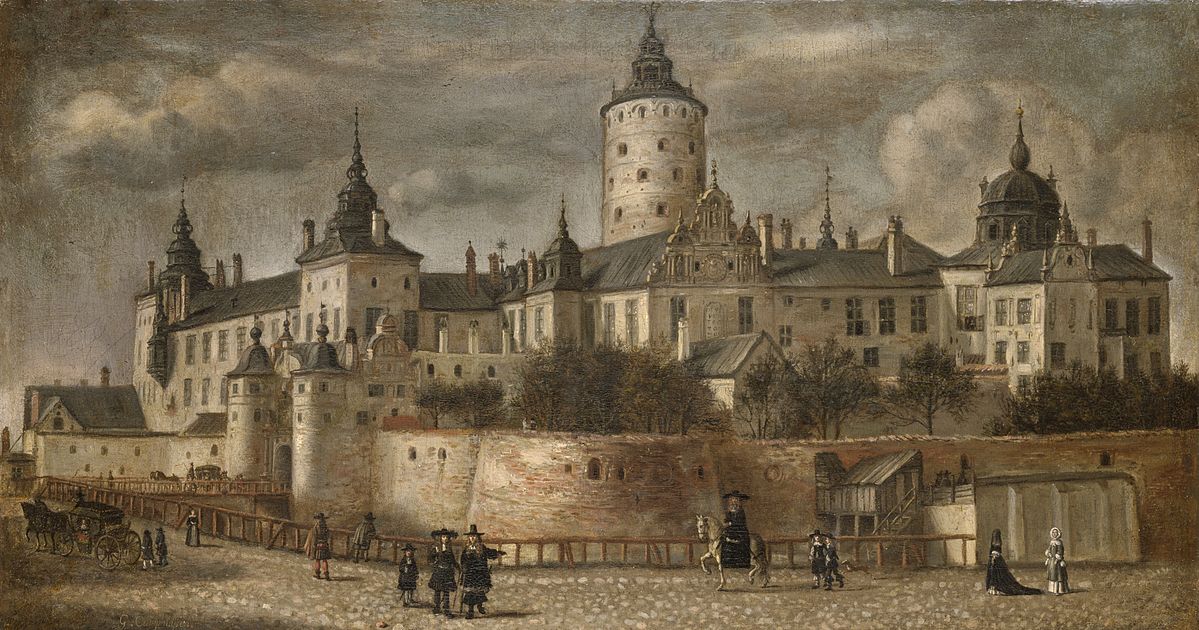
The old royal castle of Stockholm, where the estates usually gathered in plenum. Painting by Govert Camphuysen, 1661.
The old royal castle of Stockholm, where the estates usually gathered in plenum. Painting by Govert Camphuysen, 1661.
In 1617, chancellor Axel Oxenstierna drafted an ordinance to bring some order to this unruly process. As well as demanding sobriety and stipulating a clear hierarchy between the representatives, the ordinance placed the initiative of the proceedings firmly in the hands of the king. He would set the agenda by first presenting his proposal the representatives, who would then convene individually to formulate their collective responses. Finally, the whole assembly would meet up in the grand hall of the royal castle, where each estate must explain their position in plenum. This was a clear disadvantage for the commoners, who were less trained in political matters and feared that they might be pressured by the elites into making unfavourable concessions. The commoner estates duly protested, and it seems that the ordinance was never implemented in full. The estates insisted on their right to draft separate written statements, and in plenary sessions the cause of the commoners was often eloquently addressed by the bishops. The King on the other hand, would use informal meetings to pressure his opponents and to achieve the desired results.
The ordinance of 1617 was never officially recognised. The key agents wanted to maximise their room for manoeuvre, and therefore distrusted formalised procedure. This freedom of action would be fully exploited by ruling monarchs, to the point that summoning the estates might appear redundant. Gustav II Adolf (r. 1611–1632), convened smaller meetings with some of the privileged estates, excluding the peasants altogether. These gatherings were often held in the provinces. The fact that the commoners needed support from the king to counter the ambitions of local lords placed them in a vulnerable position. In the longer run however, monarchs as well as aristocrats needed the support of the full Riksdag to render their politics legitimate. Eventually, Charles XI (r. 1672–1697) would impose absolute rule with the full support of the commoner estates. This process repeated itself a century later, when Gustav III (r. 1772–1792) summoned a Riksdag to approve his claim to rule as an enlightened despot. On these occasions, the estates contributed to their own (temporary) suppression.
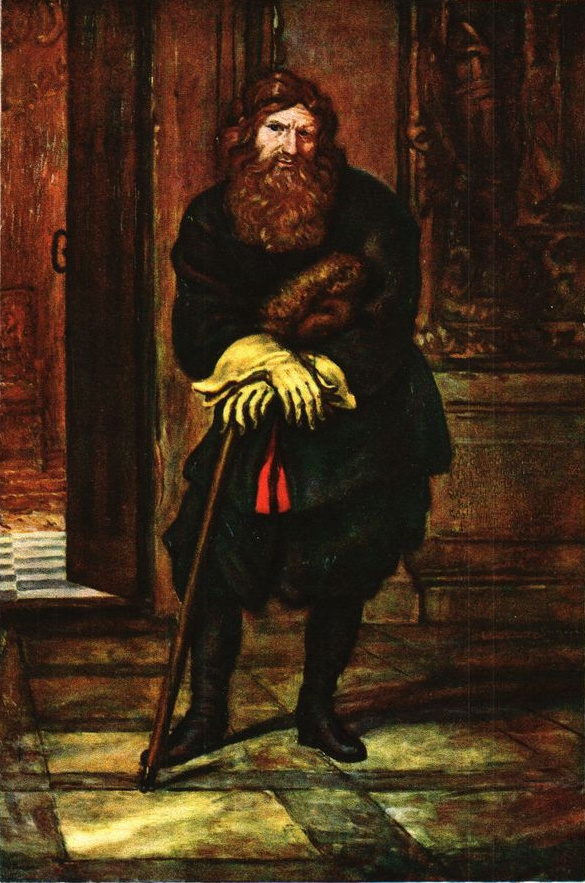
Per Olsson of Gladhammar, spokesman for the peasant estate at the Riksdag of 1686. Painting by David Klöcker Ehrenstrahl.
Per Olsson of Gladhammar, spokesman for the peasant estate at the Riksdag of 1686. Painting by David Klöcker Ehrenstrahl.
In Swedish historiography the early modern Riksdag has sometimes been described as a proto-democratic forum, paving the way for a broader political participation. In some circles, the active involvement of the peasant estate in national politics has been a source of national pride. On the other hand, the Riksdag has also been characterised as an instrument of royal power and vested class interest. The meeting was primarily the king's arena and the peasant representatives were excluded from all discussions regarding national security. Accordingly, the estates never managed effectively to counter royal absolutism. What the Riksdag did provide, however, was a national arena for the restoration of political dialogue and constitutional rule after periods of royal despotism. This was in itself a considerable achievement, one that would serve the country well in the centuries to come.
Mats Hallenberg,
Professor of History,
Stockholm University
mats.hallenberg@historia.su.se
Further Reading:
Almbjär, Martin, The voice of the people?: supplications submitted to the Swedish Diet in the Age of Liberty, 1719–1772, Umeå universitet, Umeå, 2016.
http://urn.kb.se/resolve?urn=urn:nbn:se:umu:diva-124423
Glete, Jan, War and the state in early modern Europe: Spain, the Dutch Republic and Sweden as fiscal-military states, 1500–1600, Routledge, London, 2002.
Gustafsson, Harald, Political interaction in the old regime: central power and local society in the eighteenth-century Nordic states, Studentlitteratur, Lund, 1994.
Hallenberg, Mats, ”For the Wealth of the Realm: the transformation of the public sphere in Swedish politics, c. 1434–1650”, Scandinavian Journal of History, 37:5 (2012).
Holm, Johan, Konstruktionen av en stormakt: kungamakt, skattebönder och statsbildning 1595 till 1640, Acta Universitatis Stockholmiensis, Stockholms universitet, Stockholm, 2007.
Ihalainen, Pasi (red.), Scandinavia in the age of revolution: Nordic political cultures, 1740–1820, Ashgate, Farnham, 2011.
Ihse, Cecilia, Präst, stånd och stat: kung och kyrka i förhandling 1642–1686, Acta Universitatis Stockholmiensis, Stockholms universitet, Stockholm, 2005.
Lindegren, Jan. ”The Swedish “military state”, 1560–1720”. Scandinavian Journal of History, 10 (1985).
Metcalf, Michael F. & Schück, Herman (red.), The Riksdag: a history of the Swedish Parliament, St. Martin's Press, New York, 1987.
Scherp, Joakim, De ofrälse och makten en institutionell studie av riksdagen och de ofrälse ståndens politik i maktdelningsfrågor 1660–1682, Acta Universitatis Stockholmiensis, Stockholms universitet, Stockholm, 2013.
http://urn.kb.se/resolve?urn=urn:nbn:se:su:diva-84027
Scherp, Joakim, “The peasant estate of Sweden: its rise and early modern evolution”, in Szijártó, Blockmans and Konter (eds), Parliamentarism in Northern and East-Central Europe in the Long Eighteenth Century: Volume I: Representative Institutions and Political Motivation, Routledge, London, 2022.
Scherp, Joakim, “The Estates in the middle: populist absolutism and constitutionalism in early modern Swedish politics”, in Szijártó, Blockmans and Konter (eds), Parliamentarism in Northern and East-Central Europe, 2022.
Sennefelt, Karin, Politikens hjärta: medborgarskap, manlighet och plats i frihetstidens Stockholm, Stockholmia, Stockholm, 2011.
Villstrand, Nils Erik, “Stormaktstidens politiska kultur”, i Christensson Jakob (ed.), Stormaktstiden. Signums svenska kulturhistoria, Signum, Lund, 2005.