
The Senate of Milan (1499-1786)
There was no active representative assembly in the duchy of Milan. Unlike other early modern Italian states like Venice or Florence, Milan’s government had no regular institution to allow spokespeople to congregate, deliberate, or legislate.
This particularity is explained by Milan’s history: a late medieval commune transformed into an imperially-sanctioned ducal state in 1395, Milan (and the surrounding region of Lombardy) was ruled during the fifteenth century by officious princely families – the Visconti and Sforza – who preserved their own power by restricting the size of consultative councils. In the fourteenth century, a Council of Nine Hundred had existed (consisting of 150 representatives from the capital city’s six gates), but in 1396 Duke Giangaleazzo Visconti excluded commoners from it, and in 1408, his successor reduced its membership to seventy-two. Thereafter it essentially ceased to congregate.
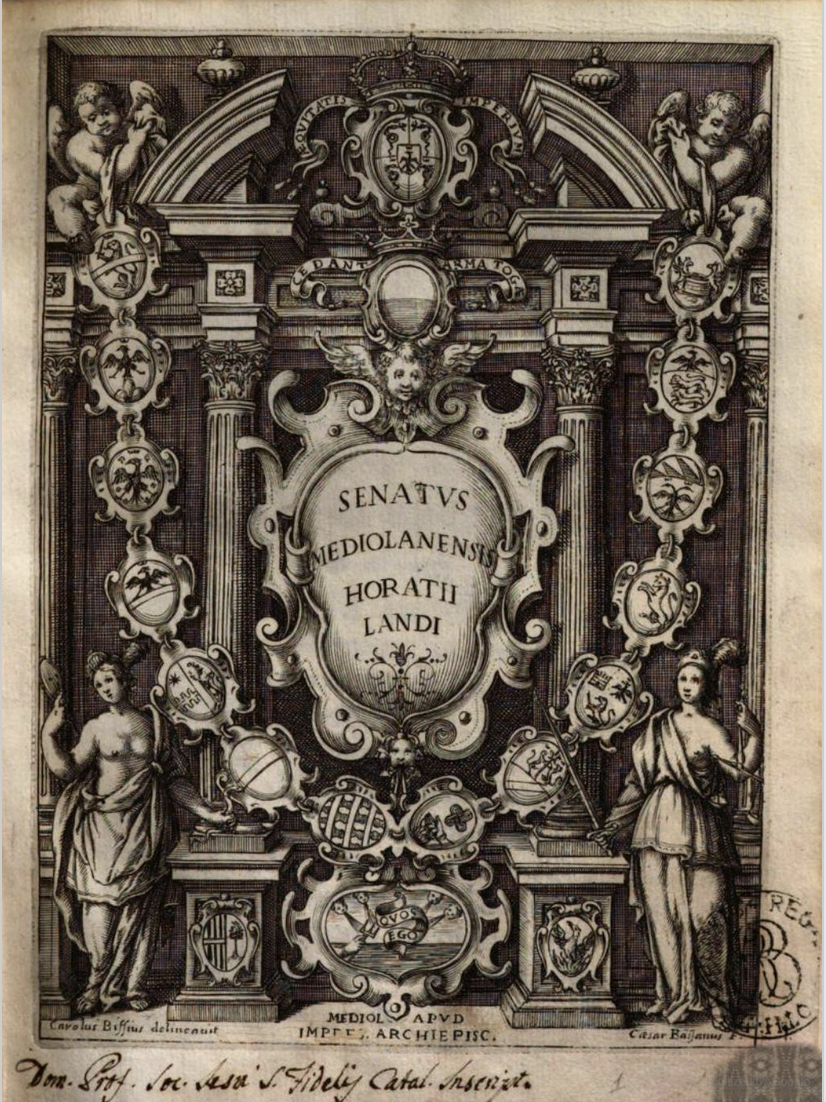
Frontispiece of Orazio Landi’s 1637 book, Senatus Mediolanensis. Biblioteca di Cremona, Public Domain
In the ducal period (1395-1499), a trio of elite assemblies advised Milan’s ruler (namely the Council of State, the Secret Council, and the Judicial Council, rarely staffed with more than twenty members each), but they existed as extensions of the ducal court and gathered at the prince’s discretion. Other magistracies in the capital and in the duchy’s cities governed law, war, finance, and health, yet their prescribed functions prevented them from deliberating together as might be done in other states. The commonest way for communities to address Milan’s sovereign was in person through elected delegations. Petitioners – usually a town or region – voted for a group of their best-qualified representatives to travel to court and appear before the duke as a corporation, resisting the ruler’s frequent attempts to single out only one of their number as a negotiator. In this way, they sought to preserve the power of the collective and evade individual pressure the dukes were so expert at applying.
Urban parishes also met to elect representatives for ad hoc consultative councils. This mechanism worked, for instance, during the single episode in the fifteenth century when a governing council ruled Milan: the three years of the Golden Ambrosian Republic (1447-50), between the collapse of the Visconti principate and the capture of the state by the Sforza. A republican government led by elites, its rulers were the Captains and Defenders of Liberty: an executive of twenty-four, later twelve, men. The Captains oversaw a revived Council of Nine Hundred, whose delegates were elected by parish vote. These bodies ceased to exist once the Sforza set up their regime in 1450.
Less commonly, parishes forwarded representatives to other ad hoc assemblies formed in moments of crisis, often when citizens needed to remonstrate against rulers. This was especially the case during the Italian Wars, when governance of Milan was a pawn in European disputes (1499-1535). In such times, these self-forming councils, usually convened in churches, only existed long enough to accomplish a specific task, or to replace an absent ruler, or to resist a meddlesome one. They disbanded once a solution had been reached. Once the wars abated after 1535, the nature of political power shifted fundamentally in the duchy: from that year forward, there were no more dukes, but rather governors representing Spain or (from 1714) Austria.
This background helps us understand the institutional role of Milan’s senate, a body designed by conquerors. The senate was founded by French King Louis XII (r. 1498-1515) upon capturing the duchy with his sizable invasion force. Louis sent Duke Ludovico Sforza (nominal ruler from 1480; duke from 1495-99) fleeing for aid to the imperial court at Innsbruck. The Edict of Vigevano, dated 11 November 1499, outlined the senate’s features as imagined by King Louis. The edict described it as an amalgamation of two of the pre-existing ducal chambers (the Secret and Judicial Councils) with a membership composed of seventeen appointed senators: two prelates, four soldiers, and eleven learned men – of those inaugural eleven in 1499, five were French and six were Italian. But numbers were evidently elastic over time; in 1520 there were at least twenty-six senators; in 1533 thirty of them; in 1587 only twelve. The senators’ professional competencies no doubt fluctuated as well. Observers called some Italian-born senators ‘foreigners’ (‘forestieri’, i.e., not from the city of Milan), and those members may have at times brought perspectives from regional cities such as Parma, Pavia, Tortona, and Novara. But historian Ugo Petronio has shown, at least over the long seventeenth century, that these forestieri rarely amounted to ten percent of senators, while the majority were Milanese-born. The senate was thus predominantly a body staffed by cosmopolitan patricians.
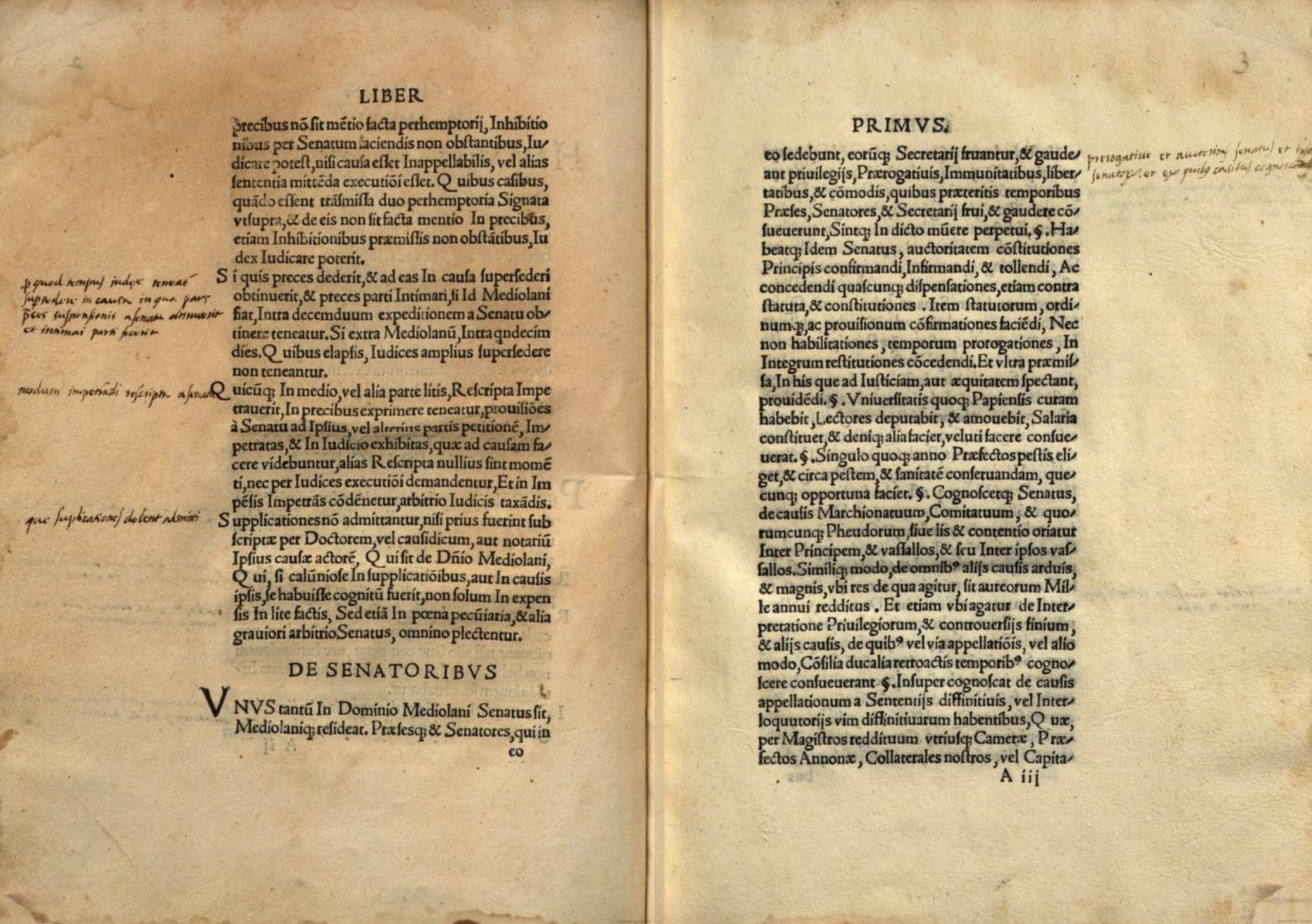
Chapter on Senators in the Constitutiones Dominii Mediolanensis of 1541, sig. A ii v to A iii r. Biblioteca di Cremona, Public Domain
The senate’s purpose was the civil administration of the duchy under the leadership of a president appointed by the ruler. One sixteenth-century report tells us the senate assembled three times a week in the mornings at the Corte di Arengo, on the site of what is now called the Palazzo Reale, near the cathedral. (The building in Milan today called Palazzo del Senato – originally a Borromeo-era seminary for Swiss students and currently the State Archive – was so named for housing the senate of the Kingdom of Italy in the Napoleonic age, a different body from the one under discussion here.) The president of Milan’s senate was also the chancellor of the state – a Frenchman from 1499-1522, but thereafter always Italian, even under Spanish and Austrian rule – and his local authority was surpassed only by the duchy’s governor. Like a French parlement, Milan’s senate acted as a legislative council, a criminal tribunal, and the duchy’s highest appellate court, albeit with a much smaller membership. In this sense, we might perhaps compare the senate to Venice’s Council of Ten (Consiglio dei Dieci) insofar as both councils were a relatively small executive body with wide latitude over government actions. Venice, however, rotated members of the Ten annually by election, whereas Milan’s senators were appointed for life.
One further role that mirrored the French parlements was the senate’s right of interinazione (ratification): the reigning monarch’s decrees had to be registered and accepted by the senate for them to activate as law. Ratification was usually a routine process, but the senate could also reject or (more commonly) delay the registration of royal orders. France’s regional parlements knew how to deploy this heel-dragging strategy to remonstrate against undesirable decrees, and sometimes we hear complaints of sluggish interinazione from watchers of Milan’s senate as well. That tactic made the senate a potential node of local resistance to the distant demands of a foreign monarch – or of the local governor who represented him (although it is worth noting that Emperor Charles V affirmed the senate’s effective pre-eminence over the governor in the 1540s).
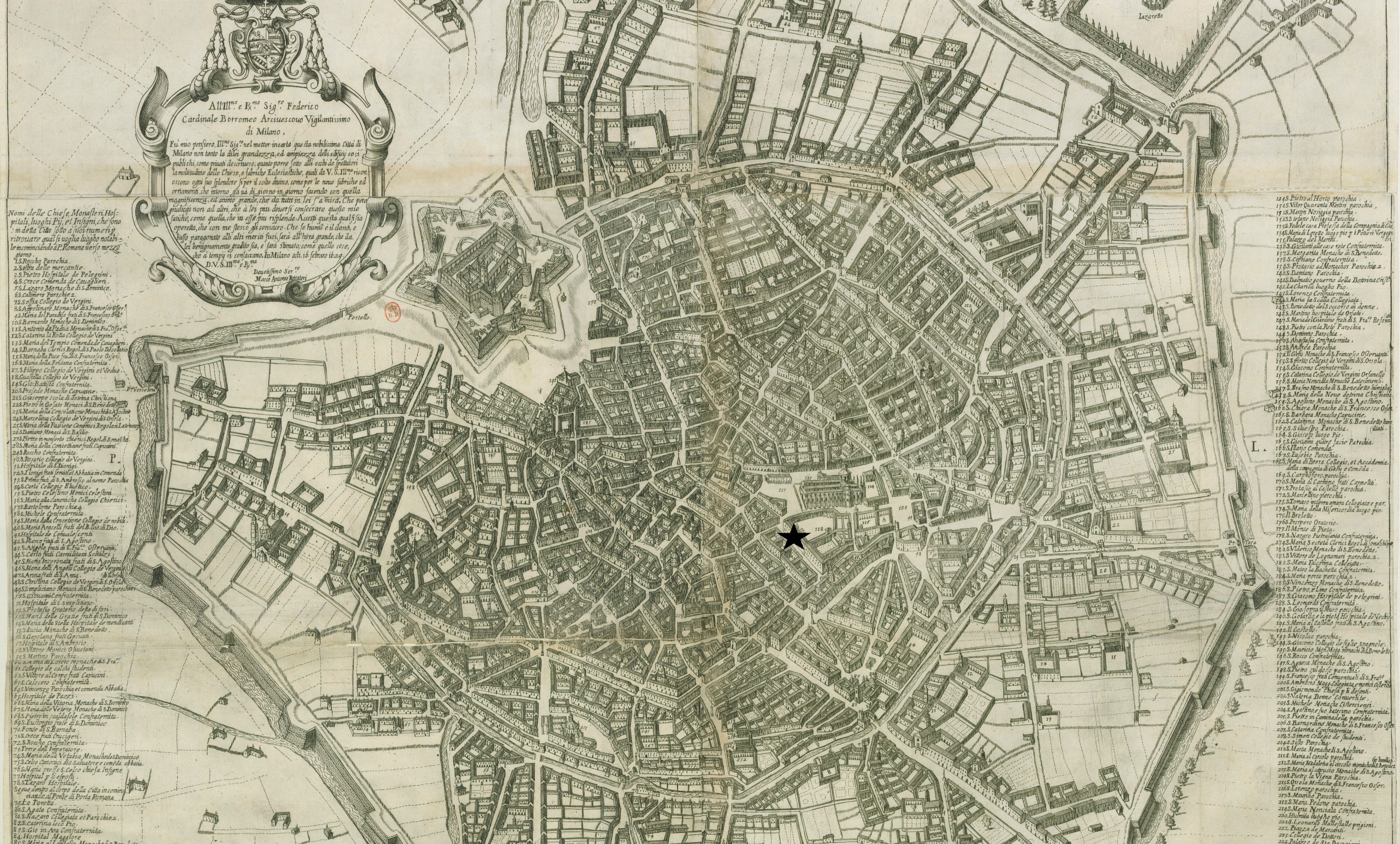
Detail of Marco Antonio Barateri’s 1638 map, La gran città di Milano. Location of senate palace indicated with a star. Courtesy of Europeana.
The extent of the senate’s power came to be disputed in the sixteenth and seventeenth centuries. In 1533, the Venetian ambassador Basadonna reported that Duke Francesco II Sforza (son of Ludovico, r. intermittently 1522-35 during a brief Sforza restoration), the last nominally independent prince of the duchy, “does not keep absolute power to himself, or rather he does not want it, but has handed it over entirely to the Senate.” Here the diplomat was referring to the plenitude of power (plenitudo potestatis) that Milan’s dukes had claimed as the font of their regnal authority since 1395. Francesco II, a weak duke nonetheless invested in fostering justice in his domain, relinquished plenitude of power to the institution nominally charged with upholding the rule of law. When Francesco II died in 1535, Emperor Charles V immediately annexed the state as a satellite province of Spain. Spanish authorities undertook a refreshment of Milan’s legal code, and we find there an echo of Francesco II’s apparent relinquishment of princely power. Published in 1541 as the Constitutiones dominii Mediolanensis (Decrees of the Dominion of Milan), the corpus contained a much-quoted subsection titled “de senatoribus” that seemed to afford the equivalent of princely authority to the senate, even giving it latitude to act against statute and existing decree.
Jurists disagreed about whether this clause bequeathed to the senate the fullness of absolute authority the dukes had exercised until 1535. The disagreement evidently seeped into the senate itself: historian Jane Black points out one moment in the 1580s when the senators invoked their own plenitude of power but were overruled by the president, who did not believe the senate legally wielded such authority. Such questions were complicated by the fact that Milan’s senators were not always lawyers; they were adjudicators of aequitas non scripta (unwritten equity), in other words, arbiters of the spirit of justice rather than magistrates bound by the letter of law. This supposed latitude to rule without recourse to statute evidently produced a certain unpredictability in the senate’s rulings. It sometimes even brought recriminations from the sovereign. In 1581, King Philip II of Spain (r. 1556-98) – Milan’s titular ruler – complained to the senators “that you so often deploy your will in both civil and criminal sentences, and you so often rule without consulting laws, statutes, or state decrees that it is said that no case […] can be assured to stand if presented before your tribunal.” Philip ordered the senate to cleave closer to aequitas scripta (i.e., written statute) in the future. Although few tribunals can be said to be judicially predictable, the senate struggled with this reputation for volatility, caprice, and secrecy. In an effort to uphold its authority, the senate never justified its decisions or offered explanations for its legal reasoning.
Severe documentary losses mean that we can only partially reconstruct the senate’s history. In 1570, King Philip II ordered the papers of Milan’s senate to be stored in a purpose-built archive. The records underwent several reorganizations between the eighteenth and twentieth centuries; archivists composed a functional modern inventory by 1911. But the Allied bombing of Milan in August 1943 devastated the senate’s holdings, incinerating 10,502 boxes and 271 registers from the sixteenth to the eighteenth centuries. Much of the institution’s history since World War Two has been written from the outside in, using jurists’ writings, international correspondence, and surviving materials from imperial archives (notably Simancas, Madrid, and Vienna). Private family archives in Lombardy also retain some of the petitions (preces) subjects sent for adjudication and the senate’s instructions (rescripta) to lower judges advising how to decide those cases.
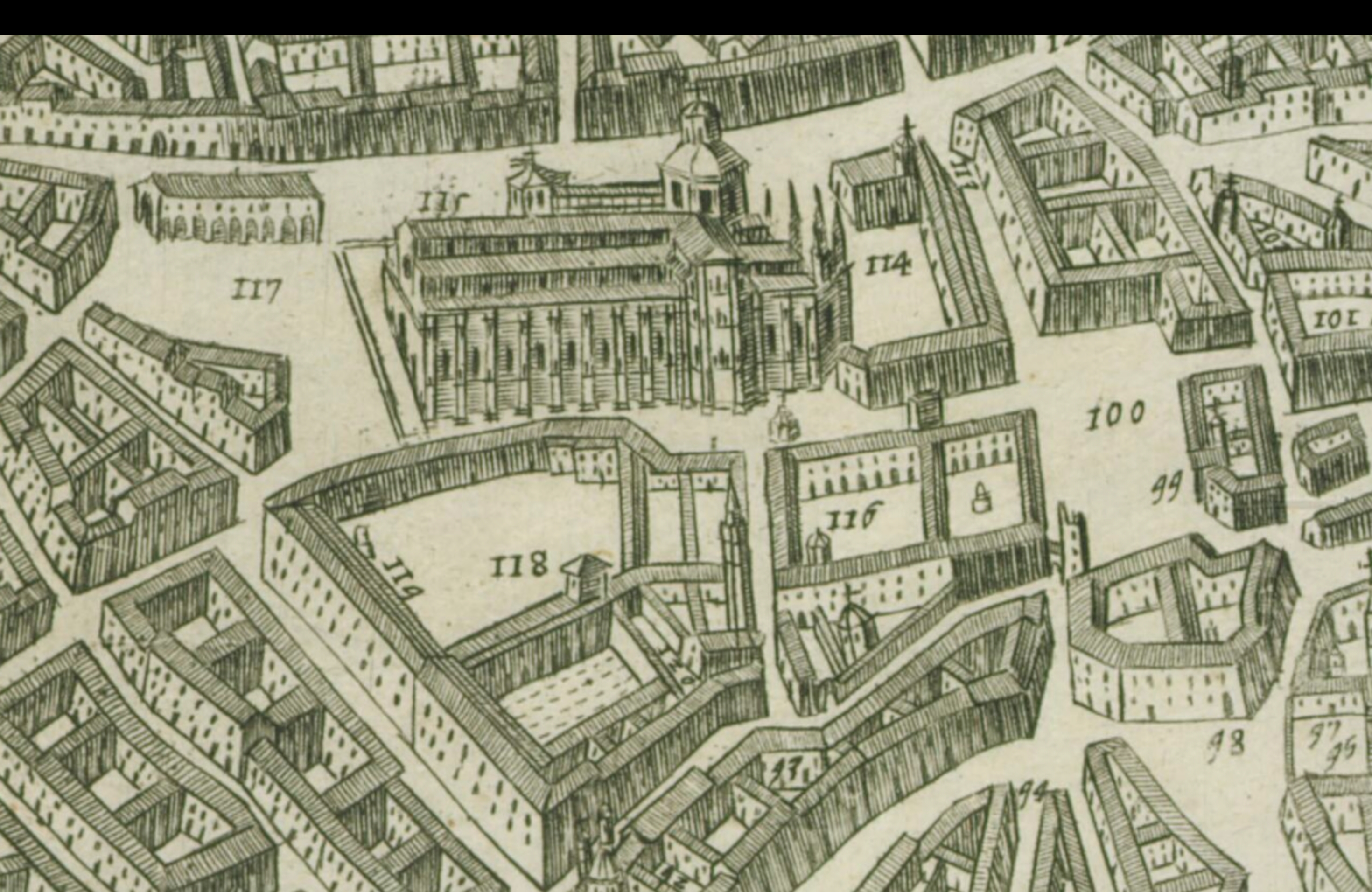
Close detail of Marco Antonio Barateri’s 1638 map, La gran città di Milano, with location of senate palace indicated at number 119, adjacent to Milan’s cathedral in the Corte di Arengo. Courtesy of Europeana.
Nonetheless, enough material survives for us to outline some of the senate’s most important features in relation to coeval European assemblies. For its entire existence, it was a transnational entity in dialogue with external rulers and their Milanese policy. In that regard, the senate has been called a “tool of foreign domination” even though it was predominantly staffed for centuries by local elites. Since senators were appointed as eminences rather than elected as representatives, they had no specific mandate to advocate for the interests of the duchy’s inhabitants, and indeed often succumbed to corruption and venality. As such, Milan’s senate cannot be counted among the forerunners of democratic systems like some of the other European assemblies outlined in the “Parliamentary Cultures” survey. Unlike many of those bodies whose histories nourished a growth of representative government, Milan’s senate instead concentrated power in an opaque patrician institution with wide discretionary powers.
This impression was shared by Austrian Emperor Joseph II (r. 1765-90) who found Lombardy’s legal system a maze of “confusion, slowness, uncertainty, and possible partiality.” In a decree of 11 February 1786, Joseph abolished the senate, ending what the progressive philosopher Pietro Verri (1728-97) called Milan’s “dispotismo togato” (senatorial despotism). A body originally conceived to fold the duchy of Milan into the regional architecture of the French Renaissance state instead settled into a long period of reactionary rule under Spanish domination; it took the bracing reformism of the Austrian Enlightenment to recognize the obstacle to governance it had become.
John Gagné, Lecturer in History at the University of Sydney
Select Bibliography:
Primary
Basadonna, Giovanni. “Relazione del ducato di Milano,” in Eugenio Albèri, ed., Le relazioni degli ambasciatori veneti al Senato durante il secolo XVI, vol. 11: 331-47. Cambridge: Cambridge University Press, 2012.
Grassi, Francesco, ed. Constitutiones Dominii Mediolanensis. Milan: Per Vincentium Medam Calusci Impensa, 1541.
Landi, Orazio. Senatus Mediolanensis. Milan: Apud Heredem q. Pacifici Pontij, 1637.
Secondary
Black, Jane. Absolutism in Renaissance Milan: Plenitude of Power under the Visconti and the Sforza, 1329-1535. Oxford: Oxford University Press, 2009.
Della Misericordia, Massimo. “‘Como se tuta questa universitade parlasse.’ La rappresentanza politica delle comunità nello stato di Milano (XV secolo),” in François Faronda, ed., Avant le contrat social. Le contrat politique dans l’Occident medieval (XIIIe-XVe siècle), 117-70. Paris: Publications de la Sorbonne, 2011.
Monti, Annamaria. “Under the Legal Authority of the Senate of Milan (Sixteenth to Seventeenth Centuries),” in Guido Rossi, ed., Authorities in Early Modern Law Courts, 137-49. Edinburgh: University of Edinburgh Press, 2021.
Petronio, Ugo. Il senato di Milano. Istituzioni giuridiche ed esercizio del potere nel ducato di Milano da Carlo V a Giuseppe II. Milan: Giuffrè, 1972.
Storti Storchi, Claudia. “‘Acciò che le cause passino più consultamente e con minor rechiamo’. Nodi della giustizia nei primi anni del dominio di Luigi XII sul Ducato di Milano,” in Letizia Arcangeli, ed., Milano e Luigi XII. Ricerche sul primo dominio Francesco in Lombardia (1499-1512), 147-65. Milan: Franco Angeli, 2002.
Visconti, Alessandro. “Note sul diritto di interinazione nel Senato Milanese (con documenti inediti),” Archivio storico lombardo, ser. 4, vol. 11, fasc. 21 (1909): 59-96.