
The Polish–Lithuanian Sejm
The Polish-Lithuanian Sejm was established in 1569 at the Union of Lublin, which created the first parliamentary union in European history. Lithuania had its own Sejm before 1569, but the union Sejm in terms of structure and procedure was essentially based on the Polish Sejm, as it had developed from the 1460s, although—in contrast to the Anglo-Scottish union of 1707—considerable efforts were made to ensure parity of esteem between the two polities, especially with regard to the Senate, the Upper House of the Sejm.
The Polish-Lithuanian Sejm has not enjoyed a particularly favourable reputation, on account of its decay after 1652, the fateful year that established the notorious principle of the Liberum Veto, by which the objection of one envoy was sufficient to break a Sejm session and ensure that no legislation was passed. Since extraordinary taxation had to be agreed by each Sejm, casting of the veto threatened to bring government to a halt. Between 1652 and 1763, 31 out of 80 sejms were broken. The nadir was reached in the reign of Augustus III (1733 –1763), when only the 1736 Pacification Sejm reached a conclusion. By 1795 Poland-Lithuania had ceased to exist, and the failure to develop an effective system of parliamentary government has long been seen as a primary cause of the loss of Polish statehood.
That the Sejm decayed as a political institution in the seventeenth century is incontestable; to understand why, however, it is important to consider it on its own terms, and not criticise it for failing to be what it never tried to be. For the Sejm was neither a classic estates body of the kind found elsewhere in Europe, nor a representative parliament in the Anglo-American tradition. Understanding of why it developed its unique parliamentary culture is greatly assisted, however, by the extensive body of sources that it left behind. Since the Sejm met very regularly after 1569, and almost all its sessions were held in public with none of the restrictions on reporting debates seen elsewhere, a vast body of material has survived, including diaries, many of them extensive, of individual Sejms, the accounts of foreign ambassadors, and the unparalleled series of detailed reports made by representatives of the Danzig Council, held in the protocols of the Estates of Royal Prussia in the State Archive in Gdańsk. Reports of Sejm debates circulated widely across the Polish-Lithuanian Commonwealth, and particularly memorable speeches were copied into numerous Silvae Rerum (commonplace books), bearing testimony to the regard in which the Sejm was held by the Commonwealth's citizens.
Three major factors help explain why the Polish-Lithuanian Sejm was different. Firstly, although its structure and procedure after 1569 was based on the Polish Sejm as it had developed from the fifteenth century, the Polish-Lithuanian Sejm was a union parliament in a vast Renaissance republic that was a union of unions: these included not just the union of the kingdom of Poland and the grand duchy of Lithuania, but also those of Royal Prussia with Poland (1466); of Podlasie and the Ukrainian palatinates of Volhynia, Bratslav, and Kyiv with Poland after they seceded from Lithuania in 1569; and of Livonia, whose union as part of a Polish-Lithuanian condominium was finalised in 1598. Secondly, the Polish political system was from the outset uncentralised. Before the Polish Sejm established itself, the 1454 Privileges of Nieszawa affirmed the principle that the monarch had to consult on major decisions with district and provincial assemblies, known as sejmiks (sejmiki), rather than just with his magnate-dominated council, and that he could not call out the noble levy (pospolite ruszenie), participation in which was a duty for all nobles, without sejmik consent. Finally, Poland-Lithuania was a Renaissance republic, based on the classical ideology of the mixed form of government, with a substantial citizen body: the szlachta (nobility) who formed it was among the largest nobility in Europe, constituting about 6-8 percent of the population, perhaps as much as a million individuals by the late eighteenth century, although only males enjoyed political rights. The szlachta was highly diverse, ranging from tens of thousands of impoverished nobles, many of them illiterate, to magnates who were among the wealthiest aristocrats in Europe.
Every citizen had a right to attend their local sejmik, the sheer number of which (see fig. 4) ensured that the monarch found it more convenient to call a central assembly which, from the 1460s and definitively in the 1490s, was bicameral, with the upper house, later called the Senate, based on the royal council, and the lower house, the Chamber of Envoys, constituted by envoys from the sejmiks. The Senate comprised government ministers, Catholic bishops, and the major provincial officials: the palatines (wojewodowie), and castellans. In 1505 the obligation to consult was enshrined in the statute of Nihil Novi, which stipulated that no new positive law could be made without Sejm consent.
Lithuania, in union with Poland since 1386, developed its own Sejm in the fifteenth century, but it was dominated by government ministers and council magnates. Over the course of the union, however, the lesser Lithuanian nobles, impressed by the liberties enjoyed by their Polish counterparts, pressed for closer union in the 1560s. In 1566, the Polish system of sejmiks was extended across Lithuania, and in the 1569 Union of Lublin, the two Sejms were united, to create one republic formed of two states and two nations. At Lublin, the Royal Prussians were ordered by the king to join the union Sejm, which they had previously attended only as observers.
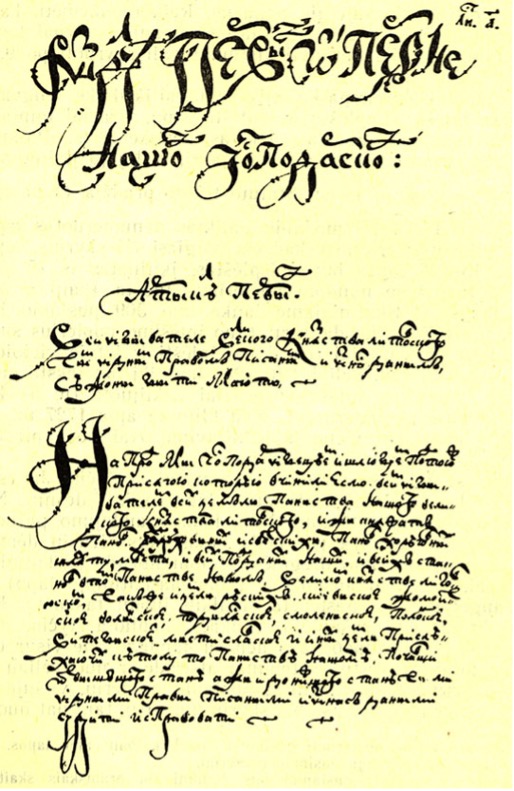
‘The Second Lithuanian Statute (1566)’. The three Lithuanian statutes (1529, 1566, 1588) constituted a remarkable codification of the law of the Grand Duchy of Lithuania. The Second Statute was the centrepiece of a set of refomrs in 1566 that extended the Polish system of sejmiks and local land courts to the Grand Duchy. The statutes were written in cyrillic, in Old Chancery Ruthenian, a formal legal language. It was only with the Third Statute of 1588 that the Statute was printed.
‘The Second Lithuanian Statute (1566)’. The three Lithuanian statutes (1529, 1566, 1588) constituted a remarkable codification of the law of the Grand Duchy of Lithuania. The Second Statute was the centrepiece of a set of refomrs in 1566 that extended the Polish system of sejmiks and local land courts to the Grand Duchy. The statutes were written in cyrillic, in Old Chancery Ruthenian, a formal legal language. It was only with the Third Statute of 1588 that the Statute was printed.
After 1569 the truncated Grand Duchy was treated as an equal partner in the union. Its ministers, palatines, and castellans were admitted to the Senate, and paired off with their Polish counterparts in a strict hierarchy of honour. Lithuania had no minor castellans, who were responsible for less important towns in Polish palatinates, but the 49 minor castellans were mostly of local significance, and although they were formally senators, very few attended meetings of the Senate Council between sejms, which they were entitled to do. Some of them preferred election to the Chamber of Envoys, where their voice was more likely to be heard, although this practice largely died out after 1600.
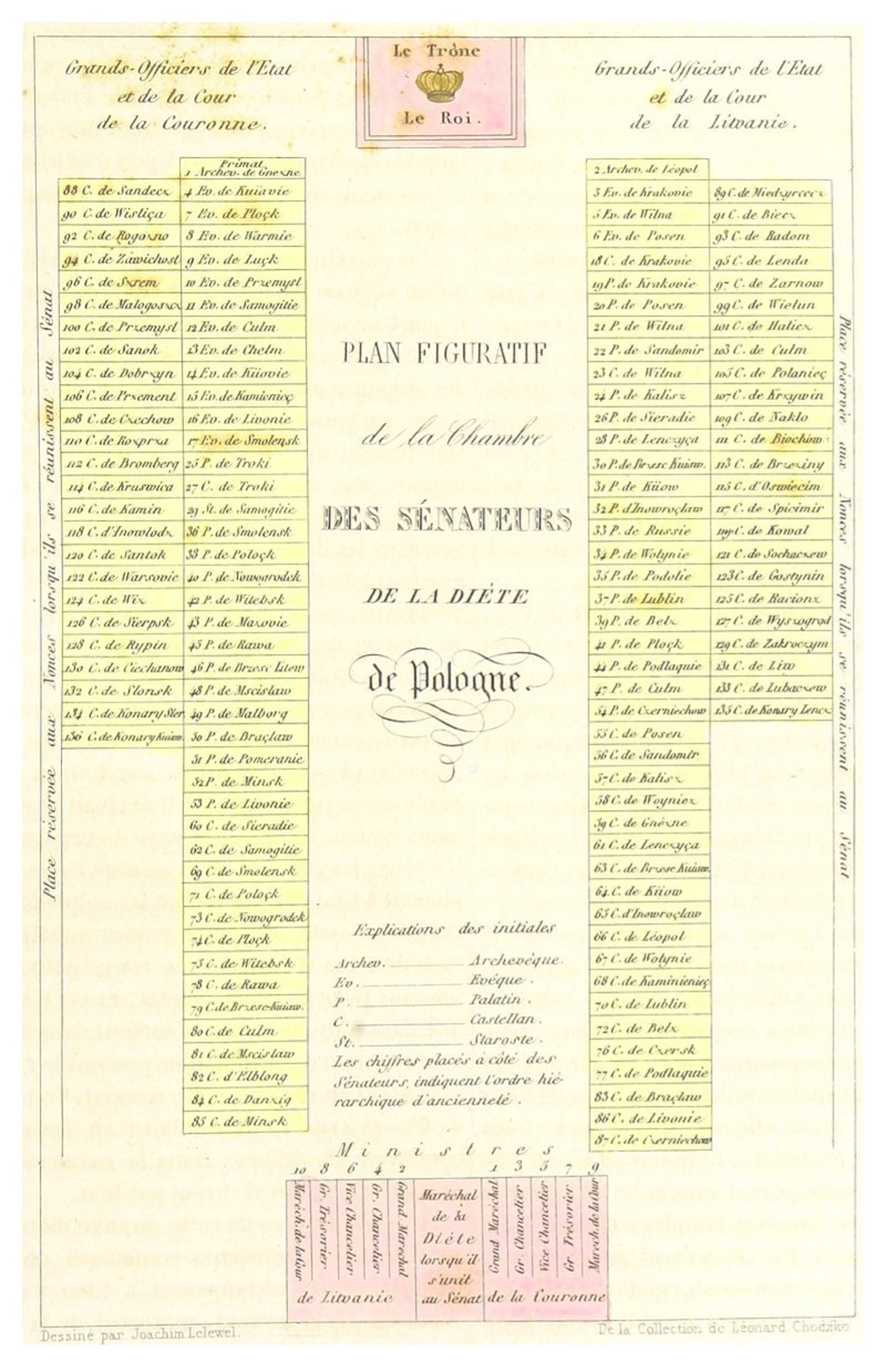
‘The Order of Precedence in the Senate (Eighteenth Century)’. From La Pologne historique, littéraire, monumentale et illustrée (1839). https://commons.wikimedia.org/w/index.php?curid=35062330
‘The Order of Precedence in the Senate (Eighteenth Century)’. From La Pologne historique, littéraire, monumentale et illustrée (1839). https://commons.wikimedia.org/w/index.php?curid=35062330
The sejmiks were the bedrock of the system. The structure was complex (see fig. 3), with local variations in practice: some provinces had general sejmiks that met after the district sejmiks, although the general sejmiks largely fell into disuse in the seventeenth century. Except during an interregnum, only the King could summon the Sejm and sejmiks, although after the establishment of the elected tribunals as high courts of appeal in Poland (1578) and Lithuania (1581) sejmiks met once a year to elect deputies (judges) to the tribunals, and it became increasingly common for sejmiks to meet without royal summonses over the course of the seventeenth century.
The King retained the sole right to summon the Sejm. In 1572, following the death of Sigismund August, the last of the Jagiellon dynasty which had ruled Poland and Lithuania since 1386, without a male heir and with no agreed procedure for electing a successor as stipulated in the Lublin Union, it soon became apparent that a Sejm was necessary to establish the rules of the election. Controversially, Jakub Uchański, the Archbishop of Gniezno, as Roman Catholic primate, summoned a Convocation Sejm which agreed when, where, and how the election was to be held. Crucially, the first Convocation Sejm in 1573 rejected the traditional method of election by the Senate Council, and decreed that royal elections should henceforth be viritim: that is, every noble citizen had in principle the right to participate directly in elections. Although the Lithuanians protested that the Convocation Sejm was in breach of the Lublin Union, the principle was ultimately accepted, and Convocation Sejms were held in all subsequent elections.
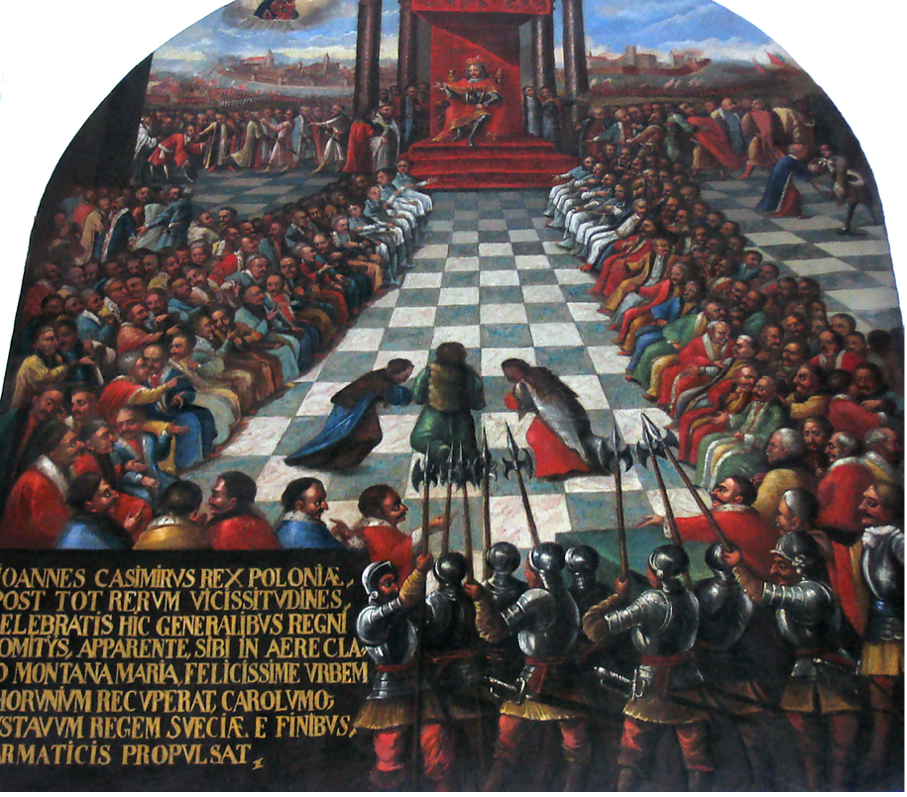
‘A Session of the Senate Council Under John Casimir’. This painting in the Pauline monastery in Częstochowa depicts an extraordinary session of the Senate Council, to which non-senators were invited, held in Częstochowa in 1657 to discuss proposals for political reform. The sejm had not met since the summer of 1655 on account of the invasion of Lithuania by the Muscovites, and of Poland by the Swedes and this assembly was called as an emergency measure.
‘A Session of the Senate Council Under John Casimir’. This painting in the Pauline monastery in Częstochowa depicts an extraordinary session of the Senate Council, to which non-senators were invited, held in Częstochowa in 1657 to discuss proposals for political reform. The sejm had not met since the summer of 1655 on account of the invasion of Lithuania by the Muscovites, and of Poland by the Swedes and this assembly was called as an emergency measure.
Under the Henrician Articles, drawn up for Henry of Valois, the first monarch freely elected on the viritim principle after 1572, and first sworn to by Stefan Batory in 1576, a Sejm had by law to be called every two years. Since envoys were elected by the sejmiks, he had first to issue summonses across the republic, which he did by despatching royal agents to each sejmik with the royal proposals, which provided the basis for instructions drawn up by the sejmiks for their elected envoys. In some cases instructions were prepared directly by the district sejmiks, in others envoys assembled in palatinate or general sejmiks to agree common instructions.
After 1569 the Sejm usually met in the royal castle in Warsaw, which was more central than the old capital of Cracow, a major consideration in such a vast republic, over a million square kilometres at its height in the 1640s. Travel to the Sejm from Smolensk or Chernihiv took weeks, and although some expenses were paid, living in Warsaw, a relatively small city in the impoverished province of Mazovia, during Sejm sessions was expensive, as accommodation for envoys, senators, and magnate retinues was in short supply. In consequence, Sejm sessions were limited to six weeks by law. After an opening mass, the Sejm began with the election of a marshal (speaker) of the Chamber of Envoys, an office that rotated through Wielkopolska, Małopolska, and Lithuania in consecutive Sejms. This was then followed by a joint session of the two chambers, presided over by the king, in which the royal proposals were formally presented by one of the chancellors. Senators then gave their vota, in which they expressed their opinions on the proposals. Senatorial vota tended to be supportive of the royal agenda; opposition senators usually delayed their arrival until after the vota were over, so they did not have to comment publicly on the government proposals.
The chambers then separated. The Senate spent most of its time, with the king presiding, in its traditional capacity as the royal court of justice, which even after the establishment of the tribunals, judged serious criminal cases, and—controversially—occasional appeals from tribunal verdicts. Meanwhile, the pace of proceedings was set by the envoys, who discussed the royal proposals, raised grievances (egzorbytancje) and discussed draft statutes of their own. Legislation could only be agreed in a plenary session of the three estates of the Sejm (see fig. 4), in which final versions were agreed or rejected. From 1633 the envoys were supposed to be invited ‘upstairs' to the Senate chamber for this joint session five days before the Sejm's legal end, although it could be extended, but only with unanimous consent at the end of each subsequent day. Unanimous consent had also to be obtained for bringing candles into the chamber; since the Sejm rarely met in high summer, and sessions often did not begin early in the morning, this could represent a serious difficulty. There was good reason for the principle in the minds of envoys, who feared that if sessions continued long after the stipulated term, or late into the evening, the king and his supporters might bribe envoys to attend and agree to controversial legislation.
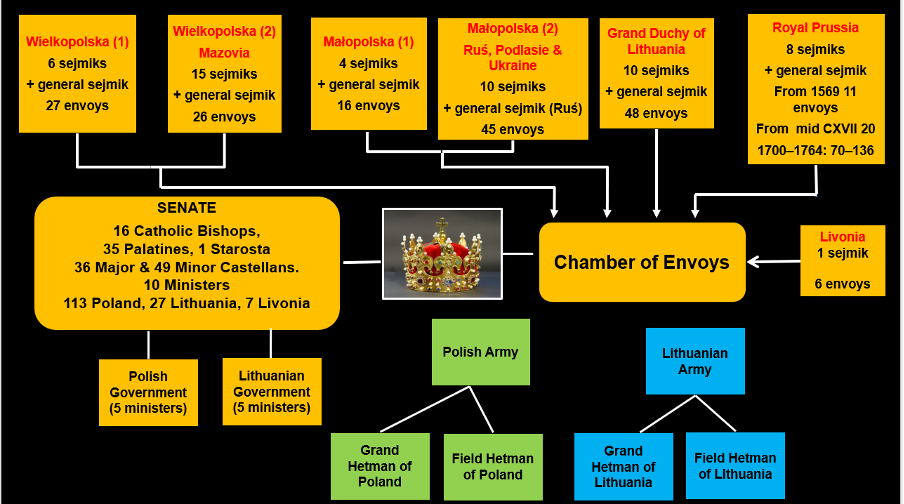
‘The Polish-Lithuanian Sejm in the mid-Seventeenth Century’. The Sejm comprised three estates: the King, the Senate, and the Chamber of Envoys. The number of envoys elected by individual sejmiks varied according to tradition and the size of the district they represented. Based on Stanisław Kutrzeba, ‘Skład sejmu polskiego’ Przegląd Historyczny, 2/3 (1906), 309–41. © Robert Frost, 2022.
‘The Polish-Lithuanian Sejm in the mid-Seventeenth Century’. The Sejm comprised three estates: the King, the Senate, and the Chamber of Envoys. The number of envoys elected by individual sejmiks varied according to tradition and the size of the district they represented. Based on Stanisław Kutrzeba, ‘Skład sejmu polskiego’ Przegląd Historyczny, 2/3 (1906), 309–41. © Robert Frost, 2022.
Speeches could be long and rambling as envoys protested their grievances and local concerns at length, refused to enter discussion on the royal proposals until they were satisfied, and justified their positions on the basis of their instructions. There were long disputes over the wording of individual statutes, insults flew, envoys stormed out of the room, or attempted to, as the king sat patiently on his throne during joint sessions, often for hours at a time, to ensure that the Sejm reached a successful conclusion. Sejms had often failed before 1652: in 1576, 1582, 1585, 1597, 1600, 1605, 1606, 1615, 1637, and 1645, but it was not until 1652 that one envoy's objection had been sufficient. The issue that gave rise to the first veto was banal enough, The session had already passed its six-week term, and On that occasion, the Sejm had passed its legal term. unanimous consent had been obtained by Andrzej Maksymilian Fredro, the marshal of the Chamber of Envoys for extensions on previous days. On Friday 9 March, however, when he asked for permission to adjourn the session until Monday morning, Władysław Siciński, a Lithuanian envoy, stood up, objected, and left the chamber. Before anyone could reach him and persuade him to withdraw his objection, he mounted his horse and galloped off home. On the Monday morning, when Siciński did not appear, Fredro, with tears in his eyes—he understood the implications only too well—declared that the Sejm could not continue.
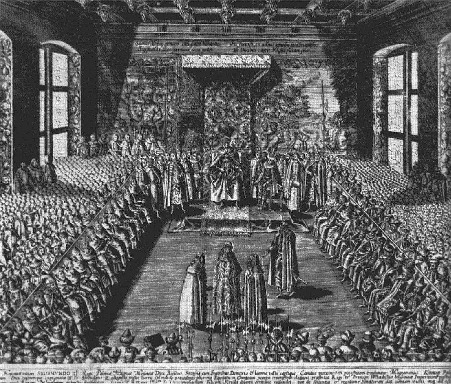
‘The Presentation of Tsar Vasilii Shuiskii and his Brother to the Sejm, 1611’. Vasilii Shuisky was deposed and captured in July 1610 after the Polish victory at the battle of Klushino. The contemporary engraving shows a joint session of the Sejm in the Senate Chamber of the Royal Castle in Warsaw. King Sigismund III (ruled 1587–1632) is shown sitting on his throne. Tomasz Makowski, 1613 Biblioteka Narodowa, Warsaw. Public Domain.
‘The Presentation of Tsar Vasilii Shuiskii and his Brother to the Sejm, 1611’. Vasilii Shuisky was deposed and captured in July 1610 after the Polish victory at the battle of Klushino. The contemporary engraving shows a joint session of the Sejm in the Senate Chamber of the Royal Castle in Warsaw. King Sigismund III (ruled 1587–1632) is shown sitting on his throne. Tomasz Makowski, 1613 Biblioteka Narodowa, Warsaw. Public Domain.
Despite the apparent chaos of debates, the king and the government had considerable resources at their disposal to secure agreement. The most important, down to the mid-seventeenth century at least, was the high cultural value placed on consensus. The republican system was underpinned by the ideal of the bonum commune, the common good. There was much talk of citizen liberty, but liberty was not understood in the contemporary sense of the right of individuals to behave as they wished: that was not liberty, but licence. Liberty consisted essentially in the right of communal self-government, and envoys had to balance the wishes of their local citizen community as enshrined in their instructions against the interests of the republic as a whole. Votes were not taken, but although unanimity (jednomyślność) was the ideal, consensus was achieved by persuasion and moral pressure to withdraw objections in the interests of the bonum commune.
This reality was frequently enshrined in sejmik instructions. Despite defiant clauses stating that individual proposals should be rejected at all costs, they often contained riders, to the effect that the envoys should consult with their ‘brothers'. In Polish instructions, envoys were enjoined to consider the attitude of what were known as the ‘upper palatinates', by which were meant the most historically significant palatinates in Wielkopolska—Poznań and Kalisz—and in Małopolska—Cracow and Sandomierz. Finally, instructions often suggested that in matters that were contentious, or in which the envoys were in doubt, should be brought back to their ‘brothers' in the relational sejmiks at which, from the late 1580s, envoys had to report on the Sejm and the statutes and taxes to which they had consented—or not consented.
The extent to which envoys were bound by their instructions was controversial. Some sejmiks, especially in the late sixteenth century, were willing to grant them plenipotentiary powers, at least on certain items, and many envoys were unwilling to be bound entirely by their instructions. The strong presumption in favour of consensus ensured that although the Sejm was indeed a theatre—as was frequently observed—in which envoys made public stands on principle that they could report back to their sejmiks—it was also a forum for negotiation, in which deals were struck, protestors were bought off, and the texts of statutes agreed.
The royal government had many tools of persuasion. Historians have often been too keen to believe the overheated rhetoric of opposition politicians, who accused the king and his supporters of seeking to undermine the constitution and introduce absolute monarchy. Kings were pragmatists, however; well aware that any such dreams were impossible to realise. They enjoyed, on the whole, substantial support from regalist government ministers and those responsible for carrying on the government, but senators—including the bishops—were as convinced believers in republican self-government as the ordinary szlachta. Monarchs had, therefore, to concentrate on managing the Sejm. Recent scholarship has suggested that—at least until the mid-seventeenth century—they were rather better at it than tradition might suggest.
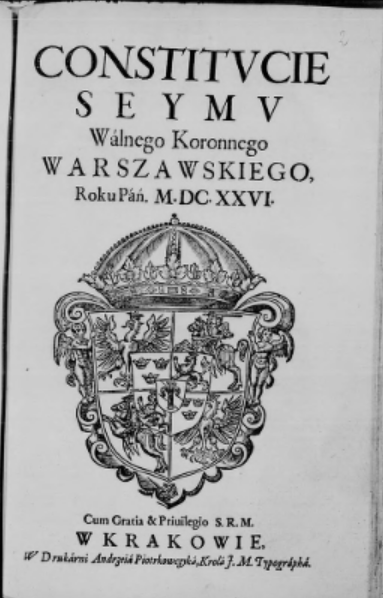
The Statutes of the Sejm of 1626’. The Extraordinary Sejm of 1626 was called to consider the defence of the Republic following the attack of Sweden on Royal Prussia in July. The Sejm opened on 10 November and closed on 3 December. Sejm statutes had been printed since the 1530s. The coat of arms of the Waza dynasty, in which the arms of Sweden are quartered, is superimposed on the coat of arms of the Republic.
The Statutes of the Sejm of 1626’. The Extraordinary Sejm of 1626 was called to consider the defence of the Republic following the attack of Sweden on Royal Prussia in July. The Sejm opened on 10 November and closed on 3 December. Sejm statutes had been printed since the 1530s. The coat of arms of the Waza dynasty, in which the arms of Sweden are quartered, is superimposed on the coat of arms of the Republic.
The most effective weapon in the monarch's armoury was his patronage powers. The king had sole right to appoint to senatorial office, and control over the vast crown lands (królewsczyzna), distribution of which, in various forms, was much in demand by both middling and wealthy nobles, whose private landholdings could be substantially reduced by partible inheritance. Although the law required the king to appoint to vacancies at the start of the Sejm, kings frequently delayed, using appointments to persuade wavering senators and envoys. They could also exercise considerable direct and indirect influence during the plenary sessions of the two chambers, over which they presided. Occasionally the king addressed them directly, although usually he spoke through one of his chancellors, but his close observance of the debates enabled him to identify individuals who were causing problems. Occasionally he even beckoned them over for a quiet word in their ear; more often attention was paid to them outside the chamber to smooth over disputes, offer patronage, or apply moral pressure to settle. If all else failed and the Sejm broke up without agreeing any legislation, the king could appeal directly to the sejmiks, especially with regard to the taxes that they were responsible for organising and collecting. After 1613, in moments of national danger, or when a Sejm had broken, the practice developed of calling an extraordinary Sejm, limited to two weeks, to allow for tempers to cool.
One remarkable feature of the Sejm, in an age of religious war, was that the Sejm was, until the early seventeenth century at least, a religiously diverse body, containing apart from Roman Catholics, Orthodox Ruthenians, Lutherans, Calvinists, and even Antitrinitarians who were almost universally personae non grata across the rest of Europe: only in Poland-Lithuania could Mikołaj Sienicki (1520–1581), an avowed Antitrinitarian, be elected marshal of the Chamber of Deputies on no fewer than nine occasions. In the mid-sixteenth century, perhaps half of the Senate were non-Catholics, but change was already setting in by the 1570s. The 1573 Warsaw Confederation, which had stipulated that religious divisions should not be utilised for political ends during the Interregnum, had been incorporated into the 3rd Lithuanian Statute in 1588, but the objections of the Catholic bishops ensured that the Henrician Articles only contained a general promise by the monarch to uphold the religious peace. As the Counter Reformation gathered force after 1563, the appeal of Protestantism faded. The determined opposition of the Catholic bishops in the Senate ensured that no effective legal protections for non-Catholic citizens could be implemented. Royal appointment policy, strongly influenced by the Catholic bishops on the Senate Council, increasingly favoured Catholics from the 1590s, and the number of non-Catholic senators declined precipitately. During the wars of the mid-seventeenth century, against Sweden and Muscovy, the Antitrinitarians were expelled from the Commonwealth in 1658, and apostasy from Roman Catholicism was made illegal in 1668. In 1712 Protestants were formally excluded from the Senate, and from 1734 could not be elected to the Chamber of Envoys.
Despite the considerable barriers, even in the difficult years after 1652, the Sejm could and did pass legislation, agree taxes, and reach a conclusion. Until 1648, Poland-Lithuania remained the dominant power in eastern Europe, capable of raising and paying for armies that defeated or repelled its many enemies. Revisionism can only go so far, however, and the system's flaws were apparent before the great Cossack revolt of 1648 shook the republic to its foundations. Ultimately, visceral attachment to the mixed form of government hampered the development of a proper theory of government: the republic's citizens were more concerned with defending their republic than building effective systems of government. When the republic was forced to fight a long series of wars on its own territory between 1648 and 1717, the Sejm degenerated as an effective parliamentary institution. Yet the republic developed methods of coping, and in the last analysis, the system regenerated itself during the Four Year Sejm between 1788 and 1792, which is the true test of a parliamentary body. That regeneration, however, provoked the final crisis and the wiping of the republic from the map. The price of liberty was high.
Professor Robert Frost,
University of Aberdeen

Further Reading:
Robert Frost, The Oxford History of Poland-Lithuania, vol. 1, The Making of the Polish-Lithuanian Union, 1385–1569 (Oxford, 2015) especially chapters 20, 26, 28 & 36.
Władysław Czapliński, ed. The Polish Parliament at the Summit of its Development (16th –17th Centuries) (Wrocław, 1985)
Edward Opaliński, ‘Sejm of the Commonwealth of Two Nations, 1572–1668', Przegląd Sejmowy 29/6 (2021), 85–114.
Kazimierz Baran, ‘Procedure in Polish-Lithuanian parliaments from the sixteenth to eighteenth centuries', Parliaments, Estates & Representation 22 (2002) 57–69.
Jolanta Choińska-Mika & David Dean, ‘Representation and accountability: a comparison of early modern England and Poland', Parliaments, Estates & Representation 21 (2001) 91–101.
Sources:
Anon [John Peyton] A Relation of the State of Polonia and the United Provinces of that Crowne Anno 1598 , ed. Charles Talbot, Elementa ad Fontium Editiones XIII Res Polonicae ex Archivo Musei Britannici (Rome, 1965).
A.B. Pernall, & A.B. Gasse, ‘Procedure in the diets of the Polish-Lithuanian Commonwealth: a description by Vincent Fabricius in 1647', Parliaments, Estates and Representation 12 (1992).