The Parliament of Scotland
On 4 November 1706, the parliament of Scotland voted to accept Article I of a proposed treaty with England that would forever unite them ‘into one Kingdom by the Name of Great-Britain'. Later in the month, parliament assented to this new entity being governed by a single parliament of Great Britain, thereby terminating its own existence as an independent institution. On the winding up of the Scottish parliament, Lord Chancellor, James Ogilvy, 1st earl of Seafield, is reputed to have said, ‘Now there's ane end of ane auld song'.
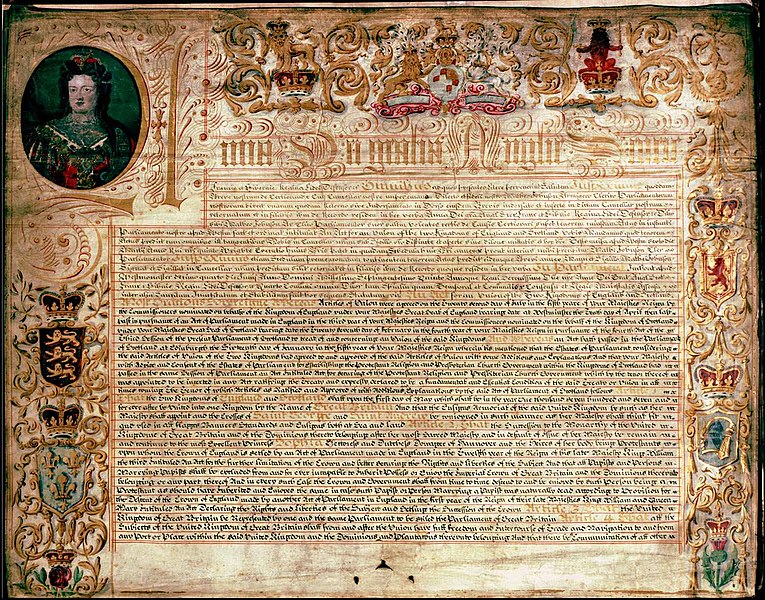
Scottish Exemplification (official copy) of the Treaty of Union of 1707.
Scottish Exemplification (official copy) of the Treaty of Union of 1707.
Nearly three hundred years later, on 12 May 1999, Dr Winnie Ewing declared to the first assembly of parliament since the early eighteenth century that its members had been ‘reconvened'. This is not quite true. The Scottish parliament had been formally dissolved on 28 April 1707 and, hence, the modern body that sits in Edinburgh is the progeny of Westminster.
Something like a parliament rather than simply an enlarged royal council was emerging in Scotland, more or less in tandem with many of its European neighbours, by at least the middle of the thirteenth century. Four centuries on, and many European political assemblies, including the Scottish example, were seemingly in decline. Throughout seventeenth-century Europe, the crystallisation of ‘absolutist' ideologies chaffed against long-established notions that kings should rule with the advice and consent of their subjects. Scotland, in the person of James VI (1567-1625), had its own exponent of the argument that kings were the fount of the law and parliament was but a ‘head court'. The status of parliament within the Scottish constitution was further complicated by the struggle to hold its own within an increasingly unequal composite state.
Since the death of Elizabeth Tudor in 1603, the peoples of Scotland, England, Ireland and Wales had shared the same ruler. Scotland, technically speaking, remained an independent kingdom with its own institutions, including its own parliament. In practice, the misnamed ‘union of the Crowns' – the Scottish Crown and, crucially, the line of succession remained separate from that of England and its dependencies – was unbalanced in England's favour because successive rulers privileged the largest and richest of their kingdoms.
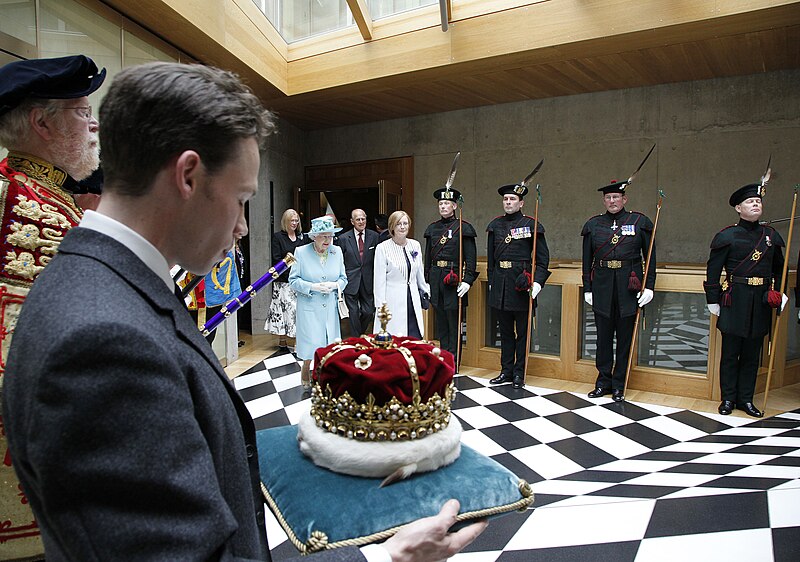
The Crown of Scotland carried at the opening of the fourth session of the Scottish Parliament in July 2011. The honours (regalia) of Scotland include a gold crown dated, in its final form, to 1540. Their survival is a remarkable story in itself. They are used today in the opening ceremony of the Scottish parliament and could be seen as a potent symbol of the ambiguities of Scotland’s status within the modern British state.
The Crown of Scotland carried at the opening of the fourth session of the Scottish Parliament in July 2011. The honours (regalia) of Scotland include a gold crown dated, in its final form, to 1540. Their survival is a remarkable story in itself. They are used today in the opening ceremony of the Scottish parliament and could be seen as a potent symbol of the ambiguities of Scotland’s status within the modern British state.
Some of the political volatility of the seventeenth century arose out of Scottish commitment to the idea of a union of equals in the face of, at best, English indifference and, at worst, outright hostility. Whereas the royal dynasty had, historically, been integral to Scotland's political identity, the status of parliament was more ambiguous. What kind of authority did parliament possess on its own account and distinct from that of the ruler? What was the relationship between statute law and the other sources of legal authority upon which early modern Scots were able to draw? Could parliament, dominated as it was by the exclusively male heads of a few hundred landowning families, meaningfully claim to be the representative of the nation?
Historians have fiercely debated why the Scottish elite chose to eliminate their own parliament and site representation of the nation in an English parliament writ large (which is what it was, certainly in the minds of most English members, despite calling itself ‘the parliament of Great Britain'). This remains a perennially interesting subject of enquiry, but carries with it the danger of seeing Scottish parliamentary history as a single-track road into a cul-de-sac. In recent decades, historians have rightly sought to recalibrate the questions we want to ask, not only of the parliamentary record itself, but also of a far wider range of sources that help us better understand how people from all social levels thought about and engaged with an evolving institution.
The parliament that convened for the last time in October 1706 would, in terms of essentials such as membership, procedure, and a large proportion of its business, have been broadly recognisable to attendees at any session since at least the mid-sixteenth century. Like most of its Continental European but – significantly for later historical analyses, not its English – counterparts, the Scottish parliament was organised on the medieval principle of the three Estates: the clergy, the nobility, and the freemen representatives of royal burghs, which held their privileges direct from the Crown. Confusing matters somewhat was a general acceptance that rulers could call a less formal body called a convention. Easier to control by rulers than full parliament, conventions were subjected to closer scrutiny by the Scottish elite after 1603, when their historic utility for the quick expediting of business became less important than their capacity for manipulation by an absent monarch. Conventions were used less frequently from the mid-seventeenth century. It is a telling reflection on conventions that the last in Scotland to be so called was in the revolutionary setting of 1689.
Throughout its lifespan, parliament was a unicameral body summoned by the monarch. Members traditionally convened in full session only following the ‘riding' with which parliaments formally opened, and at the end to vote on legislation. Ridings were colourful public spectacles. All the representatives of the Estates, with the clerks, heralds, pursuivants and an armed guard, dressed in ceremonial garb, processed in strict social order through the decorated main street of the capital. Last in line, so that everyone else was seated to greet them, came the senior nobles carrying the regalia of Scotland. On six occasions in the course of the seventeenth century, crowds were gifted sight of the king himself.
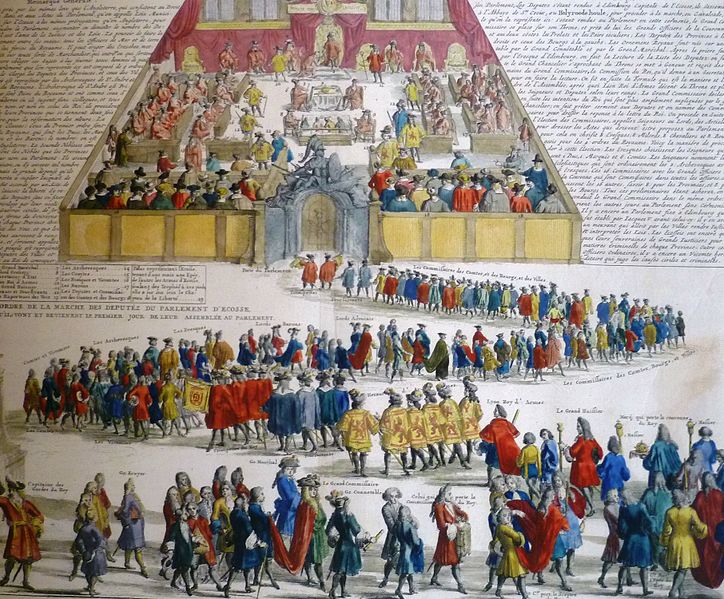
A later imagining of the riding of the Scottish parliament as it was configured in the later seventeenth century exists as ‘The downsitting of the Scottish parliament’, from Chatelain and Gueudeville’s ‘Atlas Historique’, 1720.
A later imagining of the riding of the Scottish parliament as it was configured in the later seventeenth century exists as ‘The downsitting of the Scottish parliament’, from Chatelain and Gueudeville’s ‘Atlas Historique’, 1720.
Unfortunately for historians, the deliberations conducted away from the main sessions, by a preparatory committee called the Lords of the Articles (abolished in the 1640s and after 1689), by a widening range of specialist committees, and by each estate meeting separately as the legislative agenda was being drawn up, were not routinely recorded. Moving discussion and negotiation away from full sessions also limited the need to determine clear procedures to manage parliamentary business. Relative informality was complemented by the fact that parliament was peripatetic until it acquired a permanent home of its own, in Edinburgh, in 1639. (The old parliament house still exists, positioned at the civic heart of the capital alongside the main burgh church of St Giles', the tolbooth, and the market cross. Parallels with its modern successor are evident in contemporary discussion of the expense and its architectural distinctiveness!).
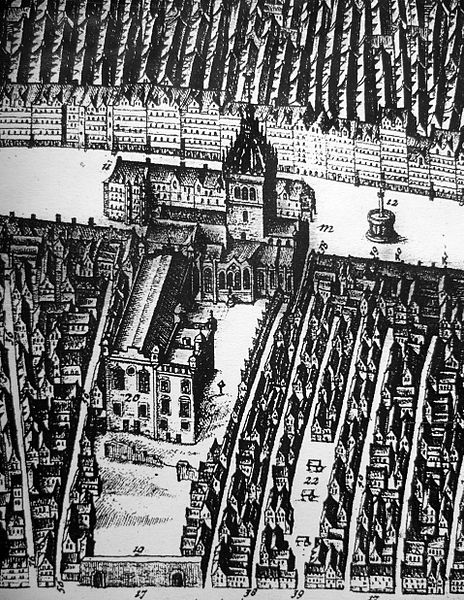
James Gordon of Rothiemay, detail of St Giles and Parliament House, Edinburgh c. 1647.
James Gordon of Rothiemay, detail of St Giles and Parliament House, Edinburgh c. 1647.
The revolutionary regimes of the 1640s and the 1690s were particularly important for the development of procedure. They opened up more business to the scrutiny of the whole house, widened parliament's remit, and formalised its deliberative functions.
Although parliament remained fundamentally the domain of great landowners, its composition underwent some changes across the early modern era. Nobility in Scotland was not synonymous with ‘the peerage' and, from the later sixteenth century, there were moves to reinforce the patchy presence of the non-titled baronage (known as lairds). While peers received an individual summons from the monarch, suggesting they possessed a right as titled nobles to attend parliament, the baronial heritors of each shire were required to convene and elect commissioners from amongst their number. Similarly, the (largely self-selecting) councils that governed the royal burghs also elected their commissioners. These practices do not appear to have encouraged the idea, potent in England, of parliamentary representation for ‘the commons'.
Ecclesiastical representation, thanks both to the Protestant Reformation of the mid-sixteenth century and longer-term developments in land tenure, was probably the most volatile feature of Scottish constitutional practice. Bishops, at least in theory, survived the Reformation crisis, leaving them as the rump of a once-powerful and wealthy ‘first Estate'. Reformation intensified an existing trend towards the secularisation of ecclesiastical property. By the early seventeenth century, the lands and the parliamentary representation once enjoyed by the wealthy heads of monastic houses had passed into the hands of hereditary temporal lords. The status of Scotland's two archbishops (of St Andrews and Glasgow, in order of seniority) and eleven (rising to twelve) bishops was further undermined after 1560 by the creation of a dedicated conciliar body to govern the church, called the General Assembly. Attempts by successive British monarchs to get rid of the General Assembly exacerbated growing resentment of the bishops as the instruments of unpopular royal policy both in church and state. The episcopate was controversially and audaciously outlawed by the Covenanters in 1640 (so-called after the National Covenant of 1638). Restored to church and parliament in 1662, the episcopate again failed to avoid controversy and it was swept away, this time for good, with the revolution of 1689/90.
Scottish political theorists seem to have been curiously unworried by the ambiguities and uncertainties of parliamentary practice, which for past generations of scholars fuelled the notion that the Scots were less invested in parliament as an institution than their English counterparts. George Buchanan (1506-82), nemesis of his one-time pupil, James VI, was clear that kings should be subject to the law, but vague on the proper role of parliament in regulating rulers. Although the theory of ‘a limited and mixed monarchy' advocated by the Covenanter, Samuel Rutherford (1600-61) afforded a more prominent role to parliament than in Buchanan's work, he gave little space in a substantial treatise to defining its precise workings.
A key issue fudged by Rutherford was whether circumstances could ever arise in which parliament alone had the right to exercise sovereign power. Most Scots probably thought not: one of Scotland's liveliest political thinkers, Andrew Fletcher of Saltoun (1655-1716), was arguably at his least controversial when discussing a constitution in which rulers and the Estates exercised sovereignty together. An English regime had, of course, vested the exercise of sovereign power in parliament after the execution of King Charles I on 30 January 1649. Such an idea was rendered problematic for Scots by the fact that their government's declaration of Charles II (1630-85) as king of Britain in February 1649 led directly to military conquest and absorption into the English republic. This devastating experience undoubtedly underpinned the Scottish nobility's willingness to comply with the aggressively ‘absolutist' agenda of the restored British monarchy. Yet even those who argued most vociferously in favour of unlimited lawmaker kings conceded the desirability of consulting with the Estates. Parliament was no mere cipher under either Charles II or his successor, James VII (1633-1701). It could be argued that a renewed confidence in the importance of the Estates to Scottish political life was an important precursor to the revitalisation of parliamentary culture after 1689.
At the end of the seventeenth century, it is the vitality of the Scottish parliament that seems striking. Perhaps this becomes less surprising once we remember how central parliament had been to the reshaping of the Scottish nation across the early modern era. Parliament was integral to the Reformation crisis and the deposition of a reigning monarch, Queen Mary, in the 1560s; to the post-1603 political culture in which two revolutions were forged; to the succession crisis generated after 1701 by the failure of the Protestant line of the British dynasty, represented by Queen Anne (1665-1714). Across this period, the expansion of print, combined with parliament's growing competence in social and economic matters, arguably made parliament more visible and relevant to a wider cross section of Scotland's people. As the survival of Scotland's sovereign status hung in the balance in the early years of the eighteenth century, arguments could not be confined to the chambers of the parliament house and the rooms of wealthy landowners. Men and women from all over Scotland took to the streets, read petitions and addresses, and disseminated pamphlets in defence of a separate Scottish parliament. The English writer, Daniel Defoe, acting as an agent for the government in London, not only took part in the spirited, if pugnacious, debates conducted via the printing presses, but also recorded sometimes frightening public demonstrations of collective opposition to an incorporating Union with England.
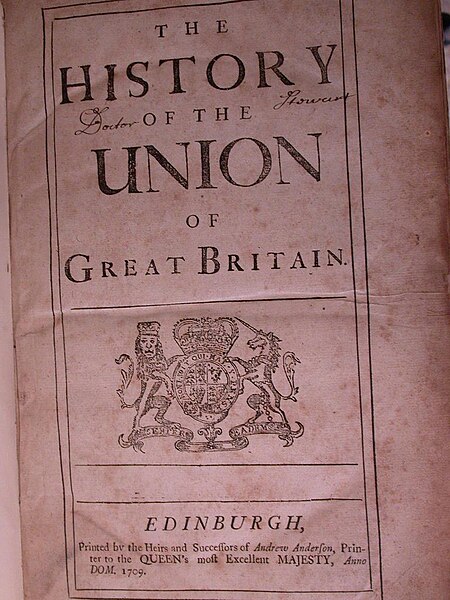
The vibrancy, and violence, of the public debates on the Union was captured by Daniel Defoe in his ‘History of the Union of Great Britain’, published first in 1709 by the heirs of Andrew Anderson, Edinburgh.
The vibrancy, and violence, of the public debates on the Union was captured by Daniel Defoe in his ‘History of the Union of Great Britain’, published first in 1709 by the heirs of Andrew Anderson, Edinburgh.
Even if historians struggle to uncover the exact quality of popular engagement with parliament, the reaction to the union debates at least suggest that it was an adaptable institution exerting a powerful influence on the Scottish public imagination up to the moment of its demise.
University of York
Sources:
The Records of the Parliaments of Scotland to 1707, Keith M. Brown, et al., eds (St Andrews, 2007-2022).
Further Reading:
K.M. Brown and R.J. Tanner (eds), The History of the Scottish Parliament, volume I: Parliament and Politics, 1235-1560 (Edinburgh, 2004).
K.M. Brown and A.J. Mann (eds), The History of the Scottish Parliament, volume II: Parliament and Politics, 1567-1707 (Edinburgh, 2005).
K.M. Brown and A.R. MacDonald (eds), The History of the Scottish Parliament, volume III: Parliament in Context, 1235-1707 (Edinburgh, 2010).
K. Bowie (ed.), Addresses against Incorporating Union 1706-1707 (Scottish History Society, 2018).
J. Goodare, ‘The estates in the Scottish Parliament, 1286-1707' in Parliamentary History, 15 (1996), pp.11-32.
J. Goodare, ‘The Scottish Parliamentary records, 1560-1603' in Historical Research, 72 (1999), pp.244-67.
J. Goodare, ‘Scotland's parliament in its British context, 1603-1707' in H.T. Dickinson and M. Lynch (eds), The Challenge to Westminster: Sovereignty, Devolution and Independence (East Linton, 2000), pp.22-32.
J. Goodare, ‘The admission of lairds to the Scottish Parliament' in The English Historical Review, 116 (2001), pp.1103-33.
C. Jones (ed.), The Scots and Parliament (Edinburgh, 1996).
A.R. MacDonald, ‘Ecclesiastical representation in parliament in post-Reformation Scotland: The two kingdoms theory in practice' in Journal of Ecclesiastical History, 50 (1999), pp.38-61.
A.R. MacDonald, ‘Deliberative processes in parliament, c.1567-1639: Multicameralism and the lords of the articles' in The Scottish Historical Review, 81 (2002), pp.23-51.
A.R. MacDonald, The Burghs and Parliament in Scotland, c.1550-1651 (Aldershot, 2007).
G.H. MacIntosh, The Scottish Parliament under Charles II, 1660-1685 (Edinburgh, 2007).
R.S. Rait, The Parliaments of Scotland (Glasgow, 1924).
L.A.M. Stewart, ‘Petitioning in early 17th-century Scotland, 1625-1651' in Parliaments, Estates and Representation, 38:3 (2018), pp. 307-322.
L.A.M. Stewart, ‘Scotland's constitution before 1707' in P. Cane and H. Kumarasingham, eds, The Cambridge Constitutional History of the United Kingdom (forthcoming, in press, 2022).
L.A.M. Stewart and A. Blakeway, ‘The Scottish parliament, c.1500-1707' in D. Hayton, ed., Writing Parliamentary History: Parliamentary History, 40:1 (2021).
C.S. Terry, The Scottish Parliament: its constitution and procedure, 1603-1707 (Glasgow, 1905).
E.E.B. Thomson, The Parliament of Scotland, 1690-1702 (Oxford, 1929).
J.R. Young, The Scottish Parliament, 1639-1661: a political and constitutional analysis (Edinburgh, 1996).