
Municipal Assemblies in Early Modern Naples
To mark its mythical origins, Naples has been traditionally identified with a siren called Parthenope. A winged creature embracing human and animal features, the siren acquired a complex significance in the early modern period. She populated the imagery of Neapolitans and came to be identified as the guardian of a city known as a locus amoenus. Parthenope was a symbol of civic identity; her marble figure pouring out water from her breasts embellished public fountains; representations of her featured in emblems, typographic ornaments and works celebrating the city’s history. Famous for her enchanting singing too, Parthenope was often represented with a lyre. Writing in 1592, Giulio Cesare Capaccio stated that ‘the lyre is a symbol of concord and Neapolitans represent the siren holding a six-string lyre to celebrate the union between the city’s Piazze.’ Here, each string of the lyre represents one of the city’s six Piazze.

Parthenope, as pictured in Giulio Cesare Capaccio’s Delle imprese (1592)
As the capital of a large kingdom under foreign rule, in the sixteenth and seventeenth centuries Naples held a dual political status that reflected on the one hand the prerogatives of its municipal government, and on the other its subject status within the larger political composition of the Spanish Empire. Between 1503 and 1707, the city hosted a Spanish viceroy, who acted as one of the highest representatives of the Spanish crown in the Kingdom of Naples (there was another Spanish viceroy at Palermo). Nonetheless, the city maintained a degree of autonomy in the structure and composition of its municipal government. The latter was inherently linked to Naples’ urban structure and the distribution of its social fabric. In the early modern period, the city was divided into regions called Ottine. These were grouped into quarters. Some of these areas – which were variously called Piazze or Seggi – hosted the imposing dwellings of the highest echelons of the city’s aristocracy. The term Seggi indicated the assembly spaces where members of the residing nobility would gather. In the seventeenth century there existed five noble Seggi called Capuana, Montagna, Nido, Porto and Portanova. In an account of his nunciature in Naples, dated July 1630 and addressed to Cardinal Francesco Barberini, Monsignor Alessandro Bichi wrote that ‘each Seggio has a loggia [i.e. meeting space] where local residents have the right to convene’. Bichi added that these assemblies were held ‘to discuss matters related to the city and to elect a gentleman who must reside at the royal court in Spain to defend the interests of the city [of Naples] and the entire Kingdom’. Neapolitan commoners had their own political body too, which was called Seggio or Piazza di Popolo. Its activities were forcibly halted in 1456, when King Alfonso I allegedly destroyed the assembly space – at that time located in Piazza Sellaria – where a large segment of Neapolitan commoners would convene to discuss matters related to the city’s government. In 1495 Charles VIII of France and King of Naples reinstated the Seggio di Popolo and granted local commoners the right to congregate in a new council chamber. This was located in the cloister of the church of Sant’Agostino alla Zecca.
Municipal assemblies were also held by each Seggio to choose their representatives. In addition to the choice of representatives to go to Spain, all Seggi held separate municipal assemblies to choose their representative to the municipal government. This representative was called an Eletto (plural Eletti). The term of office for a noble Eletto was six months, although this period could be extended to one year. To make such an appointment, noble Seggi held private assemblies during which Eletti were chosen by ballot or by lot. The nomination of the Eletto for the Seggio di Popolo was a more formalised ritual which, by the mid sixteenth century, was presided over by the Spanish viceroy. To nominate their Eletto, fifty-eight representatives of the common people were granted power of attorney and gathered at Sant’Agostino alla Zecca. There the fifty-eight representatives secretly voted for one among their number to be their Eletto. Votes were then counted and a list of the six candidates that had received the highest number of votes was given to the Spanish viceroy. From this list the viceroy then appointed the person he considered most suitable for this position. The Eletto’s term of office was usually six months. Following this appointment, the Seggio di Popolo gathered again to elect – by vote – ten advisors to their Eletto. These ten advisors all held their office for six months, although their mandate could be extended at the viceroy’s discretion.
Celebrated as the six upright men who would look after the city of Naples (Sex probi viri habentes curam Civitatis Neapolis), the six Eletti sat on the municipal government which gathered in a council chamber located in the cloister of San Lorenzo’s convent. To mark the civic and political significance of the place, the convent’s façade was decorated with the Seggi’s insignia.

Insignia of the Neapolitan Seggi (to the left of the statue). San Lorenzo’s façade, Naples (Wikimedia Commons)
In that sense, the composition of Naples’ municipal body did not differ from other contemporary oligarchic polities, although the establishment of a mixed government under Spanish rule would often be detrimental to the interests of the local élite. Spanish interference would often lead to mass discontent too, which was mainly caused by fiscal pressure. Events such as the revolt of Masaniello in 1647 are indicative of the difficult living conditions of the common people in Spanish Naples. Power struggles within the city’s aristocracy and conflicts with commoners were also a source for instability. Here, it is important to note that the five noble Seggi were located within the city’s walls. With the urban restructure of some of its major arteries in the sixteenth century, Naples expanded and developed new urban areas outside its old borders. Although some of these residential quarters became home to aristocrats and élite commoners, it was the urban districts within the old city’s walls that held political and governmental power. The demands to be included or reinstated as residents of the noble Seggi was the ultimate ambition for those families – either local or foreigners – living outside this territorial arrangement. Each noble Seggio had the authority to grant residency in their districts. This complex procedure required them to appoint officials who would assemble to decide the suitability of applicants. Granting residence in noble districts carried the right to hold civic responsibilities and was thus of the utmost importance in shaping the composition of the municipal council. To centralise control of the city’s governmental body, during the reign of Philip II the authority to grant residency in noble districts became a royal prerogative. Thus, requests to join noble Seggi were granted by the King’s licence and only nominally by the Seggi’s councils.
The local government oversaw key offices concerned with the daily management of the city. The council gathered regularly to preside over the logistics of food provision (Annona); to oversee fiscal administration; to maintain public order and cleanliness; to ensure the maintenance of public health; to grant Neapolitan citizenship and the privileges it entailed; to appoint ambassadors; and to administer justice. For the administration of justice and overseeing the activities of the city’s major tribunals, the Eletti convened in an additional chamber called the Tribunal of San Lorenzo – which was located next to the convent’s church.
The offices held by the municipal council constituted only an aspect – albeit central – of early modern Naples’ governmental and administrative structure. During the long period of Spanish hegemony new councils and offices became involved with and often controlled local institutions. As Aurelio Musi has highlighted, one of the aims of the Spanish court was to implement a governmental system which partly maintained the privileges of the local élite. The intention here was to control the city, its offices and resources. Spain needed these to generate revenue from taxation and donations. The latter – known as donativo – constituted one of the highest financial contributions to Madrid. A letter from the King asking for a donativo reached Naples biennially. Upon receiving the King’s request, a general parliament (Parlamento Generale) was summoned at San Lorenzo’s. This appointed council consisted of twelve representatives of the city; twelve barons of the Kingdom; some of the highest officers operating within major governmental and administrative bodies; and the mayor of Naples – who acted mainly as a ceremonial figure. The aim of this gathering was twofold. On the one hand this council presided over the collection of the donativo (invariably millions of ducats). On the other, the Parliament discussed and voted requests for pardon, concessions and privileges to be sent to the Spanish King by means of a letter. Once this had been written and signed, appointed representatives of the council convened at the viceroy’s palace. There, the letter was read to the viceroy and then sealed. During the following days, the Parliament and the viceroy would reconvene at San Lorenzo’s. On these occasions, the city’s mayor delivered a speech in which he stated that the King’s request for the donativo had been fulfilled. He then handed the letter to the viceroy who collected it and returned to court. It is noteworthy that the Spanish authorities successfully weakened the role of the Parliament to the extent that they stopped its activities in 1642. After that date, the procedure for the donativo would be presided over by the Eletti.
During the Spanish rule several other councils acted in different areas of state management, although three major bodies held the highest power. These were the Sacred Royal Council, which was the most important judicial body in the Kingdom of Naples; the Collateral Council – presided over by the viceroy – which was the highest administrative organ of the royal administration; and the Sommaria Chamber, which dealt with the financial and fiscal management of the Kingdom. Variously holding judicial, executive and consultative power, these councils gathered in different venues. The Collateral was summoned three times weekly; some of its meetings were held at the Vicaria court located in Capuano Castle.
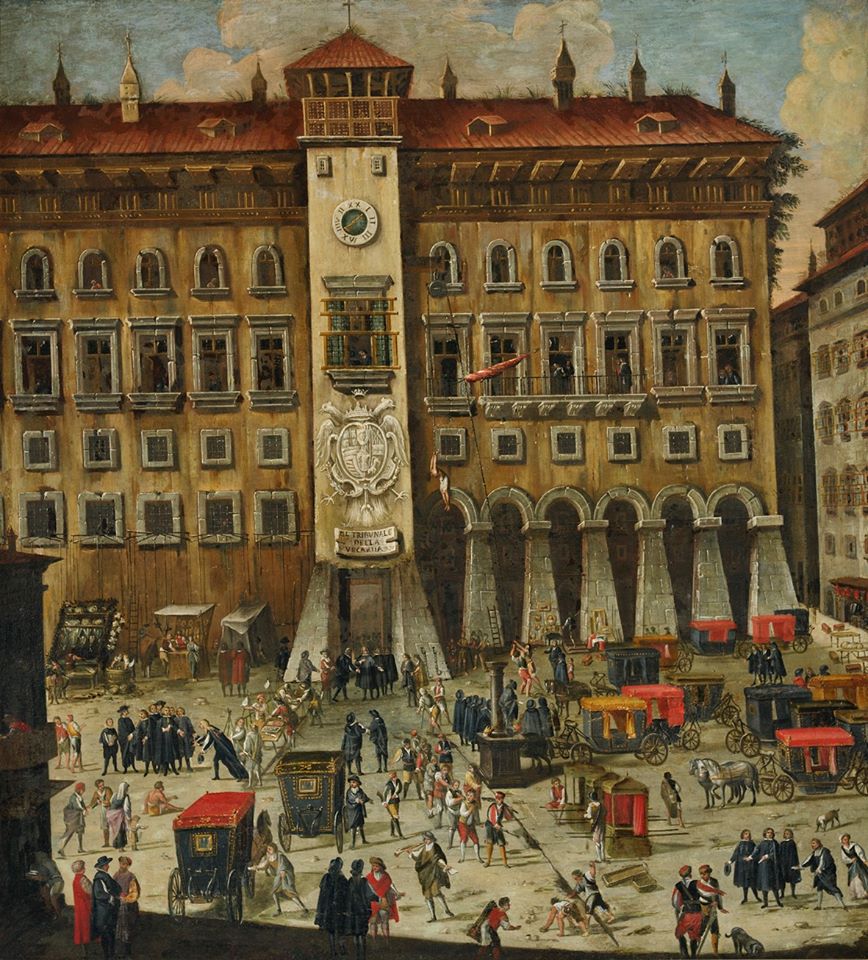
Carlo Coppola, The Vicaria Court in the seventeenth century (Wikimedia Commons)
This large building hosted tribunals, various administrative offices and a prison. The Sommaria Chamber and the Sacred Royal Council also gathered there in allocated assembly rooms. The complex bureaucratic system of the Ibero-Neapolitan governmental body required the appointment of chief officers in charge of the most important institutions in the Kingdom. Local élites – aristocrats and jurists (togati) – had to share power with Spanish representatives working with the viceroy. Indeed, Spanish officials entered the world of local councils, often presiding over offices that had traditionally been controlled by the Eletti. The presence of royal agents appointed in Madrid to oversee the action of Naples’ government increased Spanish bureaucratic and financial control. An example was the appointment of a Spanish executive (grassiere) who presided over the Annona. This was the office that controlled food provision for the city, established the price and weight of bread and regulated the commerce of grain. Writing in 1634, Giulio Cesare Capaccio defined the Spanish grassiere as homo regio who ‘ensured that the decisions that the Eletti took during councils would not become effective without his approval’. Moreover, Spanish officers sat on other councils. In his report to Barberini, Bichi remarked that of the nine presidents of the Sommaria chamber four were Spanish and five Neapolitans. The work of councils and chief officers was partly controlled by Spanish viceroys in Naples too. Although they did not hold absolute power, viceroys exercised control on the work of local institutions. Their style of government, local alliances and intervention in the distribution of offices inevitably favoured or estranged members of the Neapolitan élite. As I have discussed elsewhere, at times Spanish interference in local affairs fractured consensus and even caused the despatching of ambassadors to the king’s court to denounce any abuse of power. Nonetheless, the viceroy was a powerful figure; his court a political centre and a venue where governmental assemblies were regularly summoned.
Members of the Collateral council gathered daily at the vice-regal palace. These officers – known as Regenti di Cancelleria – presided over the activities of the Kingdom’s chancery. Their position was highly regarded and described as ‘the papacy of all the doctors in the Kingdom’ (il Papato delli Dottori del Regno). In recognition of their prestigious office, the Regenti were entitled to sit close to the viceroy during institutional gatherings. Due to the bureaucratic system of the Spanish Empire and Madrid’s demands for informative material from Naples, the viceroy worked closely with the Regenti in overseeing the production and despatch of the documentation issued in the Kingdom’s chancery. Although control of this complex body ensured that the tasks assigned to secretaries and scribes guaranteed an efficient system of record-keeping, it was the documentation issued during councils held at the vice-regal court that constituted one of the major channels for information regularly sent to Madrid.
In that sense, the institutional structure of early modern Naples consisted of different spaces – both private and public – within which social, civic and international interests were merged in what remained a precarious governmental and political system. The noble Seggi served the interests of the city, yet they also fought to defend the leadership of the old aristocracy. The Seggio di Popolo had a place in Naples’ municipal council, although its struggle against the majority held by the aristocracy made its voice an ancillary presence in the decision-making process. Moreover, Spanish rule infringed upon the rights of Neapolitans to govern their city. The arbitrary institutional ‘reforms’ imposed by Spanish monarchs also exposed the governmental structure of the city to continuous changes that variously favoured different segments of the Neapolitan élite. In this context, the complex organisation of local councils increasingly adapted (or reacted) to the aims of Madrid to implement a system that would effectively serve Spanish bureaucratic, economic and political interests. The lack of self-determination led to institutional stagnation, political instability and even rebellion. In the aftermath of the Masaniello revolt – which led to the temporary overthrow of Spanish authority and a brief period of French rule – some political groups hoped to proclaim Naples a republic.
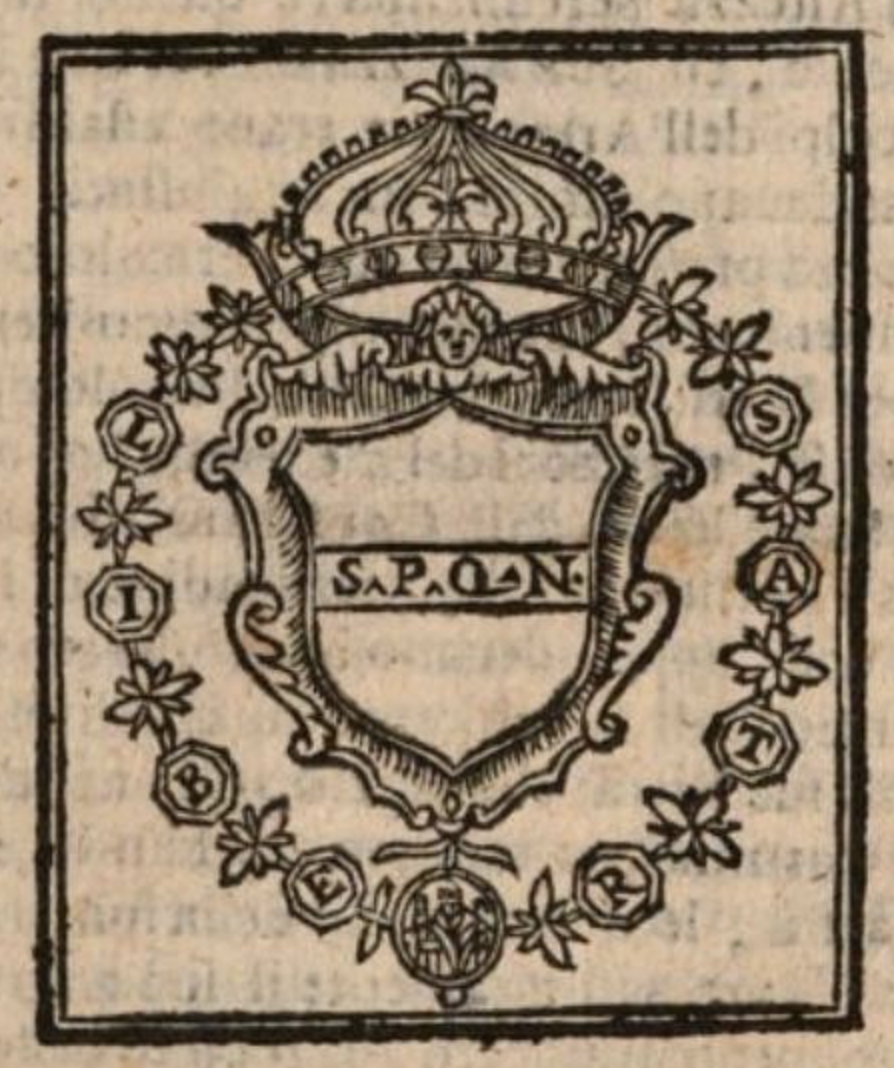
Cartouche of the Neapolitan republic embracing S.P.Q.N (Senatus Populusque Neapolitanus), from Giuseppe Donzelli’s Partenope Liberata (1647, colophon)
With the Spanish reconquest of the city in 1648, the political and institutional reforms of those who had pressed for the establishment of a Senate were crushed by the draconian measures that the Spanish authorities adopted to enforce a return to the status quo. The Neapolitan Seggi and the municipal institutions they represented survived until 1799. Capaccio’s analogy of the siren’s lyre encapsulated what would remain a chimerical hope. Power struggles between the Seggi and conflicts between the city and its foreign rulers marked the history of early modern Naples and its governmental bodies.
Lorenza Gianfrancesco, University of Chichester
Further reading:
Primary sources
Giulio Cesare Capaccio, Il forastiero (Naples: D. Roncagliolo, 1634)
Bartololeo Capasso (ed.), Descrizione di Napoli ne’ principi del secolo XVII di Giulio Cesare Capaccio, «Archivio Storico per le Province Napoletane», VII (Naples: Giannini, 1882)
Francesco De’ Pietri, Dell’Historia napoletana (Naples: G. D. Montanaro, 1634)
Giovanni Antonio Summonte, Historia della Città e Regno di Napoli (Naples: G. I. Carlino, 1602)
Camillo Tutini, Dell’origine e fundation de Seggi di Napoli (Naples: O. Beltrano, 1644)
Secondary literature
Tommaso Astarita (ed.), Companion to early modern Naples (Leiden-Boston: Brill, 2013)
Thomas James Dandelet & John A. Marino (eds.), Spain and Italy. Politics, society and religion. 1500-1700 (Leiden: Brill, 2007)
John A. Marino, Becoming Neapolitan. Citizen culture in Baroque Naples (Baltimore: John Hopkins University Press, 2010)
Aurelio Musi, la rivolta di Masaniello nella scena politica barocca (Naples: Guida, 1989)
Rosario Villari, Un Sogno di Libertà. Napoli nel declino di un impero. 1585-1648 (Milan: Mondadori, 2012)