
The Cortes of Castile and León
The Cortes de Castilla y León belonged to a diverse ensemble of parliamentary institutions in charge of representing the Kingdoms (reinos) that formed the composite structure of the Hispanic Monarchy. In theory, all the reinos contributed to the jurisdictional complexity of a monarchy under the watchful eye of one dynasty, one religion, and one sovereign. In practice, however, not all the reinos relied on Cortes to assert their privileges and their relationship with the crown, nor did many of the other kinds of territories that made up the Monarchy. The Cortes embodied rights, privileges, and jurisdictions that different corporations, groups, and individuals – often connected to municipal authorities – had been granted in exchange of their loyalty and services. Most of these rights and privileges were connected to the porous history of territorial conquest conducted within and beyond the Iberian Peninsula during the medieval period and after.
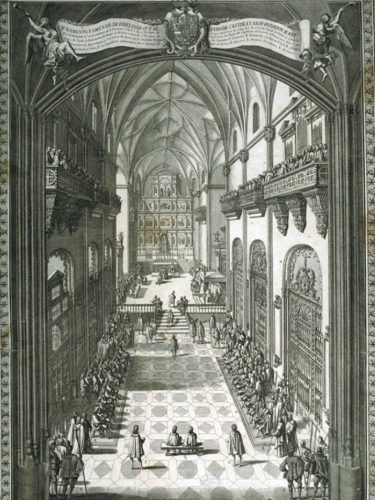
Jura de Felipe V.
Jura de Felipe V.
The Cortes de Castilla y León were not the only such assembly operating in the early modern Iberian Peninsula. There were also the Cortes of Aragon (c. 13th century-1707), and Portugal (1580-1640), among others. Loosely connected, the multiple Cortes of the Hispanic Monarchy gave visibility to the idea of the Reinos they were supposed to embody. In kingdoms such as that of Castile and Leon, the Cortes did not constitute the only assembly that was charged with representing the reino through a parliamentary assembly of procuradores or delegates. In addition, the Cortes often pushed back against the desires of state ministers to enlarge and simplify the jurisdictional and territorial map of the kingdom of Castile and the Monarchy. As an assembly, the Cortes opposed the formation of agencies designed to bypass them, especially on fiscal matters and the development of financial accounting institutions. For example, under the Spanish reign of the Emperor Charles V (r. 1516-1556), the Diputación del reino or Deputation of the Kingdom was created during the celebration of Cortes in Toledo in 1525. The Deputation was supposed to keep track of what had been agreed upon by the end of the Cortes' meetings. Its members were in charge of maintaining the communication channels between municipal authorities and royal tribunals after the end of the Cortes.
The Cortes de Castilla y León refers to an assembly of a diverse group of procurators who were representing an ensemble of eighteen Castilian cities. Each city usually sent two procurators to the Cortes when the assembly was called by the King. There was no unified system for their elections and their numbers could vary. A given procurator could not go twice in a row to the Cortes. One could also sell his procuration to a third-party. These practices reinforced the degree of interference between royal/court officers, the Cortes and their procurators. Among the Cortes, urban authorities represented a majority while the number of nobles and aristocrats who attended the Cortes as procuradores fluctuated. Historian Pedro Cardim notes that attempts of the Crown to weaken the ties between the Cortes and municipal authorities corresponded to the royal desire to transfer the prerogatives of the Cortes to an autonomous organ placed under the King's control. Cities and urban oligarchies also sought privileged means to negotiate with the King outside of the Cortes. From the late sixteenth century onward, the Cortes often became spaces of aristocratic opposition to the politics inspired by royal favorites who were themselves nobles and who, for some, claimed to have had emancipated themselves from local networks of powers. Among its most distinctive tasks, the assembly was supposed to acknowledge and confer legitimacy to the sovereign rights of the Spanish monarch in Castile. In exchange, the latter would make an oath to secure the rights and historical privileges associated with the Kingdom and its parts.
In scholarship, the Cortes have most often been presented as an institution used by Spanish sovereigns to access extraordinary servicios (additional funds beyond ordinary money collected through taxation) in order to finance costly local and/or international conflicts. During the last twenty years, studies dedicated to the Cortes have for the most part focused on the negotiations that procuradores and cities conducted with the King around the question of such extraordinary fiscality. Such studies have revealed that the Cortes reinforced the idea of sovereign power being secured thanks to “popular” mediation, after being originally established between God and the King. During the sixteenth and seventeenth century, the Cortes advocated for the updating of the writing of the history of the Kingdom and rulers of Castile. Such updating would encompass the deeds of the Kingdom's rulers as well as of their subjects. As historian Richard Kagan argued, the Cortes advocated on behalf of a “Historia pro Patria,” that was supposed to consider the “popular” mediation of Castilian sovereign power. Although regional and municipal representation mattered in Castile, most of the historical studies dedicated to the royal administration of the Spanish monarchy are still influenced by a teleological view about the advent of a modern state. What's more, such views retrospectively overemphasize how the decrees of Nueva Planta, composed after the end of the Spanish War of Succession in 1714, imposed a Castilian jurisdictional model over all the territories that opposed the Bourbon dynasty and its new King in Spain.
Departing from such observations, this essay focuses on how the Cortes came to embody a certain idea of the kingdom of Castile during the sixteenth and seventeenth centuries. They did so through the influence of cities, the Spanish royal court, and in relation to the Cortes belonging to the other kingdoms of the composite Hispanic Monarchy, such as Cortes de Aragon. This essay also analyses how the Cortes relied on historical writings, especially when their procuradores looked for the most tactical ways to embody the idea of the kingdom of Castile, considering the plurality of views about the Kingdom. The Cortes influenced the work of historians in charge of writing local and general histories of the Catholic monarchy, its cities, and its composite territories. In addition, this essay considers how such historians relied on the Cortes to promote their own understanding of what history was or should be. The procuradores' interest in historical writings is an invitation to consider how productive a return to the etymological meaning of the term Cortes (e. g. to care for) could be for modern-day historians, especially when taking into account the fact that a large and underexplored part of the history of such an assembly was connected to the political economy of care conducted throughout the territories of the Hispanic Monarchy during the early modern period.
Before looking at how the Cortes of Castile interacted with other representative assemblies and government bodies, one must interrogate what the term reino meant during the sixteenth and seventeenth centuries. Like the monarchy, the reino was composed of aggregated parts. As a coherent unit, it made sense fully only from the perspective of the sovereign. Indeed, royal authority needed the Cortes to give sense to the reino since part of the political legitimacy of that royal authority and access to “extraordinary services” to finance wars depended, in theory, on a formal recognition by the Cortes. In exchange, the sovereign would have to swear to the rights and privileges that conferred legitimacy on the parts that composed the reino. This idealized system of reciprocity reinforced royal political power at the same time as it consolidated the contractual nature of governance across the Spanish monarchy.
The meetings of the Cortes provided unique occasions to celebrate the contractual nature of the monarchy as well as the ideal of royal dynastic continuity. The Cortes' ceremonies were recorded and publicized across the monarchy, its kingdoms, as well as communicated to foreign audiences in the form of notes, letters, and Actas. Due to the many actors involved in such performance and recording, the idea of the reino could adopt different shapes and, in consequence, the Cortes delegates needed to find a platform to communicate about the general idea of the Kingdom. For example, during the Cortes of Valladolid (1523), and those celebrated in Toledo in 1525, 1528, 1538, delegates made sure to inscribe and repeat in their Actas one of their petitions to the Monarch which concerned the “compilation, correction, and printing” of the old chronicles of Castile. In 1538, the delegates petitioned Emperor Charles V (Charles I of Spain) “to send learned persons who know how to compile the old and ancient chronicles of these kingdoms in order to keep alive the memory of the great deeds of his (the King) predecessors and subjects.” (Alvar Ezquerra and Gómez García, 68). Making sure to influence the way the history of the Kingdom was told became a priority for anyone who wanted to reinforce the fiction of a sovereign entity in charge of administering the Monarchy, especially when considering the attempts to impose one specific model of reino (e. g. Castile) to the detriment of others.
From the ruler's perspective, the need to provide or deprive the Cortes of its ability to influence the way the histories of Castile were written kept its procuradores engaged with the production of historical discourses. One of the Cortes' recurrent petitions to the King had to do with the need to have an individual or a team in charge of writing the history of the reino and, sometimes, to blur the lines that separated local history from the history of the Spanish monarchy. After the Cortes in Valladolid and Toledo during the first half of the sixteenth century, Florían de Ocampo (c. 1499-c. 1558) was appointed as the new cronista del reino or Chronicler of the realm of Castile (1539, eight years before the creation of the office of Cronista Mayor del reino de Aragón in 1547). Ocampo worked on composing the Crónica general de España. He published its first four books in 1544. The first five books followed nine years later, in 1553. In 1555, the Cortes solicited the King to give a pension to continue his chronicle. The Cortes aimed to update the chronicles of Castile by publishing what “could not be published in private books.” They advocated for an understanding of the reino as an ensemble of past deeds accomplished by its rulers and its subjects (Kagan, 63). This vision of history hardly convinced Charles V considering the poor support given to Ocampo. However, the idea of the Chronicler of the Kingdom was long-lived, and under the rule of Philip II, it was the Andalusian humanist, Ambrosio de Morales (1513-1591), who before being appointed as royal historiographer in 1569, received the title of Chronicler of the Kingdom in 1563. This tradition continued in Castile during the seventeenth century. Both the monarchs and the Cortes used the history of the Kingdom as a discursive space from where other petitions sent by the Cortes to the kings were negotiated, while, at the same time, the kings made sure to blend their own interests with those of the Kingdom.
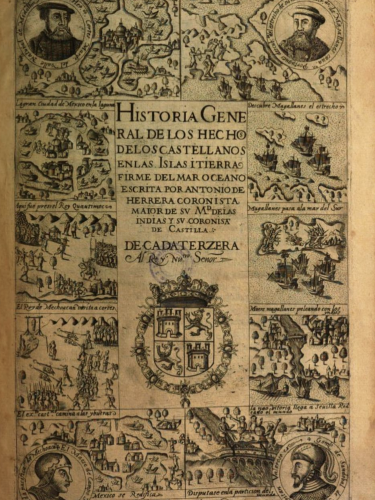
Antonio Herrera y Tordesillas, Historia general de los hechos de los Castellanos en las islas y tierra firme del Mar Océano
Antonio Herrera y Tordesillas, Historia general de los hechos de los Castellanos en las islas y tierra firme del Mar Océano
In addition to petitions that aimed to give historical visibility to the kingdom of Castile, the belief that Castile ranked first among the other reinos was predominant at the royal court and among officials who worked in the consultative organs of the monarchy. It was used as such both by the defenders of Castilian preeminence and by its detractors who wished that their reino would be considered on a par with others. When Portugal entered the composite structure of the Hispanic Monarchy after 1580, debates about having Philip II of Spain (1556-1598) and his court moved to Lisbon bolstered the idea that Portugal could become, instead of Castile, the head kingdom of the monarchy. Although the project never materialized during the Iberian Union of the Crowns (1580-1640), this idea, among others, obliged the Cortes of Castile to remain vigilant about the reputation of the kingdom and its prime position in the territorial hierarchy of the Monarchy. The Cortes redoubled its search for historians willing to celebrate Castile's central role in the history of the Monarchy. As had been the case in Castile during the sixteenth century, the historiographers of the King often benefited from a double appointment as historiographers of the Kingdom. The Cortes petitioned the monarchs for such appointments, since, in practice, the latter were responsible for supporting the historiographers and, often interested in maintaining blurry boundaries between these two appointments. For example, the historian Antonio de Herrera y Tordesillas (1549-1626) composed his Historia general de los hechos de los Castellanos en las Islas y tierra firme del mar oceano as well as his General Historia del mundo, among other works, after having been commissioned to write a Historia de Portugal y conquista de las islas Azores (1582 with a 1591 second edition published in five volumes). In the preface of his History of Portugal, Herrera affirmed that “being Castilian,” [he] did not understand why he couldn't “write the history of Portugal, especially considering that it now forms part of my [his] nation.” Herrera conceived his text as the official answer to Dell' unione del regno di Portogallo alla corona di Castiglia that the Genovese historian, Girolamo Franchi di Conestaggio had published against the Iberian Union and against the political maneuvers of Philip II and his official historians in 1585.
As the King's official historian and as historiographer of the Kingdom of Castile and León and the Indies, Herrera worked for both the monarch and the Cortes. This explains why he provided counsel during the assembly's meetings. As a historian, he was counselor to both royal interests and the assembly, specializing in diplomacy and socio-economic reforms. It is important to note that the Chamber of Castile was the royal institution in charge of calling the meetings of the Cortes and granting privileges and grants (mercedes) to Castilians and other subjects living in Castile, including historians. In practice, the Cortes expressed their opinions on historical matters and individual historians, via petitions to the rulers. Ultimately, such historians depended on royal support. The support of the Cortes was most often indirect, although interpersonal connections between historiographers and Cortes delegates could lead toward other forms of support outside royal and assembly jurisdictions.
Positioned at the center of a complex institutional web, Herrera, as a historical writer, merged in his writing the royal vision of the history of the Monarchy with the history conceived by the elites represented in the Cortes. Of course, the urban elites represented in the Cortes did not share one coherent vision of such a history nor did their vision coincide with those of other elites. However, many among them believed that the official history of the Monarchy and Castile should comprise the history of the services and individual deeds performed by their ancestors on behalf of the Kings and Queens of Spain.
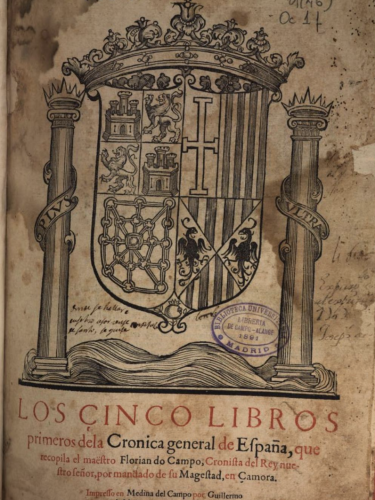
Florian de Ocampo, Los cinco libros primeros de la Cronica general de España.
Florian de Ocampo, Los cinco libros primeros de la Cronica general de España.
At the same time as the Cortes of Castile were supporting legal compilation projects in Castile, the assembly promoted compilations of “histories and chronicles as well as grand things and deeds accomplished by the kings of Castile.” Since the early sixteenth century, the Cortes petitioned to the monarchs that learned aristocrats and historians involved in the administration of the Hispanic Monarchy continue the writing of the medieval chronicles of Castile. At the start of the next century, the Cortes heard the demand of aristocrats with a similar profile to establish a junta (assembly) of historians that would supervise any historical writing dedicated to the history of Castile, the royal court, and the Monarchy. At that time, the Cortes petitioned the King and the Council of Castile to move forward with the project. Such a project almost became a reality under Philip III (r. 1598-1621) during the early 1610s. It nonetheless inspired, later on, the creation of a junta of historians by the Spanish minister, the Count-Duke of Olivares who, under Philip IV (r. 1621-1665), positioned himself as a staunch promoter of a Castilian-inspired union of the kingdoms of the Monarchy (the project was known as the Union de Reinos).
The will to confer historical texture on the activities and negotiations of the kingdoms that composed the Spanish monarchy pushed the Cortes to finance, at different levels, all kinds of historical works, including royal, local and urban histories of the cities that were sending procurators to the Cortes. As seen earlier, they collaborated with royal historiographers, although sometimes they also commissioned historians who did not hold such a title. The Cortes oversaw the polyphony of historical visions that resonated at different territorial scales across the Monarchy. Should the history of Castile and by default, of the Hispanic Monarchy, become an assemblage of the histories of the cities that were represented in the Cortes? Did the historical interests of these cities overlap with the craze for local histories (corografías)? Those and many other questions were left unsolved, but in its eagerness to attribute meaning to the concept of reino, the Cortes participated in the representation of historical traditions that served to articulate as much the inner life of the monarchy and its diverse territories, as its foreign relations.
The historiographical projects orchestrated by the Cortes did not only result in new histories being written, they also contributed to memory erasure and historical censorship. Many territories that were connected to the kingdom, such as the Spanish vice-kingdoms in the New World, were mainly featured through the deeds that Castilians accomplished there. Even in Castile itself, many cities were excluded from Castilian historical narratives: the eighteen cities represented in the Cortes came mainly from Castile and Leon, and the Cortes offered lesser representation to cities located in regions such as Andalucía and Extremadura. Neither the Basque territories nor the lands under the jurisdiction of Military Orders, which all formed part of Castile, obtained representation in the Cortes. Herrera's title as King's historiographer of the Indies remained separate from his other title of the historiographer of the King in Castile. This distinction was made in spite of the fact that the West Indies had been placed under Castilian jurisdiction. Considered as reduced, conquered, and colonial territories, no cities from the Americas obtained representation in the Cortes. These examples show how history could serve to push aside what other historians in the Iberian Peninsula and in the Americas considered to be essential parts of the reino. Herrera's histories served as an excuse to support the integration of the history of other reinos within that of Castile. Although Portugal remained juridically independent after the Union of 1580, history was used to deepen the connected histories of subjects and families who lived between the two kingdoms. The popularity of corografías in Castile and in Southern Latin America at the start of the seventeenth century could be interpreted as a reaction against the alleged and highly publicized monopoly of the writing of history that the Cortes and the royal court claimed in Castile.
The Cortes solidified its hold over historical narratives by relying on professional but also non-professional historiographers. They were interested in the control of local religious histories. Such histories came in handy when creating interpersonal anchors that would add a spiritual meaning to the idea of the reino. The celebration of the lives of Saints associated with the prestige of a city conferred to the reino a sacred aura which was then used by the Cortes of Castile to compete with other Cortes, including those of Aragon, who also cared about historical writings as one of their top priorities for asserting privileges and political status.
New research is also exploring other dimensions connected to the history of the Cortes. Historians are studying further the conflictual and radical dimension of early-modern politics in places such as Spain and Portugal, especially when it comes to learning more about of political participation beyond royal, regional, and municipal institutions. The question of whether and, if so, how far the Cortes contributed to the advent of a modern state has ceased to be the historian's priority.
When looking back at the etymological meaning of the word Cortes, one realizes that the capacity of such an assembly to deal with extraordinary fiscal situations was connected to its vocation to ‘care for' and ‘conserve' the reino and, by extension, the Monarchy. It has since become easier to see how the Cortes focused on these two fundamental concepts of early modern governance: care and conservation. When considering these politics of care and conservation, it becomes possible to analyze a representative institution designed to deal with exceptional demands on society and government. It also becomes possible to ask, for example: What role did the Cortes play in unexpected or extraordinary situations such as the many social crises that Castile suffered throughout the sixteenth and seventeenth centuries? The King was not the only one in need of extraordinary resources to manage such situations.
When facing wars or crises such as plagues, the Cortes also looked for solutions. The Cortes have recently been placed at the core of ground-breaking investigations of historians such as Ruth Mackay, who showed how at the turn of the sixteenth and seventeenth century, a divided Castilian society, including its institutions such as the Cortes, cared in their own terms for the well-being of people during political crisis and epidemic waves. The Actas (written registers) of the Cortes show how its procurators engaged with the most pressing needs of the inhabitants of the Kingdom by supporting new beliefs, social practices, laws, and relationships, that altogether reinforced Castilian political authority and identity.
Of course, this care for care was not only motivated by humanistic compassion nor by care for egalitarian forms of political representation. The Cortes sought to maintain privileges and social exceptionalism as a norm. However, and more than acting as simple spatial-temporal points of contact between the Crown, cities, and local powers, the Cortes modified the dynamic that consisted of always being convoked and consulted from above. In their negotiations on behalf of local powers and when taking positions to reduce tax payments, especially during epidemics, the Cortes offered additional channels of communication and policy-making to find extraordinary solutions (i. e. solutions of emergency) which often had social repercussions far beyond the time of the crisis. The advocacy for the creation of hospitals by some Cortes procurators, the development of social assistance platforms that were not limited to the ecclesiastical sphere, the ability to comfort troubled spirits by the publicity of new local devotions, and even the aforementioned writing of histories, all reinforced the powerful comforting role of the Cortes.
The role of the Cortes in an early modern economy of care needs to receive more attention. More research is needed into the technical and religious aspects of the support that the Cortes offered to or took away from Castilian societies, especially foreigners and migrants who lived in or passed through Castile. Such research will help scholars to fully grasp the role of representative assemblies driven by a certain definition of what care meant socially, judicially, legally, and politically speaking. The need is even more pressing considering the fact that the Cortes were both a repository and a laboratory of political, social, and religiously conservative and radical ideas. When considered together, these ideas deliver to historians today a better sense of how deeply the Cortes intervened in the daily life of Castilian societies from the end of the fifteenth century to the early nineteenth. The history of the Cortes of Castile, among other Cortes, is a good reminder of the importance of the history of the economy of care in the broader history of early-modern parliamentary culture.
Professor Fabien Montcher,
Saint Louis University, Missouri

Further Reading:
Cortes de los antiguos reinos de León y de Castilla publicadas por la Real Academia de la Historia (Madrid: Real Academia de la Historia, 1882), vol. 4-5-18-25, and “Petición de financiación por parte de Antonio de Herrera para la publicación de la tercera y cuarta parte de su Historia general de Indias,” 19-I-1608, vol. 23, p. 732.
Ocampo, Florían de, Los cinco libros primeros de la Crónica general de España, que recopila el maestro Florían do Campo, Cronista del Rey nuestro señor, por mandado de su Magestad en Çamora (Medina del Campo: Guillermo de Millis, 1553).
Herrera y Tordesillas, Antonio de, Historia general de los hechos de los castellanos en las islas I tierra firme del mar oceano escrita por Antonio de Herrera coronista maior de su magestad de las Indias y su coronista de Castilla (Madrid: Imprenta Real, 1601).
Alvar Ezquerra, Alfredo and Gonzalo Gómez García, Los “Padres de la Historia” en Castilla (1476-1688) (Madrid: Universidad Carlos III de Madrid, 2020).
Cardim, Pedro, “Las Cortes de Portugal y la dinámica política en la época moderna,” in Portugal y la Monarquía Hispánica (Madrid: Marcial Pons, 2017), 79-162.
Dubet, Anne “Felipe III, las Cortes y las ciudades. Discurso reformador y negocación política en Castilla (1599-1618),” Mélanges de la Casa Velázquez 34-2 (2004), 59-90.
Kagan, Richard, Clio and the Crown. The politics of History in medieval and Early Modern Spain, (Baltimore, The John Hopkins University Press) 2009.
MacKay, Ruth, Life in a Time of Pestilence. The Great Castilian Plague of 1596-1601 (Cambridge: Cambridge University Press, 2019).