
Unrepresentative Assemblies? Parliamentary Culture in Early Modern Ireland
The case of Ireland is something of an outlier in the longue durée history of European parliaments. Generally speaking, such assemblies enjoy positive press as instruments of representative governance and harbingers of a more democratic politics. In Ireland, however, the institution itself was a colonial import, established under Henry II in the wake of the twelfth-century Anglo-Norman invasion and run in the service of the crown and a settler community. Parliament in Ireland, then, was born an un-representative body. Curiously, being an instrument of colonialism did not insulate it from becoming a victim of colonial power itself. The so-called Poynings’ Law, enacted in 1495, made it so that the Irish legislative body could propose but not enact laws: bills would have to pass through the viceroy, then King and Privy Council, before finally returning to Ireland under the Great Seal of England for ratification. The Declaratory Act of 1720 would reaffirm both Westminster’s ‘right’ to legislate for Ireland and, in so doing, the subordinate status of the local assembly. There is, of course, a nationalist narrative in which a late eighteenth-century iteration of the assembly inspired by radical political developments in contemporary America and France – ‘Grattan’s parliament’ (1782) – plays a star role in the pursuit of pan-insular self-determination grounded in some conceptualization of natural rights theory. And yet that assembly excluded Catholics and, despite the separatist and emancipationist language of some of its members, it was no less in the service of a colonial and creole community than was its twelfth-century forebear. Indeed, it was arguably more impotent than its medieval progenitor in that streaks of independence could be more quickly swatted away by an imperial centre fashioned over time to ensure the subaltern status of such peripheral legislative pretensions.
That said, the ‘culture of parliament’, and of representative assembles more generally, in Ireland is more complex than simply a tale of colonial domination and ‘Atlantic revolutions’. On the one hand, while the institution of parliament was a colonial import, the phenomenon of representative assemblies had a long and rich indigenous lineage. Political and social life across the island was marked by gatherings deemed to have some charge for the collective good. Famously, the Gaelic political system ran differently than the neighboring system in England. In spite of some instances of functioning, central monarchy in the medieval period – most famously the high kingship of Brian Boru from 1002-1014 – Ireland’s political landscape consisted of a mosaic of smaller, regional kingships. Those monarchies did not practice primogeniture. Instead, succession followed a more dynamic process by which any of a number of potential male claimants – collectively known as the deirbhfine – could be rí (king). As such, the very procedure of determining and maintaining executive authority was always more ‘democratic’ than in England and most of continental Europe and some form of counsel and negotiation was inherent in the system and necessary for establishing leaders’ legitimacy. The most dramatic performance of such community representation occurred at the oireachta, gatherings – be they indoors or out – of the ‘political nation’ which featured various forms of spectacle and ritual befitting their importance. Like the English parliament, such deliberative assemblies appeared and disappeared at the executive’s pleasure. Nevertheless, they constituted an ‘institution’ in the sense that they were a recognized and necessary element of the political process and social landscape, but still operated as an ‘event’ given their irregularity of convening and dependence upon royal will.

The chief of the Mac Sweynes seated at dinner and being entertained by a bard and a harper (from: John Derrick, The Image of Irelande (London, 1581), available through the website of the University of Edinburgh).
‘Parliamentary culture’ in Ireland over the medieval and early modern periods, then, was marked more by bricolage and syncretism than of strict ethnic exclusion. separate spheres. Gaelic lords attended sittings of parliament over the centuries, and Irish-language annals and poetry bear occasional mention of these events. An entry in the Annals of Loch Cé in reference to the year 1585 demonstrates knowledge of and contact with these political assemblies, but also aspects of fear and anxiety regarding them:
Fir Erenn uile, do neoch dob inairimh dib, do dol go Baile Atha Cliat dochum acta pairlimint. Mac Uí Maoilmuaid, ocus Emann Dorcha mac Domnaill mic Murchada mic Suibhne, ocus daoine imdha oile, do crochad ar an acta pairlimint sin. Maithe Erenn do theacht slán on comairle sin Atha Cliat gan tarba.
‘All the men of Ireland – such of them who were of any account – went to Dublin to an act of parliament. The son of Ó Maoilmuaidh and Éamonn Dorcha son of Domhnall son of Murchadh Mac Suibhne, and several other persons, were hanged at this act of parliament. The nobles of Ireland came safely from that council of Dublin without profit’. (From: The annals of Loch Cé: a chronicle of Irish affairs from A.D. 1014 to A.D. 1590, vol. ii; William W. Hennessey (ed. and trans.), (London, 1871), pp. 466-67. I’ve slightly altered the translation to make clear that ‘Baile Atha Cliat’ refers to Dublin, and I've kept the Irish spelling of Irish personal names.)
As for the descendants of the twelfth-century Anglo-Norman invaders, and subsequent English settlers who followed in their wake, they frequently took on aspects of Irish political (and wider) culture. Referred to in the scholarly literature as ‘Gaelicization’, but as ‘degeneration’ to contemporary observers like the poet/colonist Edmund Spenser in his A view of the present state of Ireland (1596), such cultural blending became a standard feature of ostensibly loyalist, English lieges and lineages. The Butlers of Ormond offer an excellent example of this semi-assimilationist phenomenon and its changing characteristics over time. In the sixteenth century, Thomas Butler, the 10th earl of Ormond and cousin to Queen Elizabeth I, was the crown’s man for managing the unpredictable post-Reformation parliaments (however infrequently they convened). Simultaneously, he was no stranger to Gaelic forms of political assembly and rites of legitimacy: whereas his primary residence at Carrick-on-Suir boasted a long room encircled at ceiling level by repeating plaster moldings of Elizabeth I and Edward VI, it was simultaneously celebrated in the poem beginning ‘Taghaim Tómás’ (I choose Thomas; anonymous) as the richest, strongest, noblest and grandest court in the land. Given the family’s comfort with multiple political and cultural forms, it was no accident that Charles II believed the Protestant James Butler, 1st Duke of Ormond, to be his man for Ireland in attempting a rapprochement between parliamentary and royalist factions post-Restoration.
From an institutional standpoint, the syncretic quality of Irish ‘parliamentary’ culture peaked in 1642 with the establishment of the Confederate Catholics’ ‘General Assembly’. This body served as the legislative branch of a self-governing kingdom loyal to the English monarch but – unsurprisingly! – opposed to the English Parliament. At its sessions could be found members of Gaelic, Old English and English stock. There was even a territorial Butler/Ormond connection in that the Confederacy and its governing bodies were based in Kilkenny, one of the family’s ancestral strongholds. While linked to various traditions of representative government found across lines of cultural and social difference in Ireland throughout the medieval period, the fledgling state was innovative in linking its assembly to a multi-headed executive – or ‘Supreme Council’ – that would ensure some checks and balances without setting up a singular figure whose authority might appear to rival that of the king. Built in a time of confessional crisis, however, the ‘General Assembly’ was by design exclusionary. The legislative arm of a ‘Catholic Confederacy’ could hardly be otherwise.
The late seventeenth century would prove the nadir of representative political assemblies and thought in early modern Ireland. Most obviously, the Parliament based in Dublin excluded Catholics. More than that, it was driven by a desire to ensure that exclusion in perpetuity, something which put it at odds with not only the crown but with its legislative counterpart in Westminster. An independent streak it may have had, but it was one that only looked modern if apartheid is the comparison. Equally worrisome for representative politics was the disappearance of much of the conciliar and – dare I say – democratic impulse of the Gaelic system. Where once the input of intellectual élites (bards and clergy) and the holding of the oireacht were deemed necessary for legitimising power, now was found a political imaginary focused almost solely on the Stuart restoration and expressed most famously in a poetical genre of longing, the aisling or vision poem, that saw Ireland’s salvation in the coming of a rightful king from across the water to rescue a feminized Ireland. Caught as it was between a ferociously exclusionary Protestant parliament and an increasingly monarchical/royalist Catholic majority, representative government was on hard times at the start of the modern era.
Sectarian exclusion was not the sole challenge to the practice of representative government in early eighteenth-century Ireland, faced as it was with an increasingly muscular move on the part of the Westminster parliament to legislate for the western realm. Largely as a result of the need to vote regular supply to support the massive standing army stationed in Ireland, the Irish Parliament had begun meeting regularly for the first time in its history in the wake of William III’s success on the field. Biennial meetings would characterize the ensuing century. Such institutionalisation would not prove guarantee of autonomy, however. Repeated effort by members of this now uniformly Protestant legislative body to claim ‘sole right’ to initiate money bills was complemented by increasingly vociferous rhetoric about the constitutional, indeed natural, right to legislative self-determination. At stake in these nascent party politics – such agitation being primarily a Whig phenomenon – was neither union on the model of that concluded with Scotland’s parliament in 1707 nor separatism. Rather, it was effort to define, institute, and practice what ‘patriot’ pamphleteers like William Molyneux and Jonathan Swift believed were the rights of a constitutionally recognized realm within a multiple monarchy state system. Lawmakers in Westminster were having not of it; they sniffed an independent streak that needed snuffing out. The Declaratory Act (1720) would do just that, declaring as it did Ireland’s ‘subordinate’ and ‘dependent’ status under the British crown and enshrining in law that ‘the King’s majesty, by and with the advice and consent of the lords spiritual and temporal and commons of Great Britain in parliament assembled, had, hath and of right ought to have full power and authority to make laws and statutes of sufficient force and validity, to bind the kingdom and people of Ireland’.
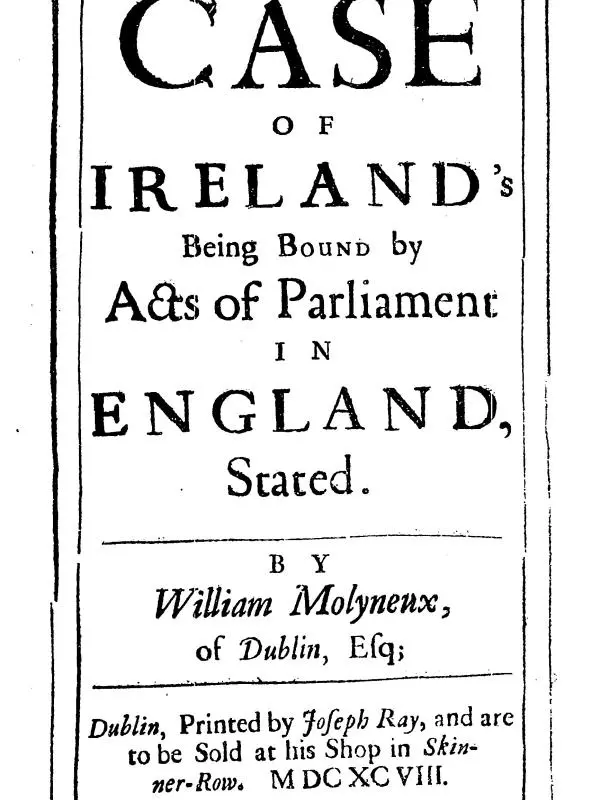
Title page of William Molyneux’s influential pamphlet in support of the legislative agency of the Irish Parliament (“Eighteenth Century Collections Online,” Gale Primary Sources, document number GALE|CW0100466875])
The place of parliaments – broadly construed – in Irish political life remains a complex matter in the modern era. Whereas O’Connellites in the nineteenth century fought for Catholic emancipation and the right to sit in Westminster, Sinn Féin revolutionaries in the twentieth boycotted it and established their own parallel assembly – the Dáil – to serve the republic they sought to invoke. Eventually, a bicameral legislative body would be established for the Republic of Ireland, consisting of the Dáil and the Seanad and bearing the title of Oireachtas (related to oireacht, mentioned above). The Northern Ireland Assembly (Stormont), established in 1998, has experienced its own challenges with various disagreements, boycotts, and obstructionist tactics among political parties leading to multiple and extended periods of suspension. These present-day stumbling blocks – which might be seen to echo the experience of faction in an earlier time – remind us of the complicated matter of representation that lies at the conceptual and practical heart of such assemblies. They also suggest the value of adding the Irish case, and of considering ‘internal’ colonialism in other settings across the continent, as we look to reconstruct the culture(s) of early modern European parliaments.
Brendan Kane, University of Connecticut
Further reading:
Primary sources
Osborn Bergin (ed. and trans.), Irish bardic poetry (Dublin, 1970).
William Molyneux, The case of Ireland's being bound by acts of Parliament in England, stated; Patrick Hyde Kelly, ed. (Dublin, 2018).
Duanaire Dháibhidh Uí Bhruadair = The poems of David Ó Bruadair, 3 volumes; John MacErlean (ed. and trans.) (London; 1910, 1913, 1917).
Edmund Spenser, A view of the present state of Ireland (https://celt.ucc.ie/published/E500000-001/).
Nicholas Williams (ed. and trans.), Pairlement Chloinne Tomáis (Dublin, 1981).
Secondary literature
Marc Caball, Poets and politics: continuity and reaction in Irish poetry, 1558-1625 (Cork, 1998).
Coleman Dennehy, The Irish Parliament, 1613-89: The evolution of colonial institution (Manchester, 2022).
Bríd McGrath, The operations of the Irish House of Commons, 1613-48 (Dublin, 2023).
Michelle O Riordan, Poetics and polemics: reading seventeenth-century Irish political verse (Cork, 2021).
Katharine Simms, From kings to warlords: the changing political structure of Gaelic Ireland in the Later Middle Ages (Woodbridge, 1987).