The Imperial Diet
The Imperial Diet of the Holy Roman Empire of the German Nation was an integral part of Europe's multifaceted ecclesiastical-political culture of collective consultation. Both the designation of the assembly as the Imperial Diet and the designation of the Teutsche Nation (German Nation) as the successor to the Holy Empire date back to the time around 1500. These semantic innovations reflect the fact that from this time onwards the practice of meeting and deliberating took on a new quality. The late medieval 'imperative of efficiency' (to quote Michel Hébert) reached the Empire, albeit late in comparison with the south- and north-western parts of Europe. Frequent and often fruitless deliberation seemed to contemporaries increasingly incompatible with the challenges of their time. With the claim that deliberation had to produce a result that was binding for all members of the Commonwealth, as the 16th century drew to a close something new gradually emerged that could be described pictorially. As far as we know today, this image from 1598 is the first printed pictorial representation of a European Assembly of Estates. The broadsheet illustrates what this emerging institutional order had in common with other political assemblies, but also what distinguished it from them.
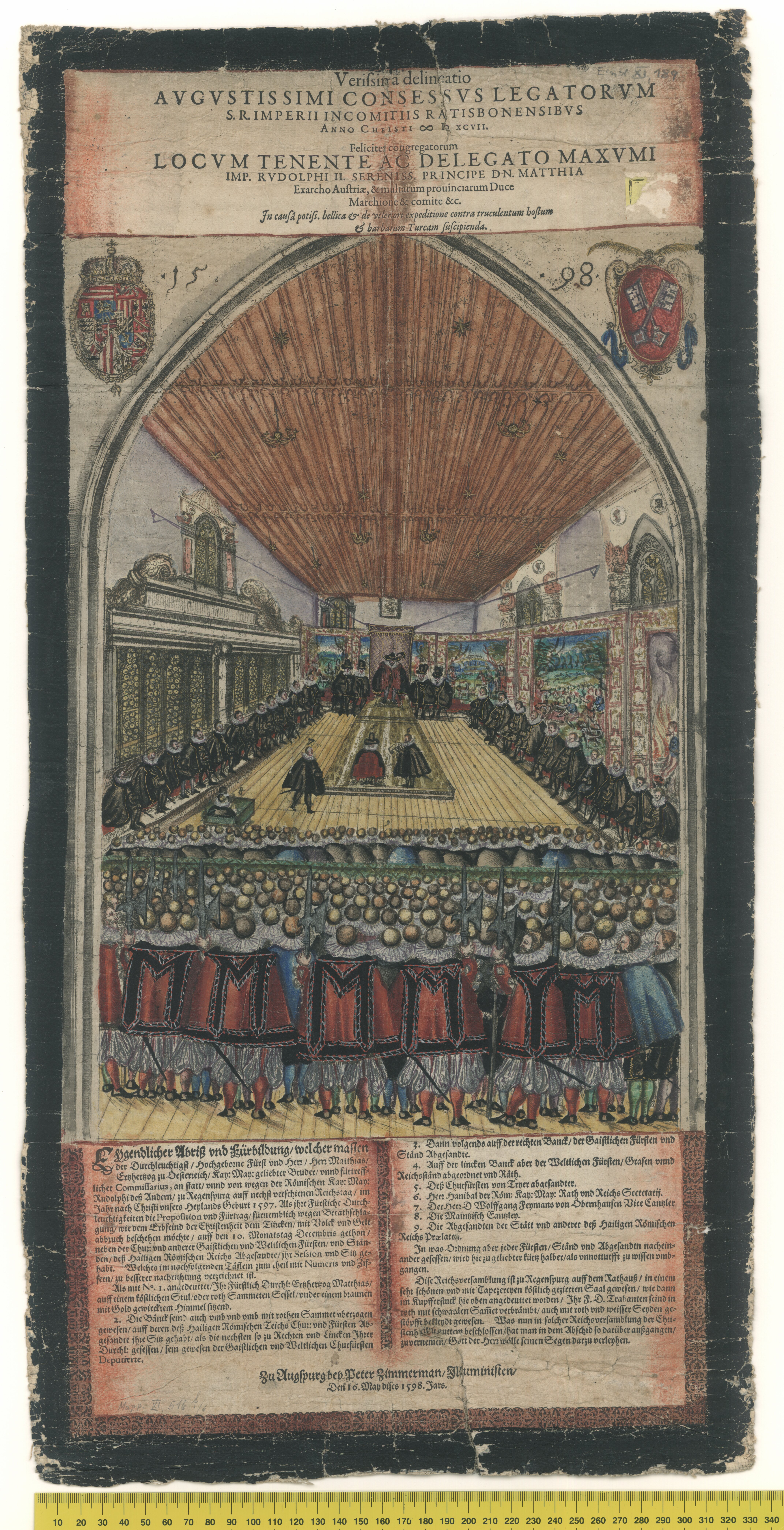
Wilhelm Peter Zimmermann, Verissima delineatio (…), Augsburg 16. Mai 1598 (63 x 30 cm, etching: 42 x 30 cm)
Wilhelm Peter Zimmermann, Verissima delineatio (…), Augsburg 16. Mai 1598 (63 x 30 cm, etching: 42 x 30 cm)
One difference, however, which iscritical in the historiography of the Imperial Diet, is only indirectly apparent in the ‘poster'. The Augsburg-based producer and publisher Wilhelm Peter Zimmermann († 1630) came from the Teutonic Nation, namely from Savoy. Like Germania, Teutsche Nation is not an ethnic but a political concept in contemporary understanding. And as spatially imprecise as it is, it cannot be appropriated in terms of the nation-state. Of all the European assemblies of Estates, the Imperial Diet eludes national appropriation the most, which is the reason why it is largely incompatible with the still dominant ‘single nation' framing of research into early-modern political assemblies.
Zimmermann's picture, whose Latin title is repeated in the vernacular and which is explained in more detail in the caption, precisely locates the event depicted in space and time. It is the ceremonial opening of the Imperial Diet on 10/20 December 1597, the central element of which is the reading of the Emperor's proposition by one of his secretaries. Andreas Hanniwaldt (not “Hanibal” as in no. 6 on the key), was his name in 1597. The blazing fire on the right-hand side of the picture draws attention to a feature of such meeting rooms that can be found throughout Central Europe (as shown by Petr Mat'a). Like the Auditorium of the Regensburg town hall depicted here, assembly halls could be heated.
The type of picture with the ruler sitting in maiestate in the centre and the participants sitting with him can be found in continental Europe as well as in England. What is portrayed is very different to assemblies such as the Swiss Tagsatzung or the Dutch States General: here, those present, both literally and figuratively, do not meet on the same level, but they are the political body consisting of head and limbs. This imagery expressed the nature of the forthcoming deliberation. It was performed, and thus underlined, at the opening of each assembly. The reminder was essential. For even though Imperial assemblies were held more than 30 times up to the outbreak of the Thirty Years War and 20 of these Diets lasted longer than three months, there were long years and decades in which no one was summoned to a Diet (1533–1539, 1583–1593, 1614–1639).
Two details of the depiction point to something that distinguishes the Imperial Diet from late medieval imperial assemblies as well as from other European assemblies of Estates. One is the fact, made prominent in both title and caption, that it was not the monarch himself, Rudolph II (r. 1576 - 1612), but his brother Matthias who was present as his deputy. The other is an apparently trivial feature of the seating. The caption describes how the monarch sits elevated on an "armchair" and that this "precious chair" is covered with red velvet, as are the benches. Red and white are the heraldic colours of the Holy Empire and not, like black and yellow/gold, those of the monarch. That is to say, the Emperor is ideally as well as in fact, and like other monarchs, the head of the polity and therefore sits elevated. But at the same time, he is related to the Empire (in colour) in the same way as the others present. He exercises the office of a trustee, the exercise of which he can delegate to a proxy. In the formula of the sovereign as the "Mehrer des Reiches", this idea is an integral part of the Emperor's title.
It was Maximilian I (r. 1486/93 – 1519) who, in order to commit the German high nobility to his financial and military ambitions, felt compelled to no longer base his extensive demands merely on monarchical authority and the duty of assistance owed to him personally, but to "objectify" them (in the words of Ernst Schubert). Just as he himself was obliged as king and trustee to serve the Holy Empire and Christendom, he likewise communicated this service as the duty of the German Nation. The contradiction between the traditional monarchical claim to authority and the now postulated equality with regard to the common service of the Holy Empire, along which the Imperial Diet took shape, was irresolvable. It had far-reaching consequences in both the short and long term, and because it produced these consequences, it became more and more obvious.
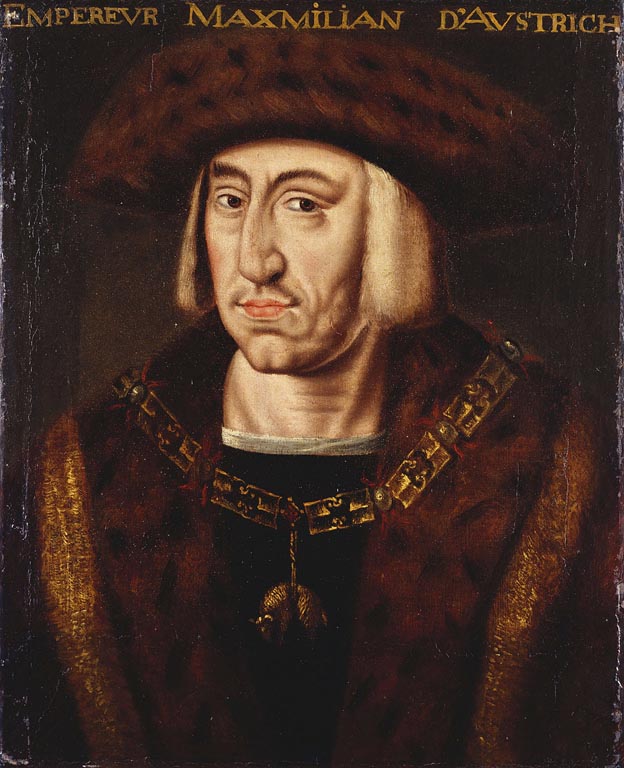
After Master of Frankfurt (1460 - c.1533), Emperor Maximilian I (1459-1519). Oil on canvas | 55.2 x 44.7 cm. Royal Collection Trust.
After Master of Frankfurt (1460 - c.1533), Emperor Maximilian I (1459-1519). Oil on canvas | 55.2 x 44.7 cm. Royal Collection Trust.
From 1495 onwards, all emperors were excluded from the consultations of the German Nation, or stood ‘at the door', as Maximilian I indignantly put it in 1497. Only in the plenary sessions at the beginning and at the end of the Diets could amicable cooperation be shown to be the modus operandi of the body politic. And no matter how much thought was put into defining the Forma Imperii in terms of political theory from around 1600 onwards, it was not able to resolve the contradiction, but only made it sharper the longer it lasted. Samuel Pufendorf's (1632 -1694) famous dictum that the Empire resembled a monster ("monstrum simile") sums up the impossibility of classifying this political entity in the traditional categorical grid of monarchy, aristocracy and democracy. It was precisely for this reason that the Empire's political fabric attracted the attention of the founding fathers of the American Constitution in Philadelphia.
The construction of the Holy Empire as a political entity shouldering common burdens, above all to oppose "the hereditary enemy of Christendom the Turk", as Zimmermann's print puts it, was also decisive for its composition. Invitations to the Imperial Diet were no longer issued arbitrarily as they had been to the medieval royal Court. The Imperial chancellery addressed those who were listed with the shares, which they had to pay for the financial and/or military services decided on at the Imperial Diet ("Reichsmatrikel"). The form of the compilation represents on paper what Zimmermann depicts in space. As with other representative assemblies, e.g. the English Parliament, proximity and distance to the monarchical centre and postures, sitting and standing, communicate who is the primary focus - the high nobility as spiritual and secular lords. Separated from the circle of sitters by a bar, the 'emissaries of the cities', as Zimmermann informs the audience, attend the opening of the Imperial Diet standing.
The group of princes electing the King, the Electors, since the 15th century derived their claim to a voice in the election not from the king but from their responsibility for the Empire. Maximilian I's transfer of the Holy Empire to the German Nation had been in part an attempt to neutralise this assertion of primacy. As the picture shows this was in vain. The electoral representatives, recognisable by their hats, still sit next to the king. And since the secular electors, under completely different conditions, also wore royal crowns in the 18th century, their distance narrowed further, both ideally and in terms of power politics (the Elector of Saxony was incorporated in the kingdom of Poland, 1697-1706, 1709-1763; the Elector of Brandenburg was incorporated ‘in' the kingdom of Prussia from 1701 ("in") /1772 ("of"); the Elector of Hanover was incorporated in the kingdom of Great Britain from 1714). The opposite was true for the autonomous cities (“Freie Reichsstädte”), most of which were subject to royal rule. It was not until the 1540s that they were integrated into the consultation process on a regular basis. At the end of the 16th century, the visual correspondence of the Regensburg city coat of arms (right) with the large coat of arms of Emperor Rudolph II (left) is evidence of this gain in position. In the time of the “Permanent Reichstag” (1663-1806) however, it did not translate into a position of corresponding political importance. Until the second half of the 17th century, the group of both princely and non-princely high nobility remained quite heterogeneous. And even if Zimmermann declared it unnecessary to know anything about the "order" in which they "sat one after the other", this seating order, which defined one's place in the polity, was fought over bitterly, albeit increasingly routinely and to little detriment to the deliberative process.
The composition of the Reichstag thus presents itself as one of the many variations on a basic theme, resulting from the very different geographical, geopolitical as well as socio-economic conditions from which the European assemblies of Estates unfolded. Singular, however, as far as I can see, is the development that again already appears in the title of the print. From the second half of the 16th century onwards, the Imperial Diet increasingly became a "Consessus Legatorum" - a gathering of representatives of their noble lords, who originated from the urban bourgeoisie and the lower nobility, including an increasing number of graduated jurists. As far as we know today, an average of eight out of ten were mandataries of third parties, and from 1663 onwards only authorised envoys gathered at Regensburg's town hall. Therefore, the Imperial Diet was less and less able to fulfil its function of being the monarch's "point of contact" with the powerful of his realm. As long as the Imperial Diet was both a festive Court and an Imperial Diet, as it was, for example, in the 1540s, it was the Empire's most important stage of the political theatre. The more businesslike and professional it became, the less it was able to fulfil this function in a society shaped by feudal logic. This was one reason, but not the only one, why its deliberations were unable to counteract the escalation of military violence from 1608 onwards.
The fact that in 1640, after more than a quarter of a century without a meeting, a Diet was convened again is proof that in the Empire, as elsewhere, rule without participation did not function in the long term. From 1663 onwards, the Diet met continuously because the structural contradiction that characterised the Imperial Diet as an institutional order was eluding active management. Thus, the deliberations could no longer be concluded with what appears in Zimmermann's work as the decisive element of Imperial Diet deliberations - a published result ("Abschied"). However, especially in the time of Louis XIV (r. 1642/61 – 1715), the protection and defence of the Empire was still organised from Regensburg in cooperation with the Emperor, and agreements were reached on matters that had already been discussed in the 16th century as serving the Common Weal.
Above all, the Permanent Reichstag became to an even greater extent what it had always been - a communicative hub of European politics. In addition to the envoys' reports of the representatives of the Imperial estates, which were already being extensively distributed in the 16th century and were often accompanied by "Zeitungen", i.e. current news, extensive reports from foreign diplomats were increasingly passed around. Furthermore, another characteristic of the Diet's history since the beginning of the 16th century became more and more dynamic. Printed media – pamphlets and leaflets as well as periodical summaries of the most important news (“Meßrelationen”), newspapers and magazines – made information about Regensburg events and European politics increasingly accessible to a wider audience.
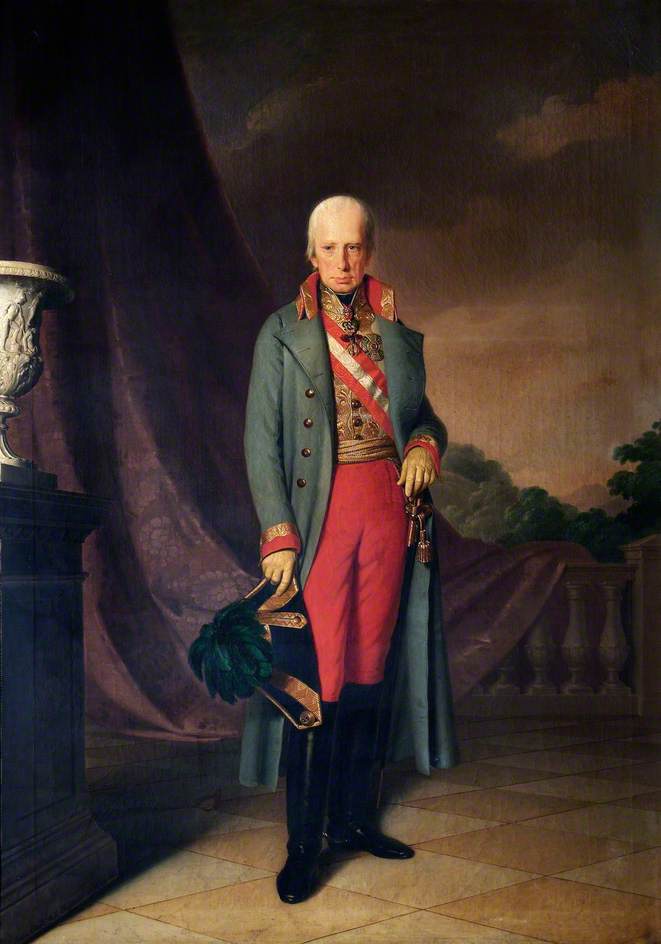
Anton Einsle (1801–1871), Francis II (1768–1835), Emperor of Austria. Oil on canvas (232 x 158 cm). Historic England Archive.
Anton Einsle (1801–1871), Francis II (1768–1835), Emperor of Austria. Oil on canvas (232 x 158 cm). Historic England Archive.
The decisions, though, concerning the fate of the German Nation, which had now become 'Teutschland', the last of which was the dissolution of the Imperial Diet by Emperor Franz II (6 August 1806), were no longer made in Regensburg but at the Courts of the powerful secular Imperial princes, above all in Vienna and Berlin. Learning from the aporias of the past 60 years, Europe's centre was re-established in Vienna in 1814/15 in a new institutional guise as a "federative nation" (to quote Dieter Langewiesche), the German Confederation. This was achieved because all the diplomats present in Vienna were in no doubt that, according to the envoy of the former Electorate of Hanover, a new 'representative system' was needed. Their conviction is inconceivable without the centuries-long history of political participation, including at the Imperial Diet.
Professor Gabriele Haug-Moritz,
University of Graz
Further Reading:
Primary Sources (Diet: until 1654)
Deutsche Reichstagsakten, edited by Historische Kommission der Bayerischen Akademie der Wissenschaften, series: Ältere Reihe (1376-1493), 1867ff.; Mittlere Reihe (1493-1519), 1972ff.; Jüngere Reihe (1519-1555), 1893ff.; Reichsversammlungen (1556-1662), 1988ff. (in detail: https://www.historischekommission-muenchen.de/publikationen.html).
K. Rauch (Bearb.),Traktat über den Reichstag im 16. Jahrhundert (…), 1905.
Primary Sources (Diet: 1663 – 1806)
A. Faber [= Christian Leucht], Europäische Staats-Cantzley, 115 Teile, 1697–1710.
J.J. v. Pachner von Eggenstorff, Vollst. Sammlung aller von Anfang des noch fürwährenden Teutschen Reichs-Tags de anno 1663 biß anhero abgefaßten Reichs-Schlüsse, 5 Bd.e, Regensburg 1747, hg. und mit einem Vorwort versehen von J. Burkhardt und K. O.v. Aretin, 1996.
C. Th. Gemeiner, Geschichte der öffentlichen Verhandlungen des zu Regensburg noch fortwährenden Reichstags von dessen Anfang bis auf neuere Zeiten, 3 Bd.e, Nürnberg 1794-1796, hg. v. S. Friedrich, 2010.
Secondary literature (Short titles):
[Imperial Diet around 1500]
P. Moraw, Versuch über die Entstehung des Reichstags, in: G. Haug-Moritz (Hg.), Verfassungsgeschichte des Alten Reiches, 2014, pp. 133-170 [1980].
E. Schubert, König und Reich, 1978.
[Imperial Diet 1500 – 1654]
Th. F. Hartmann, Die Reichstage unter Karl V. (…1521–1555), 2017.
M. Lanzinner/A. Strohmeyer (Hg.), Der Reichstag 1486-1613. (…), 2006.
H. Neuhaus, Reichsständische Repräsentationsformen im 16. Jahrhundert, 1982.
W. Schulze, Reich und Türkengefahr im späten 16. Jh., 1978.
C. Zwierlein, Deutsche und italienische Staatsbeschreibungskunst. Die Einkünfte aller Reichsstände, ca. 1547748 nach einer unbekannten Quelle, in: Zeitschrift für Historische Forschung 39 (2012), 593-660.
[Imperial Diet 1663-1806]
K. Härter, Der Immerwährende Reichstag (1663–1806) in der historischen Forschung; <http://www.zeitenblicke.de/2012/2/Haerter> ; 2022-10-22).
M. Rohrschneider, Österreich und der Immerwährender Reichstag. (… 1745-1763), 2014.
H. Rudolph/A. v. Schlachta (Hg.), Stadt – Reich – Europa. Neue Perspektiven auf den Immerwährenden Reichstag zu Regensburg (1663–1806), 2015.