
The House of Assembly of Jamaica
This article was contributed by Dr Graham shortly before he passed away in April 2023. It is published here in memory of a brilliant scholar and a wonderful colleague, who is greatly missed.
From its first session in 1664, only a few years after the conquest of the island, to its last in 1866, shortly after the Morant Bay Rebellion, the British colonists of Jamaica exercised power through an elected legislature known as the house of assembly. As by far the largest colonial legislature in the British Caribbean, and one of the largest within the wider British Atlantic, as well as one of the most active, it was enough of an institution for it to develop its own political culture. This came to reflect both the English political culture of the seventeenth -century, which it inherited, along with a range of precedents, privileges, processes, procedures, practices and priorities, and the economic, social, political and cultural circumstances of Jamaica, and island that rapidly became the single largest component of the British plantation complex in the early modern Caribbean. Dealing first with its institutional development and how it differed from the English or British trajectory, then with its practices, politics and its political culture up to the major watershed of 1729, when its privileges were finally definitively confirmed by the imperial government, this piece argues that the house was a ‘creole' creation. English practices were picked up or discarded as necessary to meet the needs of planters, in their efforts to defend a brutal system of slavery and radical discrimination while at the same time preserving their own privileges against imperial authorities who eventually, in the early nineteenth century, tried to intervene on behalf of free and enslaved people of colour. Examining the political culture which planters created helps to explain why this process took so long.
In the decades between its first meeting in 1664 and the passage of the Revenue Act in 1729, the assembly evolved rapidly in its institutional form, as might be expected not only from its own internal developments but also from the wider socio-economic development of the colony. The white population rose from about 6,000 to 8,000, while the number of enslaved people of colour exploded from about 1,500 to 85,000 during the same period, and exports of sugar and other plantation commodities rose accordingly. Planters were increasingly wealthy, and increasingly convinced of their own importance to the British Empire, and felt that their politics and legislature had to reflect their new social and cultural status. At the same time, the growth of the black population created new fears about slave revolts and black resistance, as the example of other islands suggested, making it increasingly important for planters to have a legislature which would allow them to take measures to combat this threat. For example, the ‘slave codes' which developed in Barbados in the late seventeenth century and spread to other islands were vital in firmly establishing the principle of chattel slavery, and the rights of planters to buy and sell people and exercise almost unchecked power over their ‘property' in order to maintain discipline and head off resistance, but were a product of assemblies in Jamaica and other islands passing legislation which granted the necessary powers, since English common law offered no basis for chattel slavery. Alongside this key element were a range of other legal powers which planters needed to manage their new environment, ranging from measures establishing courts of justice to laws regulating boats and wherries, the repair of highways, the enrolment of land deeds, and even, optimistically, ‘against tippling, cursing and swearing'. To meet these needs, the most immediate model which planters had to hand was the English Parliament, at least as it existed in the mid-seventeenth century, which planters had to adapt to their own needs.
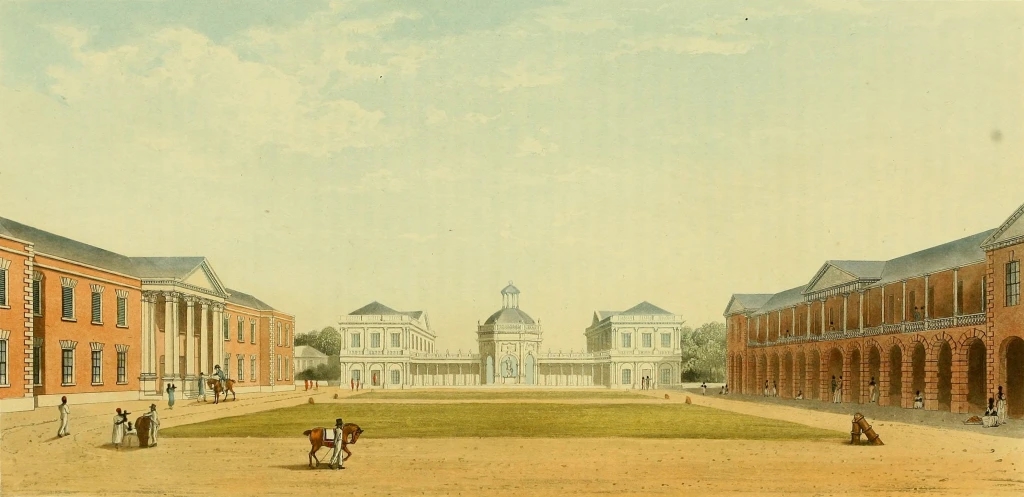
King's Square, Spanish Town, 1820-21. Taken from James Hakewill's A Picturesque Tour of the Island of Jamaica (1825).
King's Square, Spanish Town, 1820-21. Taken from James Hakewill's A Picturesque Tour of the Island of Jamaica (1825).
What emerged, as in other colonies in the British Atlantic, was an institution that superficially resembled its English model in key respects but increasing diverged in others. In a political system where the governor represented the authority of the Crown the assembly was, by anology, the lower house of the Parliament, with the appointees of the privy council of the island forming its upper house. There were thirty members, chosen by the white freeholders of the island, though as it was settled and districted these members were chosen by constituents in each parish. Both members and electors had high property qualifications intended to limit who could exercise power. Though there was, and would remain, violent disagreement over whether the council had the right to initiate and amend legislation, especially concerning revenue, it was widely accepted that, as in England, the agreement of the lower house was necessary for legislation of any sort to be passed. However, the Jamaican assembly, like many other colonial legislatures, also diverged in growing ways from the English Parliament, at least as the latter developed during the late seventeenth and early eighteenth century. Though it did not suffer the same tight limitations of the Irish Parliament under Poynings' Law before 1782, all colonial legislation was subject to veto by the Privy Council (on the advice of the Board of Trade and its predecessors), especially if it was deemed incompatible with English law. This made for considerable friction, not least since Privy Council might choose to override the assembly on the lobbying of metropolitan interest groups who did not represent colonial opinion. At the same time, the house preserved a separation between the executive and the legislature which became blurred in England after 1688; though colonial officials did sit in the assembly, and were expected to further the imperial government's legislative agenda, colonial government was not yet either ‘representative' or ‘responsible', so the assembly remained an arena where differences between the Crown and people would be hammered out, rather than a sphere of collaborative action.
As a result of both external developments and the internal political conflicts which emerged between 1664 and 1729, the house of assembly in Jamaica therefore likewise moved from being an event to an institution. It met twice, in 1664 and 1665, then not until 1672, and only from 1700 could colonists rely on it meeting each year. The number of days spent in session only rose gradually, from 25.6 days per year in the 1660s to 42.9 days in the 1690s before stabilising at between 70 and 80 days for the eighteenth century. The increase in the days spent in session meant that the assembly was more able to hear petitions and pass legislation, and thereby carry on the business not just of the imperial government but also of colonial interests. For example, only two petitions were heard during the 1670s, but this would steady increase until by the 1720s the assembly heard 7.6 petitions per year. The expansion of legislation during this earlier period is more complicated to calculate, since the raw numbers are distorted by the efforts of the imperial government during the 1670s and 1680s (discussed below) to force packages of pre-prepared legislation down the throats of the assembly across multiple sessions. However, once this was given up and members of the assembly permitted to take control of the process, the total numbers of bills gradually increased, from 52 in the 1680s to 83 in the 1720s, and the capability of the legislative process likewise grew. Although the chance of bills failing increased from about 40 per cent in the late seventeenth century to 70 per cent in the early eighteenth century, reflecting frequent conflict with the imperial government while it attempted to control the legislative agenda, the efficiency of that legislative agenda was slowly increasing. In the 1680s the members had only been able to debate 0.27 bills per day, but this had risen to 0.38 bills per day by the 1720s, and it would remain at this level until the mid-eighteenth century. By 1729 it was therefore a permanent part of the colonial political landscape, allowing the development of its own political culture.
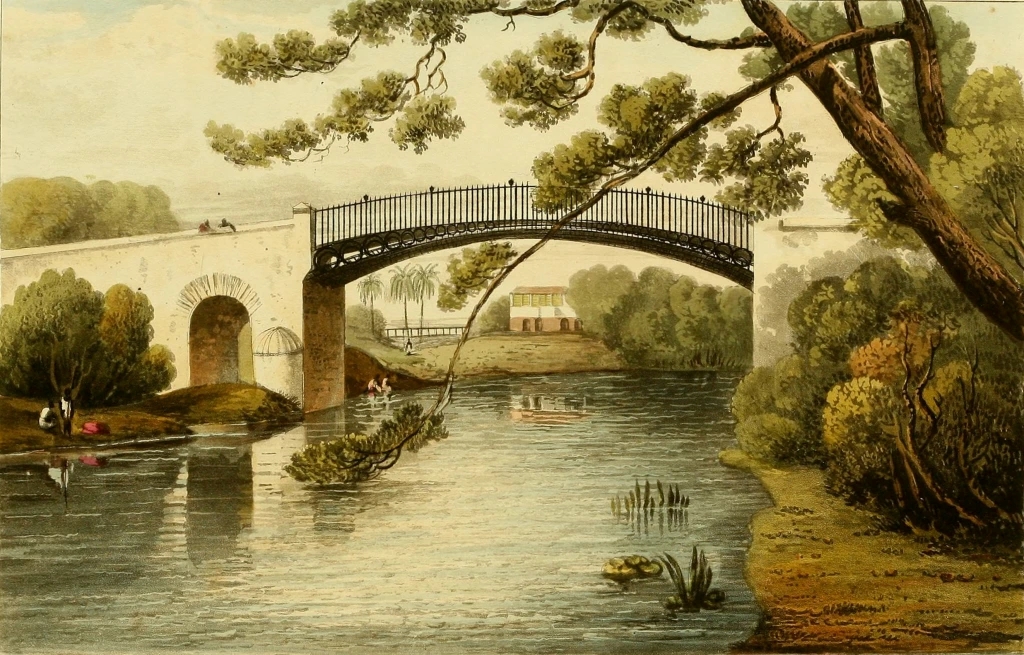
Bridge over the River Cobre, Spanish Town. Taken from James Hakewill's A Picturesque Tour of the Island of Jamaica (1825).
Bridge over the River Cobre, Spanish Town. Taken from James Hakewill's A Picturesque Tour of the Island of Jamaica (1825).
There remained a tension though in the operation of the assembly throughout and beyond this period. On the one hand, both the Crown and the colonists needed the assembly for their respective purposes. These sometimes overlapped, especially when it came to the economic and social development of the island, but could also be in conflict, such as when the Crown demanded that the planters take on the costs of the government and garrison and raise taxes. As a result, on the other hand, both sides worried about what would happen if the other managed to seize control of it. A consequence was the formation of a highly confrontational political culture that was marked by repeated clashes in the assembly between governors and colonists, resembling and sometimes exceeding similar collisions in other colonial legislatures across the British Atlantic. Colonists repeatedly insisted that their assembly was in every respect a mirror of the English Parliament, possessing the same powers and privileges, even as the events of the Glorious Revolution began to alter relations in Britain between the Crown and Parliament. This was rooted in their birthright as Englishmen, as embodied in the common law and the ‘ancient constitution', which had in key respects been transmitted to Jamaica and provided its fundamental and underlying corpus of law. Imperial initiatives, particularly those which threatened colonial interests, such as clamping down on privateering, piracy and smuggling, were all strongly opposed in the assembly, as was the idea that colonists should grant a permanent revenue, on the grounds that this directly trespassed on their liberties. As in British America in the 1760s and 1770s, one key element in this political culture was not just confrontation but conspiracy, which read all imperial moves as harbingers of an attack on their liberties. This even had some justification, since up to the 1690s the Crown made a series of manouveres intended to tamp down Jamaican legislative autonomy. Besides unscrupulous moves such as opportunistically declaring martial law to override the constitution, ministers attempted to impose a version of Poynings' Law in 1678 that would have blocked the assembly from initiating bills, and when this failed, the governor then embarked on an attempt in 1687 to ‘pack' the assembly with his supporters.
The claims of members of the house of assembly of Jamaica to have inherited fully the powers and privileges of the Westminster Parliament were reflected not just in rhetoric but also in the material and visual culture of the legislature. Unfortunately there are no illustrations of the assembly in session, but it is clear from the minutes that efforts were made to replicate parliamentary procedure. The colonists were granted a mace worth £80 by the Crown in 1671, which served the same purpose and remained in continual use, the original being lost or damaged when Port Royal, the seat of the council and assembly, was partially destroyed by an earthquake and tsunami in 1692. Further maces were ordered in 1753 and 1787, and remain in use today. The assembly also periodically laid out money for the purchase of robes for the speaker, though it was not until the mid-century that they begin to investigate the construction of a purpose-built site for their sessions. This occurred in parallel with a growing engagement with the public sphere of the island, which recognised the growth of the white and free coloured population, and the need even for leading planters and merchants to look to them as allies in the continuing political clashes of the period. The first printing press arrived in Jamaica in 1718 and its first newspaper, the Weekly Jamaica Courant, was in circulation by 1721, when the assembly ordered ‘that the Votes of this house be printed, being first perused by Mr Speaker, and that he do appoint the printing thereof, and that no person but such as he shall appoint do print the same', though there is no proof that this was a regular thing until 1749. If they occurred beforehand, these political reports would have introduced those outside the charmed circle of leading planters and merchants to the house and its clashes with imperial authorities in defence of colonial liberties.
Such rhetoric, which persisted into the eighteenth century, has inevitably drawn comparisons with the political culture and ideology of British America before 1774, as described by Bernard Bailyn and others. This risks, however, essentialising and taking at face value a rhetoric that was often used in highly instrumentalist ways. In many other respects, governors and planters could collaborate quite closely and productively, especially in areas of mutual interest such as the defence of the island and the suppression of slave resistance. Extreme language, like the impossible demands that planters often made, were opening stages in negotiations between imperial and colonial interests, and only one part of a series of tactics which were used to block metropolitan initiatives. For instance, the assembly insisted from an early stage upon controlling measures such as the franchise, electoral districts and disputed elections, as well as asserting the wide privileges of its members, such as freedom from arrest. The high levels of legislative failure noted above reflected tactics adopted by both sides of withholding bills and proroguing or dissolving the assembly in successive games of political brinkmanship with the council, governor and Board of Trade back in Britain. Planters also appealed to their political and commercial allies in the metropole, especially the burgeoning West India interest, which lobbied Parliament, the Privy Council and the government over key topics. Though they did not resort to the tactic used in Antigua in 1710 of murdering a highly unpopular governor, members of the assembly escalated in 1716 their long-running confrontation with their governor, Lord Archibald Hamilton, by arresting him for consorting with pirates and sending him for trial. This close involvement with English politics, which became highly partisan between 1679 and 1721, introduced partisanship into colonial politics, as a ‘Tory' alliance between ‘court', privateering and Royal African Company and South Sea Company interests competed with a ‘Whig' alliance of planters and interloping merchants, which in turn encouraged partisan – even eventually Jacobite – rhetoric in the island's political culture.
While this political culture did not disappear after the early eighteenth century, it declined in intensity, reflecting in part the final settlement of some of the major issues which had contributed to confrontations since 1664. An agreement with British officials in 1729 definitively confirmed several earlier ad hoc compromises which recognised the reception of English common law into the island, and the powers and privileges of the assembly, in return for a small permanent revenue. Having tested the boundaries of their respective political powers, some sort of modus vivendi had been found, eased by the imperial policy of ‘salutary neglect' which extended to British colonies in the Caribbean and eliminated some of the causes of contention. The period between about 1720 and 1783 can be seen as one of transition, marked by spasms of conflict and confrontation, and by the resurrection of rhetorics of English liberties and privileges, but also by greater cooperation between governors and planters, including the brief existence in the 1750s of a ‘Jamaica Association' to facilitate this process, resembling the system of Irish ‘undertakers' used by Dublin Castle to manage the Irish Parliament. Legislative efficiency therefore improved, stabilising after 1783 at a level which saw rates of failure falling to about 25 per cent, the number of bills per day of session rising to about 0.61 bills per day, and the number of petitions rising by almost an order of magnitude to 99 per year. Although there remained ample scope for friction, not least over matters such as the abolition of the British slave trade in 1807, and the articulation of rhetorics of rights and liberties, the political culture of the colonial assembly therefore shifted away from confrontation and towards cooperation, though it never reached the level of outright collaboration.
The experience of Jamaica and its legislative assembly in the half-century after it emerged in 1664 therefore cannot be examined in isolation. Although planters in Jamaica liked to claim that it was a direct transplant, along with their other rights and liberties, from England, its political culture reflected the particular economic, social, political and cultural circumstances of the island, especially the increasing importance of black slavery and the plantation system, and the frictions occurring from the exercise of imperial authority. Consequently, as in British America, the assembly preserved the loud, suspicious, hectoring and confrontational political culture of seventeenth-century England, even as the Glorious Revolution led to a newly collaborative relationship between Crown and Parliament in England itself after 1688. Such a political cultural suited the purposes of planters up to 1729 and beyond, even though the ‘age of revolutions' would eventually likewise require a more cooperative attitude towards imperial authorities. The political culture of the house of assembly in Jamaica was thus ‘creole', in the sense suggested by Edward Kamau Brathwaite, and part of the ‘creole society' he outlined in 1971, ‘neither purely British nor West African' but a complex synthesis of the two, and strongly shaped by a tropical environment alien to both.
Dr Aaron Graham,
University College London
Further Reading:
Bliss, R.M., Revolution and empire: English politics and the American colonies in the seventeenth century (Manchester: MUP, 1990)
Burnard, Trevor, and Graham, Aaron, ‘Security, taxation and the imperial system in Jamaica, 1721-1782', Early American Studies 18:4 (2020), pp. 461-89
Brathwaite, Edward Kamau, The development of creole society in Jamaica, 1770-1820 (Oxford: OUP, 1971)
Collins, J.M., Martial law and English laws, c. 1500-c. 1700 (Cambridge: CUP, 2016)
Graham, Aaron, ‘Jamaican legislation and the transatlantic constitution, 1664-1839', Historical Journal 61:2 (2018), pp. 327-55
Graham, Aaron, ‘Legislatures, legislation and legislating in the British Atlantic, 1692-1800', Parliamentary History 37:3 (2018), pp. 369-88
Parrish, David, Jacobitism and anti-Jacobitism in the British Atlantic World, 1688-1727 (Woodbridge: Boydell Press, 2017)
Spurdle, F.G., Early West Indian government: showing the progress of government in Barbados, Jamaica and the Leeward Islands, 1660-1783 (Palmerston North: published by the author, 1962)
Theibert, Leslie, ‘Making an English Caribbean, 1650-1688' (Unpublished PhD thesis, Yale Univeristy, 2013)
Whitson, Agnes, The constitutional development of Jamaica, 1660 to 1729 (Manchester: MUP, 1929)