
The Estates General of France
In 1789, two district-court magistrates in Paris, François-Alexis Duval and Charlemagne Lalourcé, sensed a big opportunity. The Estates General had been summoned to Versailles by Louis XVI in January of that year. Elections took place in the Spring and the deputies assembled for their first formal meeting in one of the courtyards of the official hôtel des menus plaisirs, near the royal residence, on 5 May. How things developed over the next two months, and the transformation from Estates General to National Assembly (7 June), and then to National Constituent Assembly (9 July), is the central political narrative of the French Revolution. By mid-July well over a thousand deputies had been certified by the Assembly, half of them being from the third estate. The majority of the latter were lawyers like Duval and Lalourcé. Their impassioned debates were around tradition versus innovation, and that included the precedents for the Estates General itself. That is where Duval and Lalourcé struck lucky. Before the end of the year the deputies (meeting in the salle du manège in the Tuileries, in Paris, after 6 October 1789) could consult their newly-published collection of ‘original and authentic' documents on the Estates General.
These volumes were, and remain, unique. Never before had anyone in France attempted to put together such a compilation, and it was no easy task, because there was no Estates General archive. They could draw on some manuscript compilations of the cahiers, the demands of each of the three estates (nobles, clergy, third estate). By long-standing tradition, however, the elections, the deliberations, and even the cahiers remained confidential, the king's business. Finding material, mostly in manuscript – royal letters of summons, local registers of elections, the payment of deputies' expenses, the compilation of local cahiers, the quarrels over precedence between different delegates, the layout of the sessions, the opening and closing speeches, etc. – involved trawling through local archives. To limit the task, they concentrated on the Estates General that had been summoned in the wake of the Hundred Years' War, and especially in the three centuries preceding the Revolution. The compilation came with no introduction and no steer, but any deputy reading those nine volumes in 1789 would have been comforted by a sense that they were taking part in a well-established institution of the realm, one that had just lapsed into desuetude for 175 years by a kind of oversight. If that same deputy was a Jacobin, though, the volumes brought nought to his comfort. The precedents and traditions that Lalourcé and Duval documented supported only a traditional view of the Estates General: three estates of the realm, summoned by the king, who determined how long the session lasted, who received its cahier of grievances at the end, and who decided what was to be done with it. The compilation did nothing to herald the Constituent Assembly. That explains why their work was never reprinted, and hardly mentioned after 1789. The notion of the French Estates General as an institution had hardly begun to be documented before it was subsumed into something else.
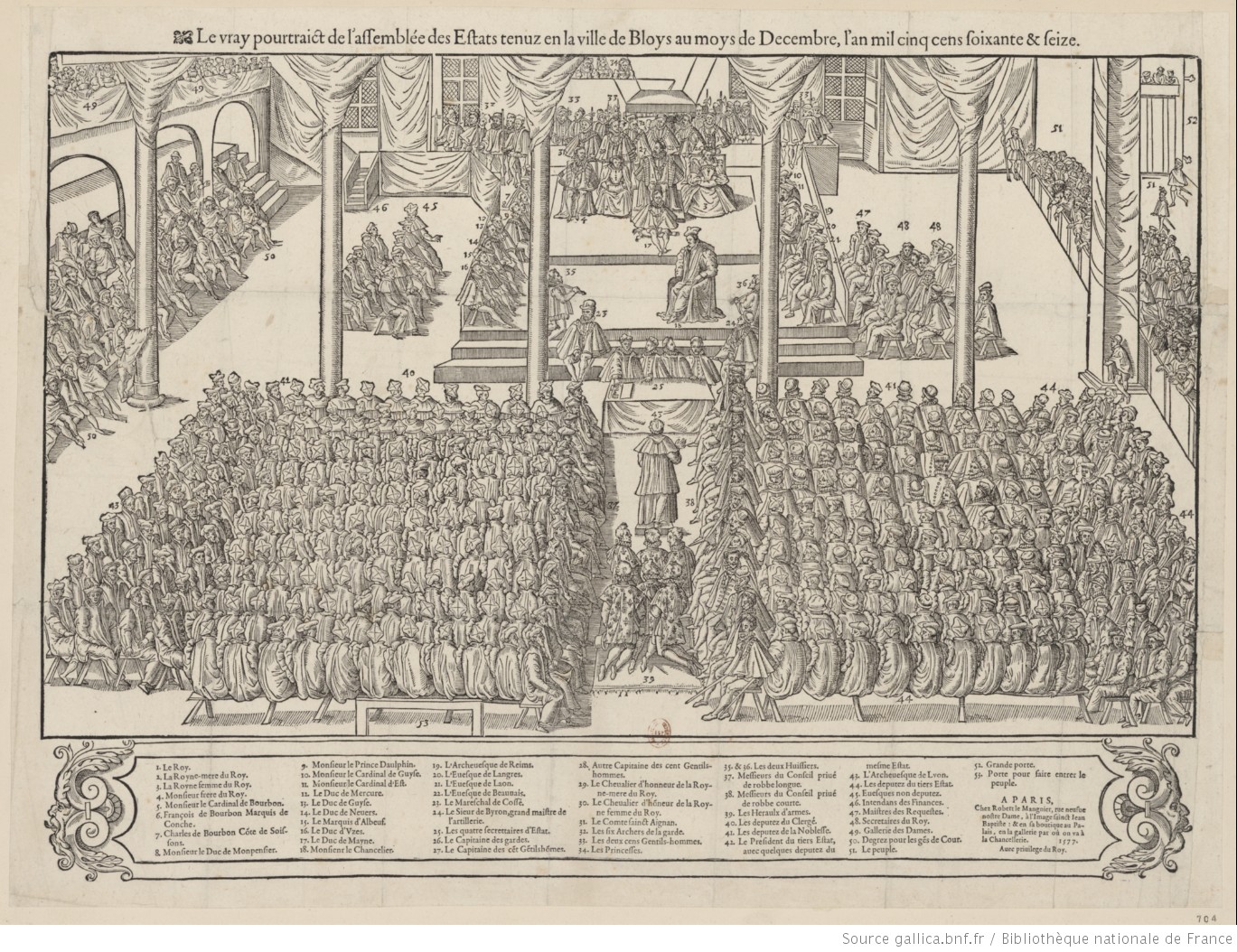
The Estates General of Blois, 1576-7. Source: BnF Département des Estampes, Réserve QB-201 (7)-fol (p. 71) – digitised image identifiant: FN-8400719.
The Estates General of Blois, 1576-7. Source: BnF Département des Estampes, Réserve QB-201 (7)-fol (p. 71) – digitised image identifiant: FN-8400719.
So the later historiography of the Estates General is a fragmented affair. Nineteenth-century liberal (i.e. ‘republican') French historiography found more to sustain its notion of a triumphant third estate in the provincial estates, and especially the estates of Languedoc, whose regular meetings had continued throughout the ancien régime, and whose treasurers became periodically essential to raising loans for the increasingly bankrupt Bourbon monarchy. Current research is therefore directed much more to the rich and continuous Languedoc institution than the fragmentary and stuttering Estates General. To piece together a picture of the latter as an institution, an entity with an impact on government, one has to go back to the period of the Hundred Years' War, which is when it played a much more dynamic (and disruptive) role in the political life of the nation. Nineteenth-century French medievalists did a good job at uncovering that. Georges Picot's four-volume history of the Estates General, published in 1872, reflected a renewed interest in the history of France's representative institutions under the Third Republic (inaugurated in 1870). He took as its starting-point the assembly of the langue d'oil convoked by Jean II le Bon (John the Good) in 1355. But the subtitle to his work is all-important. He intended to write the history of the Estates General ‘considered from the point of view of their influence on the government of France'. So he included next to nothing on the procedures for its elections, on its institutional culture, and no discussion of its sense of itself, or what others made of it.
Picot's work, published 150 years ago this year, remains (remarkably enough) the latest and last monument in French to the notion of the Estates General in the ancien régime as an institution. When, in 1974, Roland Mousnier came to publish his study of French institutions under the absolute monarchy, he defined what he meant by ‘institution': first and foremost, a governing idea, one that is inscribed in the life of a society, one that structures its laws and gives meaning to its history, that gives coherence to the procedures and ceremonials that it adopts, and that inspires with a collective sense of purpose a governing social group. By any of these criteria, the Estates General of France barely counted as an institution, and it plays only a walk-on part in Mousnier's analysis. So, to the degree that anyone has tried to reconstitute those senses of the Estates General as an institution, it is to the work of an American historian, John Russell Major, that one has to turn.
Russell Major sought to prove that representative institutions were a governing idea, in Mousnier's terms, at least for a time. The time in question was Renaissance France – a period that begins (in his mind) with the reign of Charles VII (r.1422-1461) and reaches its apogee with the wars of religion (1562-1598). He began with an analysis of the electoral procedures for delegates to the Estates General of that period – a technical analysis that invited a subsequent social study of the deputies, which never happened. This was accompanied by a volume that retraced the history of representative institutions, local and national, in the first part of the Renaissance (as he had defined it). Russell Major's strongest suit, when it comes to trying to establish the Estates General as a ‘governing idea' is his detailed analysis of the Estates General at Tours in 1484. The private journals of deputies constitute the best documentation we have of the political culture of the Estates General, but there are very few of them. The journal of Jehan Masselin, deputy from the district court (bailliage) of Rouen, in 1484 is one of the best. Originally published (in Latin with a French translation) in 1885, Russell Major used it to demonstrate how deputies were manipulated by the different aristocratic factions at court. To him, that was a sign that they were an integral part of political culture. He then went on to a more ambitious narrative of different representative institutions, local and national, in order to indicate that they played a constructive role in the governing culture of Renaissance France. The work was based on extensive archival research and secondary reading. If one wants an annotated bibliography of the French Estates General and other representative institutions in the sixteenth and early seventeenth centuries, it is to Russell Major that one turns. If one wants to consult the archival basis, it is to the microfilms he collected, now held at Emory University, Atlanta GA that one must go.
Russell Major established three things. None of them, however, was exclusive to the Estates General, or even to representative institutions in general. The first was that there was a plethora of votes and elections in Renaissance France, and concomitantly of delegates, syndics, and representatives of various kinds. They occurred in all sorts of local and national contexts. There were elections to local offices, to town councils, to cathedral chapters, to local assemblies, to university councils and deanships, etc. After 1560, the Catholic clergy had their own national assembly, for example, to which delegates were elected, and with which the crown negotiated a ‘contract' every ten years for the ‘free gift' (don gratuit) that the clergy had reluctantly agreed to give it. Protestants, too, had their own assemblies, local and national – colloquies and synods, but also general assemblies that became symbols of resistance to the monarchy in the wars of religion, the bodies that mobilised its war effort, and through which the crown (at least after 1570) negotiated the pacifications that brought the wars of religion to a close. What passed for the vox populi was never limited to the estates of the realm, and certainly not to the Estates General.
The second thing that he established was that cahiers de remontrances also played a fundamental role in the political culture of Renaissance France. The preparation of those cahiers, their elaborate formulation, their subsequent homologation at local and national levels into a document that everyone could sign up to, was a fundamental part of what happened at local estates and, pari passu, at the Estates General. But it was by no means limited to those bodies. The French monarchy received such documents from all quarters – and it would continue to do so throughout the ancien régime. There were remonstrances, for example, presented by syndics, elected for the purpose, from its own officers – treasurers, judges, and members of its secretariat. There were remonstrances from corporate bodies of all sorts. The presentation, in written and verbal form, was an art-form in itself, which drew on humanist rhetoric and legal norms. They were dutifully received by the king, sent for consideration by his royal council, and generally returned with detailed replies in the margin. There was nothing unusual in the procedures of remonstrance from the provincial estates, or the Estates General. It was well-established practice, and everyone understood the rules of the game. The crown would decide for the best. If the replies often did not satisfy the supplicants, they could always ask again another year. No one expected to be gratified on every point. It was sufficient that they had been heard. The reply that equated to ‘the king will see' was often good enough. The point had been made, and it was registered in the place where it mattered.
The third thing that Russell Major tried to establish was that the ‘French Renaissance monarchy' (a construction all his own) was ‘consultative', a kind of closet Ständestaat (‘a state with estates'). That, however, is to write history with a monocle. It ignores the enormous weight of French juridical writing from the period that was overwhelmingly in support of a high view of monarchical authority as a plenum potestas, a merum imperium, that would, in Bodin's controversial formulation in his Six Books of the Republic (1576) become royal ‘sovereignty', single and indivisible. It is also to ignore the dead weight of the Parlements, the sovereign courts and their magistrates, whose role was to defend the law, and who sometimes interpreted that role as defending the people. There were all sorts of reasons why it was politic for the French crown to let representative institutions have their say. Russell Major emphasised one of those reasons, which was that they could be the means by which the monarchy could arbitrate between different aristocratic factions in order to impose its will. There are others. The French kingdom had been assembled around the original domain of the Capetian monarchy by a series of acquisitions, generally by dynastic inheritance. In the arrangements that surrounded such acquisitions, the monarchy accepted what was in place. If it included representative institutions, as it generally did, there was little to gain and much to be lost by suppressing them. Only in the first half of the seventeenth century, when a newly invigorated Bourbon monarchy found them more irksome did things begin to change. And even then it was their opposition to the extraordinary pressures of wartime finance in the period of the Thirty Years' War that provoked their demise.
Russell Major's last proposition has few takers now. In one respect, however, he was on to something. One of the reasons why the monarchy willingly countenanced representative institutions of all sorts was also the central rationale for holding the Estates General, a governing myth that was particularly congenial to it. The state, like the church, was always in need of reform, semper reformanda. Reform, conceived of as the return to a status quo ante, sometimes seen as a golden age in the past, was what brought a largely performative monarchy close to its people. Through their remonstrances the king could discover where the shoe pinched, where things needed to be remedied. When called into session, the deputies regarded themselves as about the king's business, engaged in the pursuit of the ‘common good' (le bien commun), perfecting the common wealth (la république). This was what inspired the great reforming ordinances from the late fifteenth century through to the Code Michaud of 1629. The Estates General was one of the ways by which such ordinances were conceived and nurtured into being. But there was another way, and that was through convoking an Assembly of Notables. The latter was composed of what, in Anglo-Saxon English parlance, we would call the Great and the Good. There were no elections, no cahiers, no remonstrances. Those who attended were upon the king's invitation. There was no set protocol, and the agenda was set by the king. One reason for the crown's reluctance to hold Estates General was because it had another means at its disposal to inform itself upon the major issues of the day. The assemblies of notables were as important as the Estates General in promoting the notions of the common good and the common wealth. The myth of reform of the realm by means of the Estates General endured, partly because it became a political platform for those who felt themselves excluded from power. From the royal perspective, however, it ran past its sell-by date, especially as the rhetoric of the good of the common wealth was challenged by that of the ‘good of the state'(le bien de l'État) and ‘reason of state', as would be the case under the first Bourbon kings.
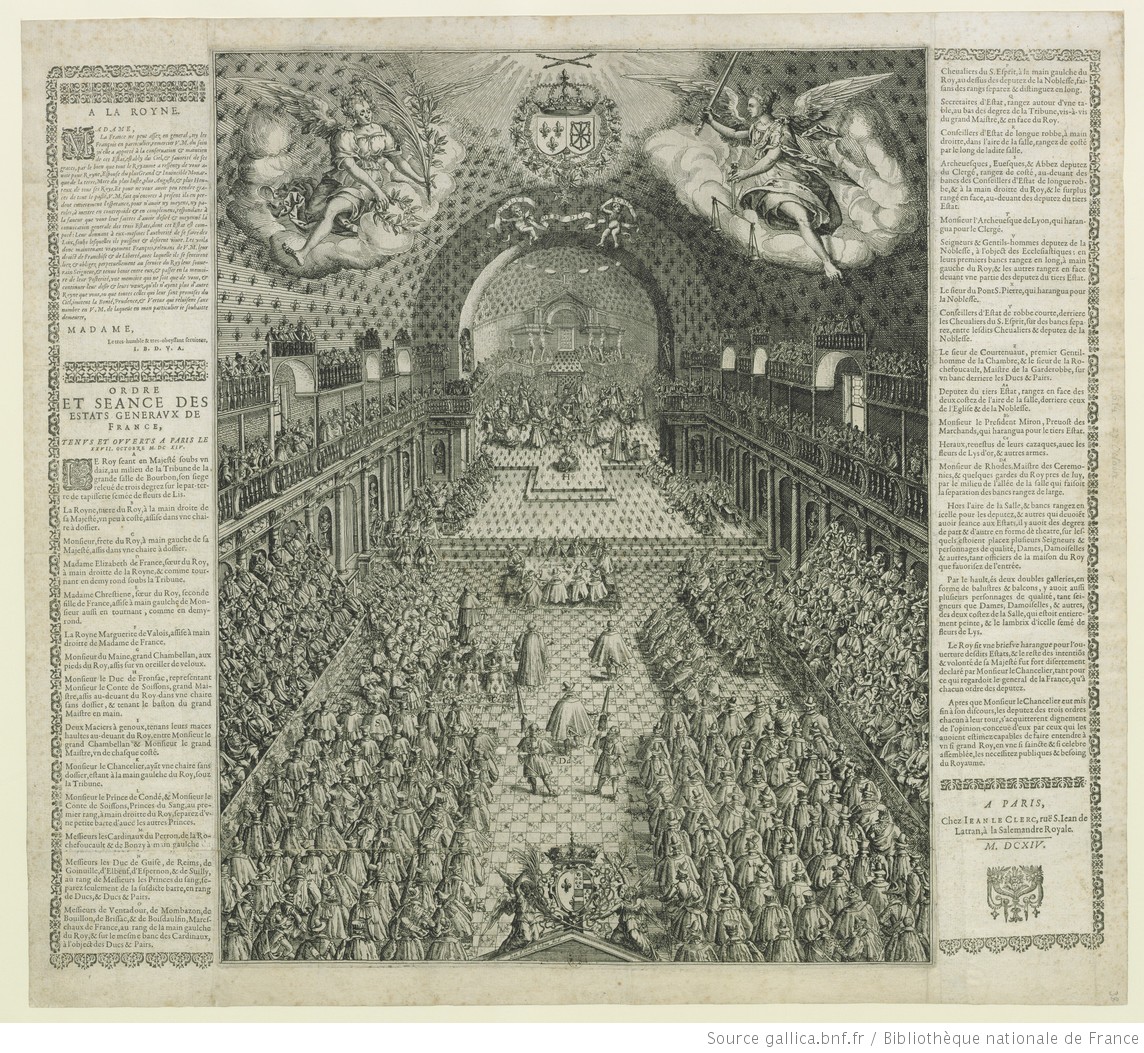
The Opening Session of the Estates General of Paris, 1614-15. Source: BnF, Département des Estampes, Réserve QB-201 (171,2)-FT 5 [p. 38]; digitised image identifiant : FN-6945256.
The Opening Session of the Estates General of Paris, 1614-15. Source: BnF, Département des Estampes, Réserve QB-201 (171,2)-FT 5 [p. 38]; digitised image identifiant : FN-6945256.
What, then, should we make of the Estates General in early-modern France? Did it add up to an institution? The sessions from 1484 to 1615 could be counted on the fingers of two hands: 1484; 1560; 1561; 1576-7; 1588-9; 1593, and 1614-5. They did not last very long. End to end, their days in session would not fill two of those 127 years. The deputies that assembled in Tours in 1484 had plenty of experience of how business was done at such a body; there had been a previous session in 1468, and a few of them had been present at it. Not so those who made it to Orléans in 1560, for whom previous assemblies belonged in the history books, and who argued the toss about the precedents for how business should be conducted. Some deputies that were summoned to Blois in 1576-7 had been at Orléans, and those previous debates found an echo in their own deliberations. If there was some continuity established in the later sixteenth century, it was within the backdrop of assemblies that had become heavily politicised by the divisions of the later wars of religion. Indeed, the assembly of 1593 at Paris was a rump body, summoned into being by the duke of Mayenne, leader of the catholic League, and its major item of business was the vexed issue of the succession to the French crown. Had the League proto-state prevailed, had the Bourbon succession to the throne not succeeded, the history of the Estates General, and no doubt that of France as well, would have been very different.
The Estates General of early-modern France was the loya jirga of the kingdom. It was summoned into being when the monarchy was in crisis, faced with an impasse. Those crises came in various forms, and in the wars of religion in battalions, at one and the same time. They included royal minorities and issues of succession, questions of royal debts and their financing beyond the resources of the increasingly mortgaged royal domain, and the unresolved and seemingly unresolvable matter of a fundamental religious division in the kingdom. Around these crises hovered the continuing presence of factions in the body politic, led by princes of the blood, and (in the case of the Guise family) by princes who were not directly of the blood royal at all. For them, when things were at an impasse, the summoning of an Estates General was an invitation to make mischief. None of the Estates General could be said to have resolved the particular impasses that confronted the later Valois dynasty. Most of them could be said to have made them worse. The failure of the Estates General of 1614/15, the best documented and most elaborately stage-managed (from the royal point of view) event of its kind, was the ultimate corroboration of that fact. It is hardly surprising that a reinvigorated Bourbon monarchy, convinced that it incarnated the good of the State, should decide that such events were more trouble than they were worth.
University of Sheffield

Further Reading:
A. Bernier (ed.), Journal des états généraux de France tenus à Tours en 1484 sous le règne de Charles VIII rédigé en latin par Jehan Masselin, Paris, Imprimerie Royale, 1885.
Auguste Bernard, Procès-verbaux des états généraux de 1593, Paris ; Imprimerie Royale, 1842.
Eric Gojosso, Le concept de république en Frabnce (XVIe-XVIIIe siècles), Aix, Université d'Aix-Marseille, 1998.
Georges Picot, Histoire des États Généraux. 4 vols. Paris, 1872.
Guy Chaussinand-Nogaret, Les financiers de Languedoc au XVIIIe siècle, Paris, S.E.V.P.E.N., 1970.
Hugues Daussy, Le parti huguenot. Chronique d'une désillusion (1557-1572), Geneva, Droz, 2014.
J. Michael Hayden, France and the Estates General of 1614, Cambridge; Cambridge University Press, 1974.
J. Russell Major, From Renaissance Monarchy to Absolute Monarchy. French Kings, Nobles and Estates, Baltimore, The Johns Hopkins University Press, 1994.
J. Russell Major, Representative Government in Early Modern France, New Haven and London, Yale University Press, 1980.
J. Russell Major, Representative Institutions in Renaissance France (1421-1559), Madison, University of Wisconsin Pressm 1960.
J. Russell Major, The Deputies to the Estates General in Renaissance France, Madison; University of Wisconsin Press, 1960
J. Russell Major, The Estates General of 1560, Princeton; Princeton Universsity Press, 1951.
James B. Collins, La monarchie républicaine. État et société dans la France moderne, Paris, Odile Jacob, 2016, ch. 1.
Léonce Anquez, Histoire des assemblées politiques des réformés de France (1573-1622), Paris, Auguste Durand, 1859.
Mark Greengass, Governing Passions. Peace and Reform in the French Kingdom, 1576-1585, Oxford, Oxford University Press, 2007.
Neithard Bulst, ‘Les députés aux états généraux de France de 1468 et 1484' in Mélanges de l'école française de Rome, 108/1 (1988), p. 265-272.
Neithard Bulst, Les états généraux de France de 1468 à 1484 – recherches prosopographiques sur les députés, Paris ; Decitre, 2022 .
Olivier Christin, Vox populi: une histoire du vote avant le suffrage universel, Paris, Seuil, 2014.
Paul-Akexis Mellet, ‘Les remonstrances : une expression paradoxale de la société politique (XVIe siècle)', in Mark Laureys, David A. Lines and Jill Kraye (eds), Forms of Conflict in Renaissance Europe, Bonn, V&R University Press, 2013, p. 247-272.
Paul-Akexis Mellet, Les remontrances: discours de paix et de justice en temps de guerre. Une autre histoire des guerres de religion (France, v. 1557-v.1603), Geneva, Droz, 2022
Pierre Blet, Le clergé de France et la monarchie. Études sur les assemblées générales du clergy, de 1560 à 1660. 2 vols. Rome, Presses universitaires grégoriennes, 1959.
Roland Mousnier, Les institutions de la France sous la Monarchie absolue, Paris, PUF, 1974.
Stéphane Durand, Arlette Joanna, et Élie Pélaquier (eds), Des États dans l'État. Les États de Languedoc de la Fronde à la Révolution, Geneva, Droz, 2014.
Timothy Tackett, Becoming a Revolutionary. The Deputies of the French National Assembly and the Emergency of a Revolutionary Culture (1789-1790), Pennsylvania, Penn State U.P., 1996.