
The English Parliament
The Parliament of England is often treated as if it were an independent corporate actor in the country's sixteenth- and seventeenth- century history. In a very well-established tradition of English historiography, usually described as ‘whiggism', the national narrative of this period was essentially a narrative about the increasing assertiveness of parliament, a story over which loomed the confrontation between Charles I and Parliament in 1642 and the subsequent civil war and desposition of the king. For thirty years or more now historians have been dismantling that narrative, trying out alternative ways of understanding power, legitimacy and resistance in the national community. But it still influences our ideas about national development in the period, and historians have struggled to find an different way of framing our ideas about parliament without it. What exactly was parliament? How significant, and how distinctive was it?
There is no doubt that at the beginning of the sixteenth century parliament was a deeply-rooted, even venerated, part of the system of English government. There was a strong medieval tradition of seeing it as an important element in moderating and controlling, even contesting, royal power through processes of impeachment (used most spectacularly in 1450) and an association with schemes of conciliar government. The primacy of its statutes over other forms of law-making was well-established, although exactly what that meant in practice was still vague. Its essential format – two chambers, one, the House of Lords, containing the higher nobility and the prelates of the Church, the other, the House of Commons, containing nominees of county communities and of the cities and towns – had been established for at least a century and a half. Its characteristic form of operation was already fairly settled, a process of the agreement of bills in either chamber which would be passed to the other for eventual submission to the king for his agreement. These bills could deal with matters of public concernment and matters of purely private interest, where individuals were hoping to put their property rights beyond legal challenge. There were no real competitors to parliament's primacy as a source of legitimacy and consent within the national community – there were no separate assemblies of town representatives, no sense in which a convocation of the nobility on their own could be seen as an effective alternative to a meeting of parliament. Governments did have other ways of raising money through ‘loans' and ‘benevolences', but none were quite as useful as the subsidies that could be authorised by parliament.
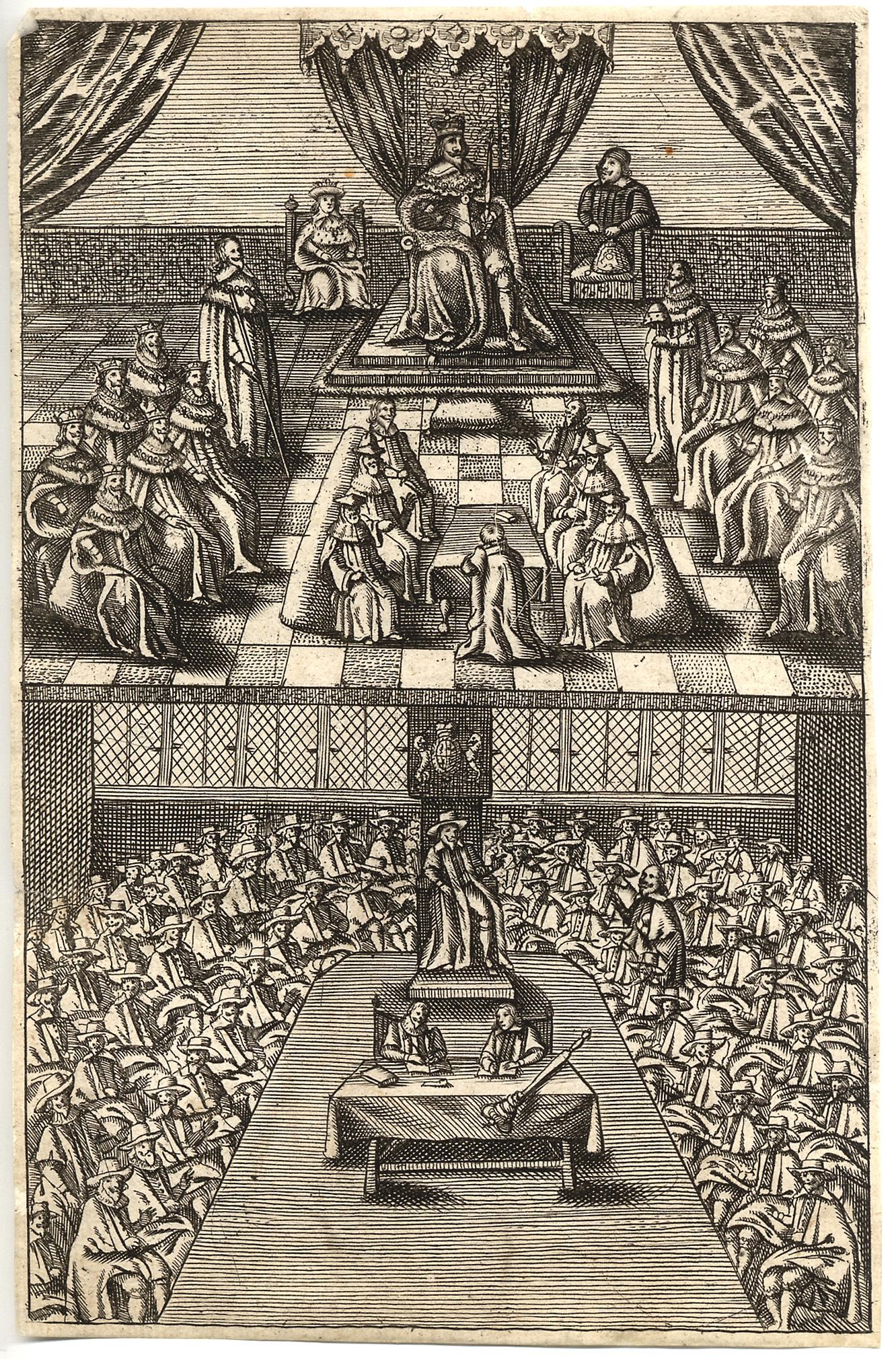
The King in the House of Lords (top) and the Speaker presiding over the House of Commons (bottom); engraving from 'An exact collection of all remonstrances, declarations, votes, orders, ordinances, proclamations, petitions, messages, answers, and other remarkable passages betweene the Kings most Excellent Majesty and his high court of Parliament...' (Edward Husbands, London, 1643). E1533.
The King in the House of Lords (top) and the Speaker presiding over the House of Commons (bottom); engraving from 'An exact collection of all remonstrances, declarations, votes, orders, ordinances, proclamations, petitions, messages, answers, and other remarkable passages between the Kings most Excellent Majesty and his high court of Parliament...' (Edward Husbands, London, 1643). E1533.
Many historians have contested the extent to which parliament felt fully established – it was, they have often argued, an event, not an institution. It is true that parliaments were called only when kings decided to call them and that this was fairly intermittent, and for short periods only. But parliament had met in 70 of the years of the fifteenth century, averaging over a month a year. It was widely anticipated, and its salient events noted in chronicles and elsewhere. It had regular meeting places, in the Palace of Westminster for the Lords, and the Abbey next door for the Commons. Its records, summary though they were, were kept securely in the royal chancery. If it was an event, it was also an institution.
In the sixteenth century the documentary traces of parliament become vastly richer. The formal record is enhanced by the survival of ‘journals', daily tallies of business done and decisions reached. Parliamentarians became towards the end of the sixteenth century vastly more careful of their archive, with the Lords creating a purpose built repository for theirs. The formal record begins, from the 1560s and 1570s, to be supplemented by fuller accounts of what people said in the course of parliamentary business, the beginnings of a habit among some participants of keeping quite full ‘diaries' recording their own, and others', interventions. Parliaments are referred to more routinely in printed material and commentaries, from sermons to histories to polemic. It is described in treatises such as Sir Thomas Smith's De Republica Anglorum (c. 1563) and Thomas Hooker's Order and Usage of the Keeping of a Parliament in England (1572). All of this material provides us with an impression of an assembly whose members are apparently increasingly talkative, increasingly assertive, increasingly aware of its status as an important institution. That sense seems confirmed by the acquisition of a more permanent home for the House of Commons, in the old chapel of St Stephen's College in the Palace of Westminster, dissolved in 1547. Our first images of meetings of parliament, though still artificial, come from this period: of the opening of parliament in 1523, 1610 and 1614; of the Commons in 1624.
Is this account of an increasingly important, increasingly institutional, parliament accurate? It's easy to be carried away with the survival of this material record into an assumption that it describes a reality fundamentally different to that which prevailed in the early sixteenth century and before. Parliaments in fact met less frequently than in the fifteenth century – there were meetings of parliament in only 43 years of the sixteenth century and in only 12 of the first 39 years of the seventeenth. But it is equally impossible to escape a sense that the increased visibility of parliament in the sources is also a reflection of a growing centrality of the body to the political mindset of sixteenth century England, of the more rapid development of a parliamentary culture that had perhaps always existed, but was becoming more legally entrenched, more historically grounded, much more strongly asserted. It had something to do with England's Reformation, for since the country had achieved its emancipation from the papacy by means of Parliament, Parliament was seen not only as the guarantor of its religious settlement, but a forum in which that settlement could be pushed beyond a tepid version of Protestantism into something more muscular and more godly. It may have had something to do with the redistribution of the wealth of the Church among the upper and lesser nobility – as the seventeenth-century political theorist James Harrington first argued in Oceana (1656) – enhancing their local and national political significance (the growth in the number of towns sending people to parliament in the sixteenth and early seventeenth century was almost certainly the result of pressure from local gentry to acquire this badge of status and significance). Parliament's new visibility also had something to do – probably as both cause and effect – with the spread of print cultures and of ‘news': the increasing availability, not just to an elite, of information about current affairs. Whatever its causes, parliament could be seen, by the early seventeenth century, as the central bastion of a corporate conception of a protestant English state, rooted, predominantly, in the English gentry and closely interested in the affairs of Europe. James I and Charles I, detected, with alarm, some tendency towards ‘democracy'.
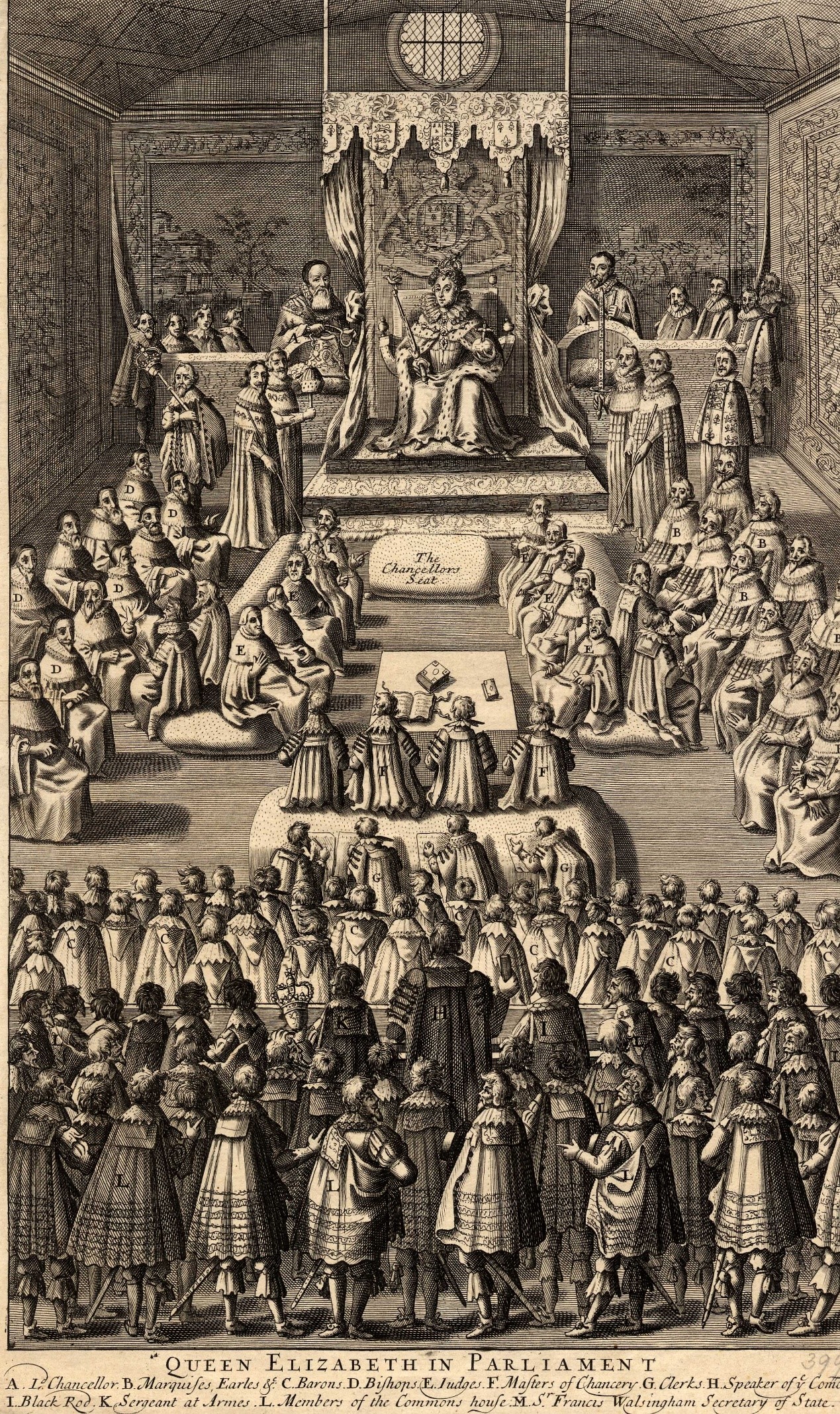
Queen Elizabeth I presiding over the House of Lords. Engraving published in 1682, in Simonds D’Ewes, 'A Compleat Journal of the Votes, Speeches and Debates, Both of the House of Lords and House of Commons Throughout the whole Reign of Queen Elizabeth, of Glorious Memory' (London, 1682).
Queen Elizabeth I presiding over the House of Lords. Engraving published in 1682, in Simonds D’Ewes, 'A Compleat Journal of the Votes, Speeches and Debates, Both of the House of Lords and House of Commons Throughout the whole Reign of Queen Elizabeth, of Glorious Memory' (London, 1682).
Democracy it certainly wasn't, though the term was pretty elastic in the seventeenth century; but parliamentarians' willingness to see themselves as defenders of that corporate conception certainly resulted in an extraordinary pushing of the boundaries of parliamentary activity. One area of remarkable activist growth was parliamentary privilege: often it was used perniciously by individual members of either House, as an aggressive move in private legal proceedings. But it was also invoked with increasing frequency as a way of pushing back against the government's objections to the decisions and actions of the Commons. Another was the encouragement of petitioning from members of the public against misgovernment. The number of petitions grew very rapidly, especially in the 1620s, to become a huge preoccupation of some members, and in the early 1640s to form one of the key ways in which opinion was mobilised behind the leaders of the parliamentary movement. A third development was associated with it: the revival of parliament as a judicial, as well as legislative body, and the revival of the fifteenth century process of impeachment as a means of controlling government actions. In the late 1620s there was a phenomenal growth in the manuscript circulation of those diaries about parliamentary proceedings.
It's true that much of what is going on in parliament has origins or effects well beyond parliament. Parliament was a stage for politics: it wasn't the subject of politics itself, at least until its effectiveness or existence seemed threatened and the defence of ‘parliamentary privilege' became a way of mobilising support. It would be wrong to say that parliament had not been central to English political culture before our period: it had been for centuries. But the nature of parliamentary culture does seem to have changed in the sixteenth and seventeenth century, to have come more into focus and become harder edged, more (if you like) ‘institutional'. The events of the 1640s and 1650s would develop it way beyond anything that had been seen before, into an authority more akin to the Dutch States General than to its English predecessors. This was reversed in 1660, but the events of the previous twenty years had left a powerful sense of the way in which parliament could be mobilised to focus discontent and how it could be made into a frame for an alternative government.
Perhaps the best way of understanding these developments is to recognise it not as the increase in the power or otherwise of ‘parliament'. ‘Parliament', like any other institution, has no real existence, but is a construction of ideas in the minds of people – is, in fact, a culture, a collection of laws, a way of thinking, of mentally organising the world. If it makes sense to recognise that there were many ways in which ‘Parliament' remained only one element of the English system of government, and an only occasionally present one, it also looks as if it was something that was looming much larger in the minds of a class of people who were, in practice, its local rulers. A parliamentary culture, seen as the focus of ideas of national unity and political consent, was almost certainly in existence before our period. But for the Protestant gentry of sixteenth- and seventeenth- century England it had become so central to their own status and survival that it had become part of their country's identity.
Paul Seaward,
Director of the History of Parliament Trust
Further Reading:
The literature on Parliament in the early modern period is huge and covers a very broad ground. This is a very small selection of recent relevant books and articles which deal with the political culture of parliament and with the historiographical issues discussed above.
Paul Cavill, The English Parliaments of Henry VII, 1485-1504 (Oxford, 2009)
Chris R. Kyle, Theater of State: Parliament and Political Culture in Early Stuart England (Stanford, CA, 2012)
David Hayton and Linda Clark (eds.) Historians and Parliament (Chichester, 2021)
Andrew Thrush (ed.), The History of Parliament: the House of Commons 1604-1629 (Cambridge, 2010), Volume I, Introductory Survey.
Andrew Thrush (ed.), The History of Parliament: the House of Lords 1604-1629 (Cambridge, 2021), Volume I, Introductory Survey.