
The Assembly of the Land (Zemskii sobor) in Russia
The Assembly of the Land (Zemskii sobor) was a Russian political organization that met on an irregular basis between 1549 and 1684 in Moscow. It had no official name. In sources of the time, it was referred to variously as the “Land” (zemlia), the “Council of All the Land” (sovet vseia zemli), or just the “Council” (sobor or sovet). The Slavophil writer Konstantin Aksakov (1817–1860) coined the term “Zemskii sobor” (lit. “land council”) in a letter to Tsar Alexander II (r. 1855–1881) urging him in 1856 to restore it, but he did not. Historiographical issues have arisen over supposed insufficiencies in the Assembly of the Land because it did not develop into a European style-parliament, and when compared with European representative institutions was found to be deficient in procedures and practices.
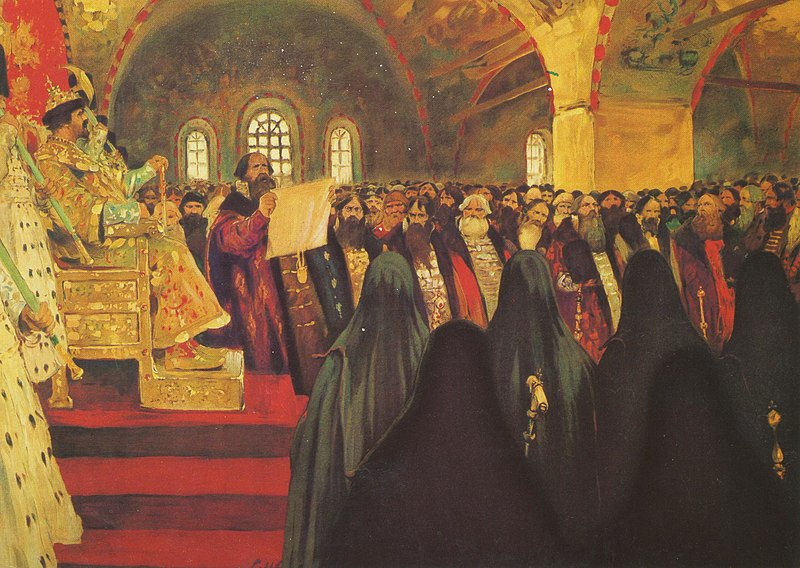
Painting of the Zemskii sobor by Segery Ivanvov (1908)
Painting of the Zemskii sobor by Segery Ivanvov (1908)
Three groups participated in its deliberations – the Boyar Duma (state council), Holy Synod (Church hierarchy), and select members of the lower ruling class, such as court officials and provincial property owners, which could also (and often did) include merchants and townsmen. For an Assembly of the Land to be official, it needed to have representatives of all three groups. The third group, however, never included peasants, serfs, slaves, or women as participants. As a result, we cannot say that the Assembly of the Land represented the “popular” will, but we can say that it was representative, to a greater or lesser extent, of the will of the ruling class. We do not have enough evidence to determine to what extent it merely confirmed decisions reached by the Boyar Duma and Holy Synod or brought to the attention of the upper ruling class concerns of the lower ruling class as well as representatives of Moscow (and on occasion other towns).
The functions of the Assembly of the Land included choosing the ruler, deposing the ruler, and advising the government on significant issues that affected the “land” overall. The coincidence in functions with the Mongol quriltai has led some scholars to conclude that it was based on the quriltai. In the context of the time, this view has some validity. Ivan IV claimed in his formal title on documents to be “tsar and grand prince of All Rus′” as well as “tsar of Kazan′ and Astrakhan′.” The first use of the term tsar in his title could be supported by the Eastern Roman Empire title “Caesar.” But both Kazan′ and Astrakhan′ had been ruled by khans, all of whom were descendants of Chinggis (Genghis) Khan. Ivan could not claim any such genealogy, which made choice by a quriltai-like assembly of importance to give his claim legitimacy in steppe-political terms. Otherwise, he would have had to place a puppet ruler who was of Chinggisid descent over these polities when he conquered them in 1552 and 1556, respectively.
Usually the ruler summoned the Assembly of the Land, but either the head of the Boyar Duma or the Patriarch could summon it to choose a new ruler when there was no ruler or to depose the current ruler when there was one. Some Assemblies were planned in advance with provincial members invited to Moscow to attend; others were called ad hoc if a sufficient number of representatives of the lower ruling class were already in Moscow for other reasons. What that “sufficient” number was, however, was never stipulated.
Historians who see the Assembly of the Land as of a kind with European representative assemblies base their perception on the claims that there are similarities in the election of representatives and in procedures, as well as the same historical process operative in both Europe and Russia of the time (in particular, the transition to constitutional democracies). Despite the claim of numerous and impressive parallels, in fact there are no election practices or procedures of the Assembly of the Land that are similar to or parallel with European assemblies. In Russia, all members of the Boyar Duma (made up of the senior members of the ruling elite) and all members of the Holy Synod (made up of the Church hierarchy) were ipso facto delegates to the Assembly of the Land. In no European representative assembly were all members of the state council or all members of the church hierarchy also members of representative assemblies. The third category of participants in the Assembly of the Land was composed of members of the lower ruling class (landowners, not commoners), although representative townsmen of Moscow and merchants could also participate. In that regard, the categories of participants in the Assembly of the Land did not represent estates such as in the French Estates General as such. Nor was there any consistent attempt or need to have “delegates” distributed according to region or district, as in the German Imperial Diet (or indeed England).
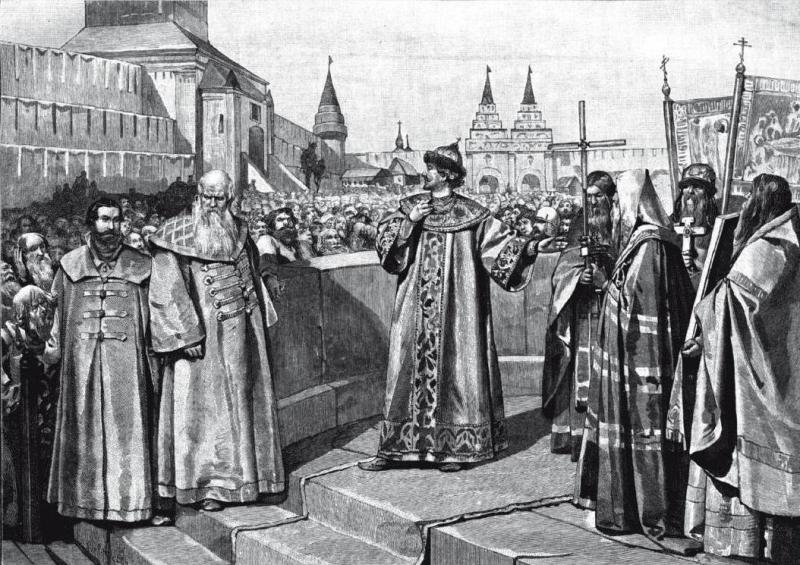
Painting of the opening of the First Zemskii sobor in 1549 by Klavdiy Lebedev (1894)
Painting of the opening of the First Zemskii sobor in 1549 by Klavdiy Lebedev (1894)
Choosing and deposing the ruler
The first calling of the Assembly of the Land was probably 1549, although this is disputed in the scholarship. Our evidence concerning it is sparse, but it most likely was connected with lending legitimacy to the addition of the term tsar′ to the ruler's title, should Muscovy conquer Kazan′ and Astrakhan′ – campaigns that were already being prepared. In Russia in the sixteenth century, the term tsar had a double meaning of king (from tsesar′ = Caesar) in the Biblical and Eastern Roman tradition, on the one hand, and khan, in the steppe tradition, on the other. Although previous Muscovite rulers, namely Ivan III (r. 1462–1505), the grandfather of Ivan IV, and Vasilii III (r. 1505–1533), the father of Ivan IV, had used the title tsar in documents, it was not officially adopted as part of the ruler's title, and it was used in only a specific type of document, one that guaranteed safe passage for merchants and diplomats. This type of document (called a iarlyk) had previously been issued by the Tatar khan, who ruled Rus′. With the Muscovite rulers claiming to be sovereign rulers of Rus′, there still was a need to issue this type of document. The Muscovite rulers, thus, claimed the prerogative as “khans” to do so. In 1547, when Ivan IV came of age and underwent a coronation ceremony that was adapted from the Byzantine ceremony, the Posol′skii prikaz (Ambassadorial Chancellery = foreign office) also wrote to the Patriarch of Constantinople in 1557 seeking confirmation, which Patriarch Josephus II gave four years later. But there was need for confirmation in the steppe tradition as well. That the Assembly of the Land was able to provide because that is how steppe khans were confirmed: after preliminary agreement by the qarachi beys (heads of the major clans), the quriltai provided the mechanism for the official implementation of that choice.
Subsequently, the Assemblies of 1584, 1598, 1606, 1610, 1611, 1613, 1645, and 1682 chose the ruler. In three of these –1584, 1598, and 1645 – the traditional forty days of mourning after the death of the previous ruler was honored. In three cases – 1610, 1611, and 1613 – the previous ruler had been deposed, so no period of mourning was involved. In one case (1682) the Assembly was convened the day after the previous ruler had died, which in itself was sufficient for those who disagreed with the decision to question its legitimacy. In two cases (1610 and 1611) the persons offered the crown –Władysław, the son of the Polish king Sigismund III (r. 1587–1632) and Gustavus Adolphus, king of Sweden (r. 1611–1632), respectively – did not take it because of the stipulation that they convert to Russian Orthodoxy, which they refused to do. There does not seem to be evidence of the calling of an Assembly of the Land in 1676 after the death of Tsar Aleksei Mikhailovich (r. 1645–1676). Instead, the death-bed wish of Aleksei that his son Fëdor succeed him appears to have been sufficient.
The most contentious of the Assemblies were the ones convened in April and May 1682 to choose the successor to Fëdor Alekseevich. At the time, the ruling families coalesced around two families – the Miloslavskiis and the Naryshkins. The Miloslavskii candidate was Ivan, the brother of Fëdor and son of Tsar Aleksei's first wife. At sixteen he was the elder of the two candidates, but sickly and mentally challenged. The Naryshkin candidate was Peter, the half-brother of Fëdor and Ivan, and son of Tsar Aleksei's second wife. He was ten years old but healthy and mentally competent. The Boyar Duma and Church prelates who had gathered to pay their respects to the dead Tsar Fëdor discussed whether Peter or Ivan should succeed. Patriarch Ioakim (r. 1674–1690) hastily called an Assembly of the Land, by going to the porch and addressing the crowd, which had gathered outside the palace, to help decide. Among the crowd were members of the lower ruling class and townsmen, which then technically formed an Assembly of the Land and which chose Peter as the successor on April 27 with his mother Natalia as regent. The supporters of Ivan cried foul play and incited the militia (strel′tsy), who already had been discontented, to storm the Kremlin by claiming that the Naryshkins had killed Ivan. In the ensuing chaos, members and supporters of the Naryshkin family were killed. In a second Assembly convened on May 26, Ivan and Peter were chosen co-tsars with Ivan's sister Sophia as regent. Some scholars have claimed that the April and May meetings were different sessions of a single Assembly of the Land while others question whether they/it can be considered a “real” Assembly of the Land because of its irregularities.
The only Assembly of the Land to depose a tsar convened in 1610. It deposed Tsar Vasilii Shuiskii, who had been chosen tsar in 1606. Most likely his deposition was the result of a change within the politics of the Boyar Duma from support of to opposition against him following the defeat of Russian forces by the Poles at Klushino on June 27, 1610.
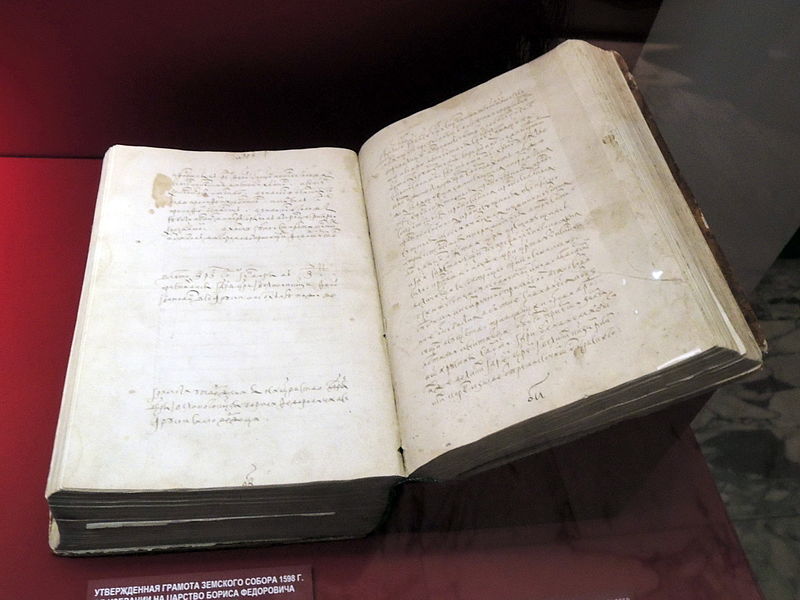
Approved charter of the Zemskii sobor of 1598 on the election of Boris Fedorovich Godunov to the throne. Russian State Library. Photo: Wikipedia / Shakko (Sofia Bagdasarova)
Approved charter of the Zemskii sobor of 1598 on the election of Boris Fedorovich Godunov to the throne. Russian State Library. Photo: Wikipedia / Shakko (Sofia Bagdasarova)
Significant issues
The Assembly of the Land advised on a wide range of policy issues, which we can place into three main categories: war, diplomacy, and domestic matters. Issues involving war loomed large, with Assemblies advising on the Livonian War (1566 and 1589), the threat posed by the Crimean Khan Gazi Girey (1598 and 1604), the siege of Moscow by the forces of the Polish-Lithuanian Commonwealth (1612), the threat posed by the Crimea Kahn Sefat Girey (1637), whether to support the Don Cossacks in the taking of Azov (1642), and war with Poland (1653).
Matters involving foreign diplomacy also loomed large with Assemblies advising on policy toward Ivan Zarutskii, hetman of the Don Cossacks (1614), negotiating peace with Sweden (1616), response to Crimean treatment of two Muscovite envoys (1639), Russo-Polish relations and negotiations with Bohdan Khmel'nyts'kyi, hetman of the Zaporizhian Cossacks (1651), and negotiations with Poland that led to the signing of the Treaty of Eternal Peace (Vechnyi mir) with the Commonwealth in 1686 (1684).
Domestic issues were a third major area, with Assemblies advising on administrative reforms (1549), placing the government under a boyar committee headed by F. I. Mstislavskii (1610), and the uprisings in Novgorod and Pskov (1650). Another example was the question of what to do following the ouster of the first False Dmitrii (1607). There were three False Dmitriis, each claiming to be the supposedly murdered son of Ivan IV. Only the first one made it to the throne of Muscovy and ruled for eleven months from 1605 to 1606. An Assembly of the Land was called in 1607 to determine what to do after his overthrow. Perhaps the most noteworthy convening of the Assembly of the Land, however, was in 1648 by Tsar Aleksei Mikhailovich to advise on the composition of a new law code and the continuance of this Assembly into 1649 to oversee its writing, which resulted in the Ulozhenie of 1649, the most advanced and comprehensive law code of its time.
Although fiscal matters could be discussed by the Assembly of the Land, there was no stipulation that it had to be involved for the policy to be legitimate, as was the case in a number of European assemblies. The Assemblies convened in 1617, 1632, 1634, 1637, and 1681–1682 advised on fiscal matters, the last two on raising money to conduct war against Poland.
In the absence of direct evidence, some scholars have posited the calling of an Assembly of the Land in 1564, 1565, 1575, 1576, 1579, and 1698 on the basis of a pattern of circumstances similar to those in which other Assemblies of the Land were convened. Further research is required to test these hypotheses. Some scholars contest the view that the Assembly of the Land as a “parliament of the feudal Estates type.” Instead, there are closer similarities and antecedents in the Mongol-Tatar quriltai (assembly of notables). That would help explain the differences between European political assemblies and the Assembly of the Land better than trying to shoehorn the procedures and practices into an idealized European representative assembly mold. The origins and consequently the characteristics of the operation of European representative assemblies and the Zemskii sobor simply stem from differing political cultures.
Donald Ostrowski,
Lecturer in History and Research Advisor in Social Sciences,
Harvard University Extension School
Further Reading:
Bushkovitch, Paul. “The Tsar and the Sobor 1613–1653.” In The State in Early Modern Russia: New Directions, edited by Paul Bushkovitch, 133–162. Bloomington, IN: Slavica, 2019.
“A Call to the Zemskii sobor, July 5, 1619.” In A Source Book for Russian History from Early Times to 1917. 3 vols. Compiled by Sergei Pushkarev. Edited by George Vernadsky. 1: 212–213. New Haven: Yale University Press, 1972.
Cherepnin, Lev V. Zemskie sobory Russkogo gosudarstva v XVI−XVII vv. Moscow: Nauka, 1978.
“An Enactment of the Zemskii sobor, January–February 1634.” In A Source Book, 1: 217–218.
Endicott-West, Elizabeth. “Imperial Governance in Yüan Times.” Harvard Journal of Asiatic Studies 46 (1986): 525–541.
“An Invitation to Join in the Zemskii sobor, November 19, 1612.” In A Source Book, 1: 208–209.
Lapteva, T. A. “The Representative Bodies in Russia in the First Half of the Seventeenth Century.” Studia Historica: Historia Moderna 37 (2015): 92–119.
Liseytse, Dmitrii Vladimirovich. “Zemsky Sobors of the Late 16th–Early 17th Century in Russia: Historiographical Stereotypes in the Reflection of Historical Sources.” Studia Historica: Historia Moderna 37 (2015): 71–91.
“A Message from the Zemskii sobor to Bolkhov, February 27, 1613.” In A Source Book, 1: 211.
Ostrowski, Donald. “The Assembly of the Land (Zemskii sobor) as a Representative Institution.” In Modernizing Muscovy: Reform and Social Change in Seventeenth-Century Russia, edited by Jarmo Kotilaine and Marshall Poe, 129–141. London: RoutledgeCurzon, 2004.
“The Record of the Zemskii sobor of 1642.” In A Source Book, 1: 218–221.
“The Summons to the Zemskii sobor, July 16, 1648.” In A Source Book, 1: 222–223.