
New article: ‘Towards a history of parliamentary culture in the early modern world'
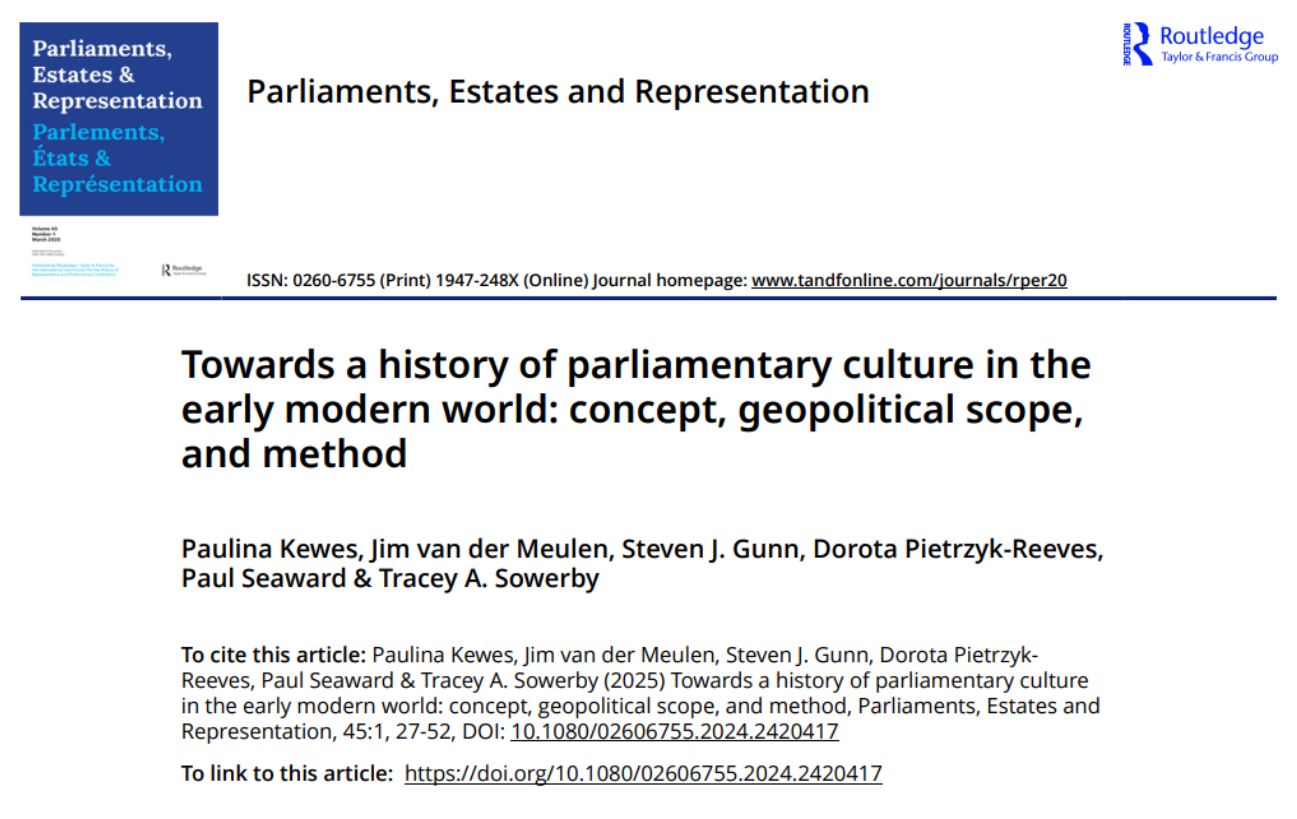
Our second article from the project has been published with Parliaments, Estates and Representation. ‘Towards a history of parliamentary culture in the early modern world: concept, geopolitical scope, and method’ is our manifesto: a call for a new way of doing parliamentary history that places cultural and transnational approaches at its heart.
Our article proposes an innovative approach to early modern representative institutions, from the later fifteenth century to the early eighteenth. It argues that only a transnational, interdisciplinary, and comparative study of such bodies can reveal their shared culture and prominence in contemporary political discourse, public memory, and cultural production. Central to this approach is the concept of what we call parliamentary culture, which sees representative assemblies as collective constructs and embodiments of a political community, and encompasses the transnational tradition of customs, ideas, and cultural expressions associated with them. These assemblies were suffused with cultural practices relating to their procedural processes, modes of speaking, debate, and record keeping, and were guided by cultural considerations in their rituals, spatial arrangements, and other day-to day aspects of business. At the same time, they greatly influenced public discourse and held a special place in the political imagination. Only by looking at early modern representative bodies through the lens of parliamentary culture can we truly appreciate the vitality and significance of this type of political organization.
In our article we first briefly sketch out the institutional, geopolitical, and historical scope of our enquiry, drawing on a wide array of research spanning across Europe. We then define parliamentary culture as a collection of practices of legitimation, negotiation, and debate in political assembly that are central to the life of a community. After outlining our notion of parliamentary culture, we demonstrate that the distinctive institutional cultures of representative assemblies were an essential component of the public life, political culture, and political thought of early modern European countries: the period saw the growing prominence of assembly meetings in all manner of cultural expressions. There was a common culture of representative assembly shared and recognized throughout Europe, one that was spread through diplomacy and print. Finally, we show that this common culture was variously transplanted to and adapted in the overseas territories of the Iberian, Anglo-British, and Dutch empires, often through interaction with Indigenous traditions of assembly.
Towards a history of parliamentary culture in the early modern world: concept, geopolitical scope, and method
Paulina Kewes, Jim van der Meulen Steven Gunn, Dorota Pietrzyk-Reeves, Paul Seaward, Tracey Sowerby.
First published: 04 November 2024