
The Aragonese Cortes
Historiography often views the Cortes of the Crown of Aragon as the symbol of a ‘contractualist' or ‘pactist' system dating back to the Middle Ages and connecting two political entities: the king and the kingdom. In this specific context, the Cortes were meetings between the king and the kingdom that lent Aragon's political institutions a tangible and ceremonial character.
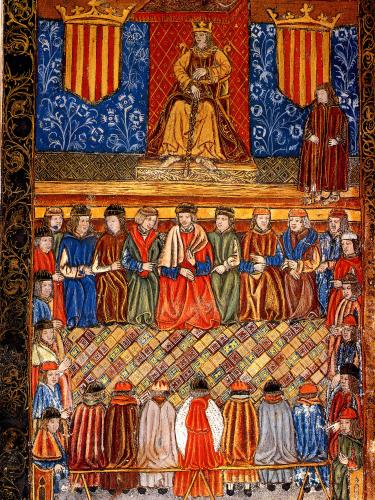
Fernando II (el Católico). entre dos escudos del señal real de Aragon presidiendo una sesión de Cortes. Frontispicio de una edición de 1495 de las Constituciones catalanas.
Fernando II (el Católico). entre dos escudos del señal real de Aragon presidiendo una sesión de Cortes. Frontispicio de una edición de 1495 de las Constituciones catalanas.
The Cortes were key moments in Aragon's political life that embodied a process of negotiated consensus-building in the name of the common good. These assemblies were regarded as the institutional bedrock of the ‘Respublica', a polysemic notion that, in its broader sense, was regarded as compatible with the monarchy: in a system where the king strictly abided by the constitutional laws of the kingdoms (fueros), the Cortes were the only legitimate place where laws were passed under the joint authority of the king and kingdom, in the form of the actos de Cortes. The levying of tax was also approved during these meetings, provided that the subjects' demands were satisfied. This republican orientation was specific to the kingdoms of Aragon and of Valencia and to the principality of Catalonia. It reveals the composite nature of the Spanish monarchy whereby each kingdom kept its own laws and maintained its juridical particularism made of ‘privileges' or ‘liberties' seen as a major component of its identity. In contrast, Castile had no fueros of its own, and the king's authority was regarded as unconditional in this kingdom – although this perception needs to be nuanced by considering extra-parliamentary and informal negotiation channels, as well as the high levels of autonomy enjoyed by cities with a strong local identity.
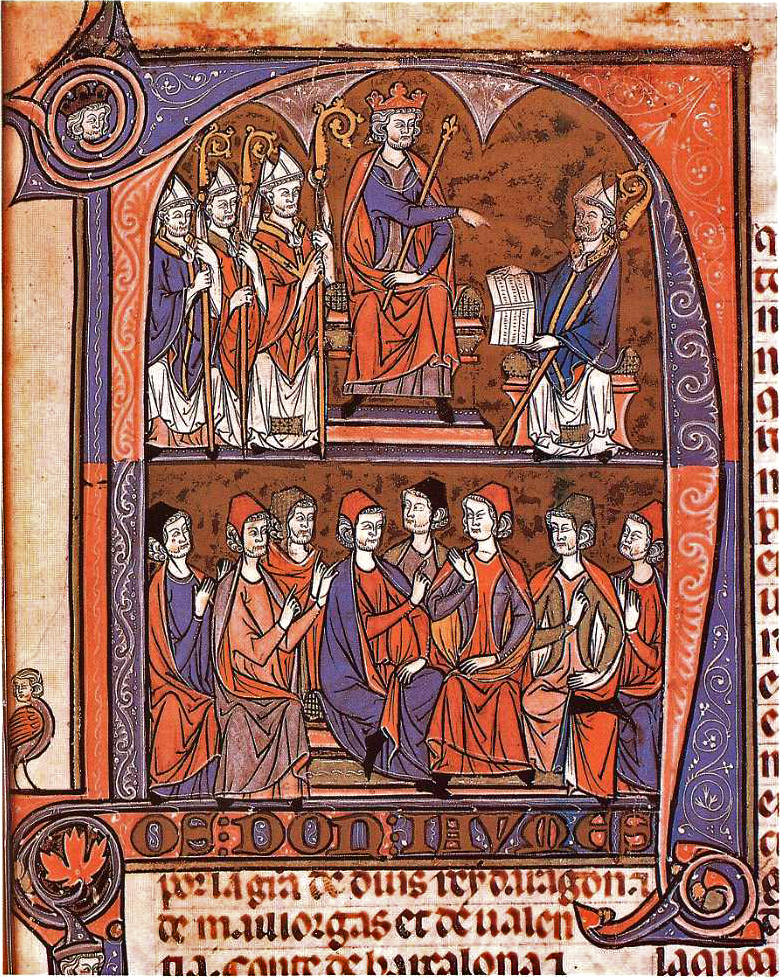
Jaime Iro de Aragón recibe del obispo y jurista Vidal de Canellas la primera compilación de los fueros de Aragón ante otros magnates eclesiásticos. Incipit de la primera compilación de los fueros de Aragón realizada por Vidal de Canellas en 1247.
Jaime Iro de Aragón recibe del obispo y jurista Vidal de Canellas la primera compilación de los fueros de Aragón ante otros magnates eclesiásticos. Incipit de la primera compilación de los fueros de Aragón realizada por Vidal de Canellas en 1247.
In theory, the Cortes could convene for three reasons: when a new king came to the throne and was required to swear to uphold the constitutional laws in order to receive a vow of fidelity from his subjects; when the king sought to raise subsidies; and when laws of relevance to a kingdom had to be elaborated and validated. The ‘General' Cortes implied the Crown of Aragon as a whole (Aragon, Valencia and Catalonia), whereas ‘particular' Cortes could apply to one kingdom only. This study focuses on the Cortes of the kingdom of Aragon, which displayed some similarities to the Catalan and Valencian Cortes.
The Aragonese Cortes were initiated by the king, and brought together the four orders of the kingdom, referred to as the ‘arms' (brazos) according to the period's organicist terminology: clergy, nobility (ricoshombres), lesser nobility (caballería) and universidades (cities), along with the royal officers of Aragon. After the opening ceremony, in which the king's speech clarifying his intentions and requesting subsidies from his ‘faithful' subjects was read, each ‘arm' met apart from the others for several months to debate an agenda set by the promovedores (promoters). Envoys from each of the arms acted as intermediaries and negotiators, interceding with the king, his procurators, and the other ‘arms'. They gradually reached an agreement, which was sealed during the closing ceremony where the new fueros were approved. In addition, the Cortes hosted a tribunal presided over by the Justicia of Aragón, the prominent guardian of the Aragonese laws called ‘liberties', in order to give satisfaction to various demands (greuges) whose resolution could be presented as a quid pro quo for obtaining a service from the king, and thus as a way of resisting the pressures exerted by the king's procurators on the representatives of the arms.
The representativeness of these assemblies can be questioned: some historians have likened them to lobbies serving oligarchic interests under the guise of the common good. However, the composition of the Cortes reflected the medieval genesis of this institution, which was designed to smooth out conflicts between the king and the nobility supported by representatives of the cities (granting of the Privilegio General by Pedro III in 1283 to a turbulent nobility). Its initial purpose was to advise the sovereign, according to the model of the curia regis (royal council). In 1348, King Peter IV transformed the 1283 privilegio into a fuero, confirming the kingdom's involvement in law-making. Moreover, these assemblies were associated with a corporatist vision of society in which the part embodied the whole and their composition was as much a matter of positive law as of custom. For this reason, the Cortes were overall perceived as the full embodiment of the kingdom and as such as a marker of Aragon's identity. Outside of the Cortes, the kingdom was represented by a Deputation comprising eight deputies, two from each arm, whose original mission was to collect and administer the taxes allocated during the Cortes and whose functions later also became political. This body worked together with the Justicia, who checked that decisions complied with the fueros.
The most debated aspect of the Cortes was their political significance and their relationship with the fueros and the figure of the Justicia: in practice, the system acknowledged the importance of the Aragonese people's consent, and therefore acted as a means of curbing royal authority. This system also gave credence to the pre-existence of ‘Aragonese law' which derived from the ‘fueros de Sobrarbe'. The ‘fueros de Sobrarbe' signified a set of laws that the Aragonese were said to have established before electing a king during the Reconquista, in the 850s, according to a myth that circulated widely in Europe, especially among the Monarchomachs (those French Huguenots who theoretically justified tyrannicide in the context of the French Wars of Religion). The Cortes initiated the compilation of the fueros: the Cortes of Monzón (1542) published their first systematic compilation in 1552, whose prologue contained an allusion to the myth of Sobrarbe, according to which some valient Aragonese had freed themselves from Muslim rule and, once reunited in the Pyrenean valley of Sobrarbe, gave themselves laws and then a king.
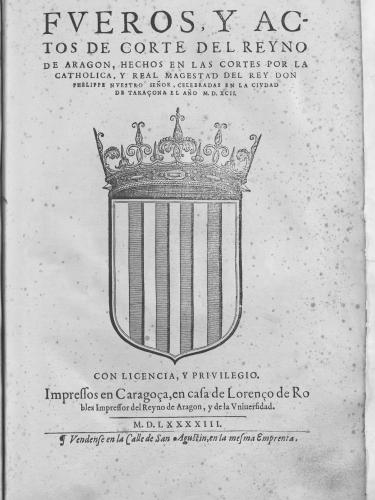
Actos de Cortes del reino de Aragon, Zaragoza, herederos de Pedro l-Lanaja, 1664.
Actos de Cortes del reino de Aragon, Zaragoza, herederos de Pedro l-Lanaja, 1664.
The official chronicler of the kingdom, Gerónimo de Blancas, was the first to write an account of these origins, built from disparate and conflicting elements. In Aragonensium Rerum Comentarii (1588), he depicted the Justicia as an all-powerful embodiment of liberty and as the pivot of the system regulating the relationship between the sovereign and the kingdom. In Coronaciones de los serenissimos reyes de Aragon, published posthumously in 1641, he reinforced the constitutionalist idea by claiming that the Aragonese were inspired by the model of Lacedaemon for their fundamental rules of functioning and the balance between parties. Finally, in Modo de proceder en Cortes de Aragón (1585), Blancas defined the Cortes as a device allowing the people to debate matters essential to their own preservation and as a process that has existed in all times and places, across all politically constituted entities. Blancas argued that these assemblies fell under the rule: ‘Quod omnes tangit ad omnibus comprobetur' (‘what affects everybody must be agreed by everybody); their importance in Aragon was so decisive, he suggested, that an assembly of the people without the king, referred to as ‘‘Parliament'' (Parlamento), was possible – as on the occasion of the succession of King Martin I the Humane without a direct heir, when this system helped put an end to the civil war among the various pretenders (Compromise of Caspe, 1412). However, according to Gerónimo Martel, one of Blancas's successors to the post of royal chronicler, the main function of the Cortes, which could only assemble when convoked by the king, was the enforcement of the subjects' duty to advise the sovereign. In his treatise Forma de celebrar Cortes en Aragón (1601), Martel wrote that on the occasion of the Cortes, the king gathered the kingdom's ‘arms', cities and localities: the assembly was not a complete and autonomous entity representing the kingdom from the outset but a body moved by its head (the king) which, in return, could not act without its body. The author described this system as a form of ‘everyday pactism'.

Gerónimo Blancas, Modo de proceder en Cortes de Aragón, publicado por el doctor Iuan Francisco Andrés de Uztarroz. En Zaragoza por Diego Dormer año 1641. A costa del reyno.
From one treatise to the next, the political context had changed. Blancas was writing in a time of political tension and of mounting disputes (the issue of the foreign viceroy, the status of the Inquisition in Aragon, the ‘privilege of the twenty' which enabled the urban council of Zaragoza to have full powers to execute justice, etc.): during this period, the Cortes associated with the Justicia were being set up as a means of limiting the king's authoritarian and intrusive power and even of historically justifying the right to resistance. In contrast, Martel registered the changes established by the Cortes of Tarazona (1592) convened by Philip II to end the crisis triggered by the 1591 revolt, during which the Aragonese army led by the Justicia opposed the royal army in the name of the defense of the fueros. The Cortes of 1592 thus fuelled a historiographical debate as to whether Philip II had put a definitive end to the foral system built on constitutional laws. It is true that the arm-based voting system in the Cortes no longer required unanimity (except in some cases of criminal law and for the levying of taxes), that the Justicia could now be removed by the king, and that the Deputation could no longer, on its own initiative, convene the ‘arms' to deliberate on important matters. However, once the consolidation of the monarchical authority had been accepted, it was agreed that there were more continuities than changes: the Deputation remained intact and independent, and the modifications that were introduced remained in line with the foral system. The chroniclers of Aragon who served under the Deputation and used its archives (including the archives related to the Cortes) show the persistence throughout this period of a ‘foral consciousness' that provided the matrix for Aragonese politics and lent it its flexibility.
Beyond the meaning elaborated from fragmentary material by official chroniclers and authors of legal treatises, the effectiveness of the Cortes and their role in the Aragonese political game depended on the sovereign's initiative since only the king could give the order to gather those assemblies, sending convocation cards. While in theory the Cortes could shape political life, this procedure was made cumbersome and unappealing for the king by their complex and costly operation, by the king's difficulties in imposing his views on them, and by the poverty of Aragon, which, unlike Catalonia, could only expect modest contributions. In fact, the king never complied with the obligation imposed on him in 1283 to convene the Cortes annually, nor with another injunction in 1307 to do so every two years, which eventually led to legislative paralysis. The Cortes met fourteen times between 1479 and 1600, and five times between 1600 and 1707, when, in the context of the War of the Spanish Succession, Philip V invoked the right of conquest to establish the ‘laws of the new government' that broke with the previous legal corpus and posed no obstacle to the expression of his sovereignty. From this moment, Spain was identified with Castile and the Aragonese foral institutions (Cortes, Justicia, Deputation) were abolished 29 June 1707, the ‘decrees of conquest' or Nueva Planta decrees, abolished the rights, privileges, practices and customs, and introduced new methods of government.
Despite their infrequency and their at times questionable effectiveness, the Cortes as an institution have left their mark on the political life of Aragon, where they remained an identity marker until the beginning of the eighteenth century. The lack of regular meetings was partially remedied with the growing weight of the Deputation and the activation of other channels of dialogue with the king (embassies, Aragonese networks at the court, etc.) which facilitated political negotiations. Throughout their existence, the Cortes remained a communication device intended to address the major problems of the kingdom and the monarchy (arbitrios) – problems which were duly read during the meetings – because they brought together various protagonists (the king and his representatives, each of the arms, the kingdom as such but also other interest groups covering other constituencies such as guilds or municipalities) that developed, beyond institutional channels, informal modalities of negotiation connecting them in multiple ways. In sum, their virtual existence as much as the efficiency of their meetings facilitated the maintenance of a foral political culture, and the perpetuation of a contractualist political imaginary whose roots derived from the medieval period.
Centre de la Méditerranée Moderne et Contemporaine (UPR 1193),
Université Côte d'Azur

Further Reading:
Arrieta Alberdi, Jon, « Las Cortes de Castilla y de la Corona de Aragon (siglos XIII-XVIII) : una visión de conjunto », El parlamiento en Europa, Vitoria, 2003, p. 35-92.
Blanco Lalinde, Leonardo, La actuación parlementaria de Aragon en el siglo xvi. Estructura y fonctionamiento de las Cortes aragonesas, Zaragoza, Cortes de Aragón, 1996.
Colas Latorre, Gregorio, coord., Fueros e instituciones de Aragón, Zaragoza, Mira ediciones, 2013.
Clemente García, Enriqueta, Las Cortes de Aragón en el siglo xvii, Zaragoza, Cortes de Aragón, 1997.
Elliott, John, « A Europe of Composite Monarchies », Past and Present, n° 137, 1992, p. 48-71.
Ferrero Mico, Remedios, Guía Marín, Lluis, ed., Corts I Parlaments de la Corona d'Aragó. Unes institucions emblemàtiques en una monarquia composta, Valencia, Universitat de Valencia, 2008.
Gascón Pérez, Jesús, « Tensiones y negociaciones en las Cortes de Tarazona de 1592 », eHumanistica. Journal of Iberian Studies, vol. 48, 2021, p. 46-53.
Giesey, Ralph, If not, not. The Oath of the Aragoneses and the legendary Laws of Sobrarbe, Princeton, Princeton University Press, 1968.
Gil Pujol, Xavier, « Las Cortes de Aragón en la edad moderna : Comparación y Reevaluación », dans Les Corts a Catalunya. Actes del Congrès d'Història institucional. 28, 29 i 30 d'abril de 1988, Barcelona, Generalitat de Catalunya, 1991, p. 304-317.
Gil Pujol, Xavier, « Parliamentary life in the Crown of Aragon. Cortes, junta de brazos and others Corporative bodies », Journal of Early Modern History, vol. 6-4, 2002, p. 362-394.
Morales Arrizabalaga, Jesús, « Aragón. Práctica y estilo parlamentarios (J. Martel : Forma de celebrar Cortes en Aragón. Diego Dormer. Zaragoza 1641) », Ius Fugit, n° 10-11, 2001-2003, p. 189-221.
Morales Arrizabalaga, Jesús, « La intervención de la corte del justicia y las Cortes del reino en la formulación del fuero de Aragón », IV encuentro del justicia de Aragón, Zaragoza, El justicia de Aragón, 2004, p. 133-153.
Solano Camón, Enrique, « Las Cortes de Aragón : de Fernando el Católico a Carlos V (1490-1530) », in Ernest Belenguer, coord., De la unión de las coronas al imperio de Carlos V, 2001, vol. 1, p. 387-410.
Fueros, observancias y actos de Cortes del reino de Aragón, ed. Pascual Avall Dronda y Santiago Penén Devesa, Zaragoza, 1986, 2 vol.
Blancas, Gerónimo de, Aragonensium Rerum Commentarii, Saragosse, Lorenzo y Diego Robles, 1588 [spanish translation made by Father Manuel Hernández, Zaragoza, Imprenta del Hospicio, 1878 ; facsimile edition, Zaragoza, Cortes de Aragón, 1995].
Blancas, Gerónimo de, Modo de proceder en Cortes de Aragón, Zaragoza, Diego Dormer, 1641.
Calixto Ramirez, Pedro, Analyticus tractatus de lege regia, Caesaraugustae, Apud Oianem a Lanaja, 1616.
Fabro Bremundán, Francisco, Viage del rey Carlos II al Reyno de Aragon, Madrid, 1680.
Martel, Gerónimo, Forma de celebrar Cortes en Aragón, Saragosse, Diego Dormer, 1641 [édition en facsimilé with an introduction of Guillermo Redondo Veintemillas and Esteban Sarasa Sánchez, Zaragoza, Cortes de Aragón, 1984].
Sumario y resumario de las Cortes celebradas en Aragon por sus serenissimos reyes hechos de orden de los señores diputados del reyno de Aragon por Geronimo de Blancas, coronista del mismo reyno. Año de 1585, Biblioteca Universitaria General de Zaragoza, Manuscritos, ms. 97.